Review
. 2019 Feb 25:2019:2368249.
doi: 10.1155/2019/2368249. eCollection 2019.

Tumour-Associated Macrophages (TAMs) in Colon Cancer and How to Reeducate Them

Affiliations
Review

Tumour-Associated Macrophages (TAMs) in Colon Cancer and How to Reeducate Them

M A F Yahaya et al. J Immunol Res. .

Abstract

Tumour-associated macrophage (TAM) serves as the site in which most inflammatory cells coreside. It plays an important role in determining the progression and metastasis of a tumour. The characteristic of TAM is largely dependent on the stimuli present in its tumour microenvironment (TME). Under this environment, however, M2 macrophages are found to be in abundance compared to M1 macrophages which later promote tumour progression. Numerous studies have elucidated the relationship between TAM and the progression of tumour; hence, TAM has now been the subject of interest among researchers for anticancer therapy. This review discusses the role of TAM in colorectal cancer (CRC) and some of the potential candidates that could reeducate TAM to fight against CRC. It is with hope that this review will serve as the foundation in understanding TAM in CRC and helping other researchers to select the most suitable candidate to reeducate TAM that could assist in enhancing the tumouricidal activity of M1 macrophage and eventually repress the development of CRC.


Figures
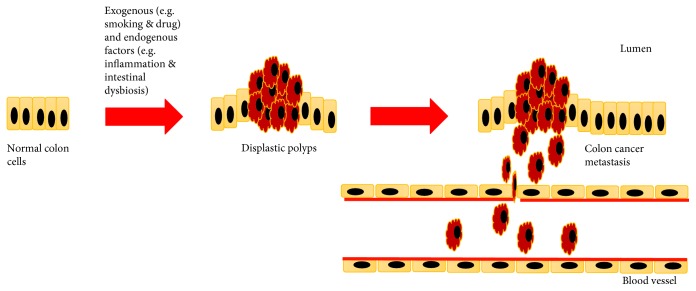
Figure 1
Figure 1
The metastasis of CRC in the presence of exogenous and/or endogenous factors (adapted and modified from Carini et al. [92]).
Figure 2
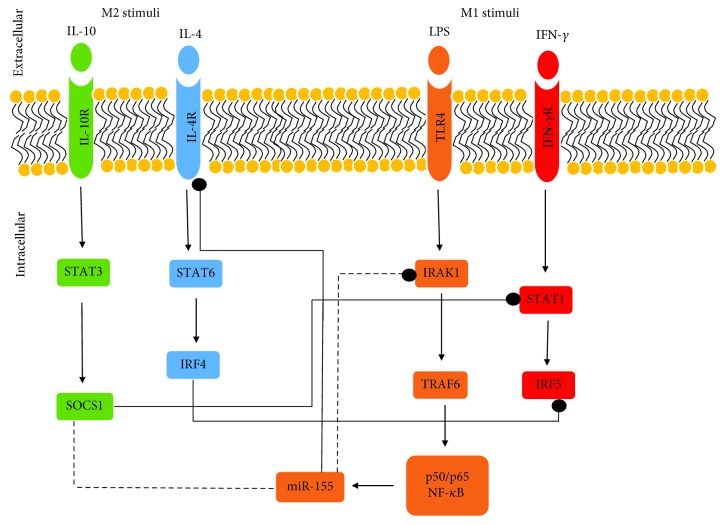
Figure 2
The polarisation of M1 and M2 macrophages from monocytes in the presence of their microenvironmental cues. The arrows indicate the effect from positive regulation (induction or activation), bullet-end lines indicate the effect from negative regulation (inhibition/inactivation), and the dotted lines indicate direct targets of the miRNA (adapted and modified from Mantovani and Locati [32]).

References

    1. Torre L. A., Bray F., Siegel R. L., Ferlay J., Lortet-Tieulent J., Jemal A. Global cancer statistics, 2012. CA: A Cancer Journal for Clinicians. 2015;65(2):87–108. doi: 10.3322/caac.21262. - DOI - PubMed
    1. Issa I. A., Noureddine M. Colorectal cancer screening: an updated review of the available options. World Journal of Gastroenterology. 2017;23(28):5086–5096. doi: 10.3748/wjg.v23.i28.5086. - DOI - PMC - PubMed
    1. Ferlay J., Soerjomataram I., Dikshit R., et al. Cancer incidence and mortality worldwide: sources, methods and major patterns in GLOBOCAN 2012. International Journal of Cancer. 2015;136(5):E359–E386. doi: 10.1002/ijc.29210. - DOI - PubMed
    1. Siegel R. L., Miller K. D., Jemal A. Cancer statistics, 2017. CA: a Cancer Journal for Clinicians. 2017;67(1):7–30. doi: 10.3322/caac.21387. - DOI - PubMed
    1. Center M. M., Jemal A., Ward E. International trends in colorectal cancer incidence rates. Cancer Epidemiology, Biomarkers & Prevention. 2009;18(6):1688–1694. doi: 10.1158/1055-9965.EPI-09-0090. - DOI - PubMed

LinkOut - more resources