


doi: 10.1038/s41562-018-0471-8.
Epub 2018 Nov 5.
Using Rigorous Methods to Advance Behaviour Change Science
Affiliations
- PMID: 30931398
- PMCID: PMC6437667
- DOI: 10.1038/s41562-018-0471-8
Item in Clipboard
Using Rigorous Methods to Advance Behaviour Change Science
Nat Hum Behav.
2018 Nov.
Erratum in
-
Author Correction: Using rigorous methods to advance behaviour change science.Nat Hum Behav. 2019 Jan;3(1):101. doi: 10.1038/s41562-018-0492-3. Nat Hum Behav. 2019. PMID: 30932042
No abstract available
Conflict of interest statement
Competing Interests Susan Michie (Principal Investigator), Marie Johnston (Co-Investigator), and Rachel N. Carey are members of the Human Behaviour-Change Project. Karina W. Davidson (Co-Principal Investigator), Donald Edmondson (Co-Principal Investigator), and Jennifer A. Sumner (Co-Investigator) are members of the Resource and Coordinating Center for the Science of Behavior Change Research Network.
Figures
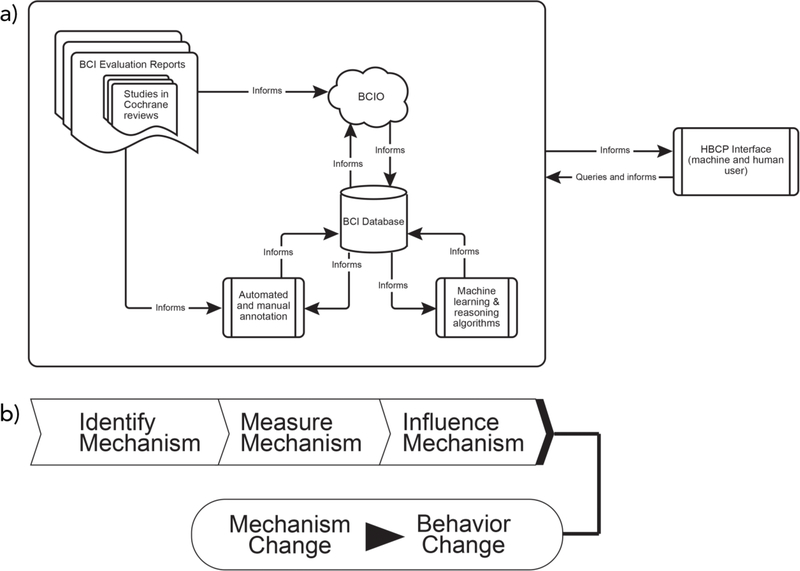
Figure 1a presents components of
the HBCP Knowledge System for generating new evidence about behaviour change
interventions (BCIs). Schematic relationships between the BCI literature, the
Behaviour Change Intervention Ontology (BCIO), and a machine and human user
interface are depicted [Michie, S., et al. The Human Behaviour-Change Project:
harnessing the power of artificial intelligence and machine learning for
evidence synthesis and interpretation. Implementation Science
12, 121 (2017)]. Figure 1b
presents the steps of the SOBC experimental medicine approach. This method is
used to identify key mechanisms underlying behavior change.
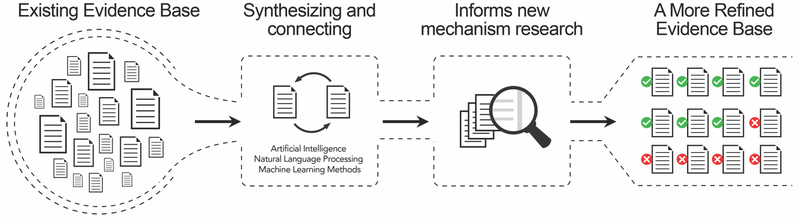
Using artificial intelligence, natural language processing and machine
learning, the HBCP aims to organize the fragmented and nonsystematic existing
literature in ways that can generate new, accessible evidence. These outputs can
show the field where to “go deep” and further examine mechanisms
underlying behavior change in new research using rigorous and systematic
methods, like the SOBC experimental medicine approach. These additions to the
empirical literature, with further processing with artificial intelligence,
natural language processing, and machine learning methods, will further refine
the evidence base.
References
-
- Murray CJ, et al. Disability-adjusted life years (DALYs) for 291 diseases and injuries in 21 regions, 1990–2010: a systematic analysis for the Global Burden of Disease Study 2010. The Lancet 380, 2197–2223 (2012). - PubMed
-
- World Health Organization. Global health risks: mortality and burden of disease attributable to selected major risks. (World Health Organization, 2009).
-
- Glasziou P, et al. Reducing waste from incomplete or unusable reports of biomedical research. The Lancet 383, 267–276 (2014). - PubMed
Publication types
MeSH terms
Grants and funding
LinkOut - more resources
Full Text Sources
