


Clinical and histopathological characteristics and survival analysis of 4594 Japanese patients with melanoma
- PMID: 30932370
- PMCID: PMC6536943
- DOI: 10.1002/cam4.2110
Clinical and histopathological characteristics and survival analysis of 4594 Japanese patients with melanoma
Abstract
Background: The incidence of melanoma among those of an Asian ethnicity is lower than in Caucasians; few large-scale Asian studies that include follow-up data have been reported.
Objectives: To investigate the clinical characteristics of Japanese patients with melanoma and to evaluate the prognostic factors.
Methods: Detailed patient information was collected from the database of Japanese Melanoma Study Group of the Japanese Skin Cancer Society. The American Joint Committee on Cancer seventh Edition system was used for TNM classification. The Kaplan-Meier method and Cox proportional hazards model were used to estimate the impact of clinical and histological parameters on disease-specific survival in patients with invasive melanoma.
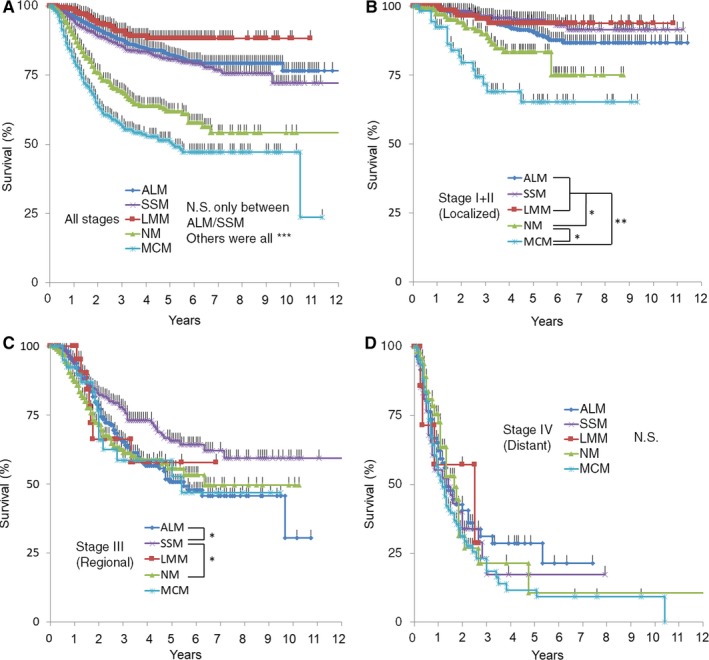
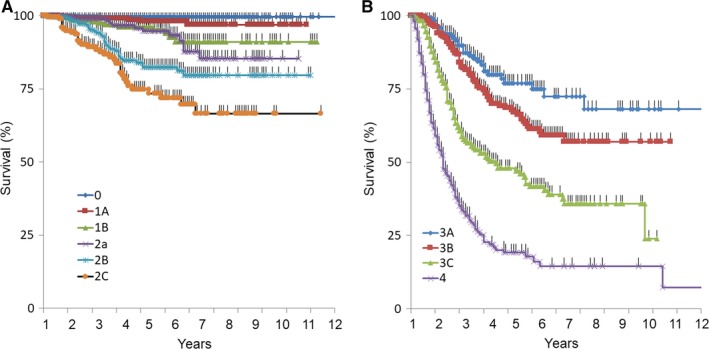
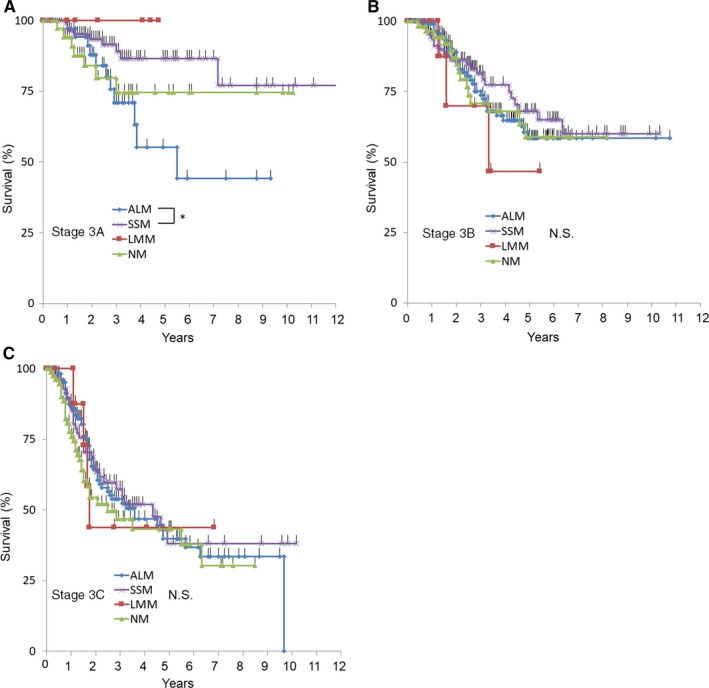
Results: In total, 4594 patients were included in this analysis. The most common clinical type was acral lentiginous melanoma (40.4%) followed by superficial spreading melanoma (20.5%), nodular melanoma (10.0%), mucosal melanoma (9.5%), and lentigo maligna melanoma (8.1%). The 5-year disease-specific survival for each stage was as follows: IA = 98.0%, IB = 93.9%, IIA = 94.8%, IIB = 82.4%, IIC = 71.8%, IIIA = 75.0%, IIIB = 61.3%, IIIC = 41.7%, and IV = 17.7%. Although multivariate analysis showed that clinical classifications were not associated with survival across all stages, acral type was an independent poor prognostic factor in stage IIIA.
Conclusions: Our study revealed the characteristics of melanoma in the Japanese population. The 5-year disease-specific survival of each stage showed a similar trend to that of Caucasians. While clinical classification was not associated with survival in any stages, acral type was associated with poor survival in stage IIIA. Our result might indicate the aggressiveness of acral type in certain populations.
Keywords: Asian; Epidemiology; Japanese; Melanoma; acral; mucosal.
© 2019 The Authors. Cancer Medicine published by John Wiley & Sons Ltd.
Conflict of interest statement
None declared.
Figures
References
-
- Tomizuka T, Namikawa K, Higashi T. Characteristics of melanoma in Japan: a nationwide registry analysis 2011–2013. Melanoma Res. 2017;27:492‐497. - PubMed
-
- Bray F, Colombet M, Mery L, et al. 2017. Cancer Incidence in Five Continents, Vol. XI (electronic version). Lyon: International Agency for Research on Cancer; http://ci5.iarc.fr. Accessed 2019 Feb 9.
-
- Ishihara K, Saida T, Yamamoto A. Japanese Skin Cancer Society P, Statistical Investigation C. Updated statistical data for malignant melanoma in. Japan. Int J Clin Oncol. 2001;6:109‐116. - PubMed
-
- Ishihara K, Saida T, Otsuka F, Yamazaki N. Statistical profiles of malignant melanoma and other skin cancers in Japan: 2007 update. Int J Clin Oncol. 2008;13:33‐41. - PubMed
Publication types
MeSH terms
LinkOut - more resources
Full Text Sources
Medical
