


Wet Markets and Food Safety: TripAdvisor for Improved Global Digital Surveillance
- PMID: 30932867
- PMCID: PMC6462893
- DOI: 10.2196/11477
Wet Markets and Food Safety: TripAdvisor for Improved Global Digital Surveillance
Abstract
Background: Wet markets are markets selling fresh meat and produce. Wet markets are critical for food security and sustainable development in their respective regions. Due to their cultural significance, they attract numerous visitors and consequently generate tourist-geared information on the Web (ie, on social networks such as TripAdvisor). These data can be used to create a novel, international wet market inventory to support epidemiological surveillance and control in such settings, which are often associated with negative health outcomes.
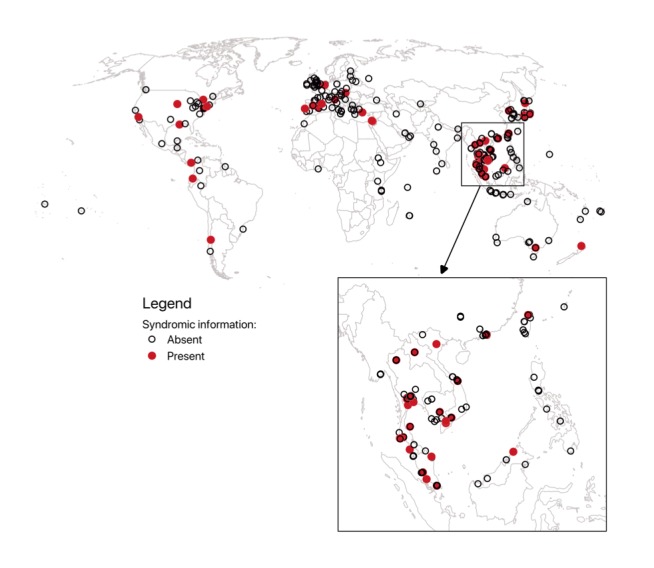
Objective: Using social network data, we aimed to assess the level of wet markets' touristic importance on the Web, produce the first distribution map of wet markets of touristic interest, and identify common diseases facing visitors in these settings.
Methods: A Google search was performed on 31 food market-related keywords, with the first 150 results for each keyword evaluated based on their relevance to tourism. Of all these queries, wet market had the highest number of tourism-related Google Search results; among these, TripAdvisor was the most frequently-occurring travel information aggregator, prompting its selection as the data source for this study. A Web scraping tool (ParseHub) was used to extract wet market names, locations, and reviews from TripAdvisor. The latter were searched for disease-related content, which enabled assignment of GeoSentinel diagnosis codes to each. This syndromic categorization was overlaid onto a mapping of wet market locations. Regional prevalence of the most commonly occurring symptom group - food poisoning - was then determined (ie, by dividing the number of wet markets per continent with more than or equal to 1 review containing this syndrome by the total number of wet markets on that continent with syndromic information).
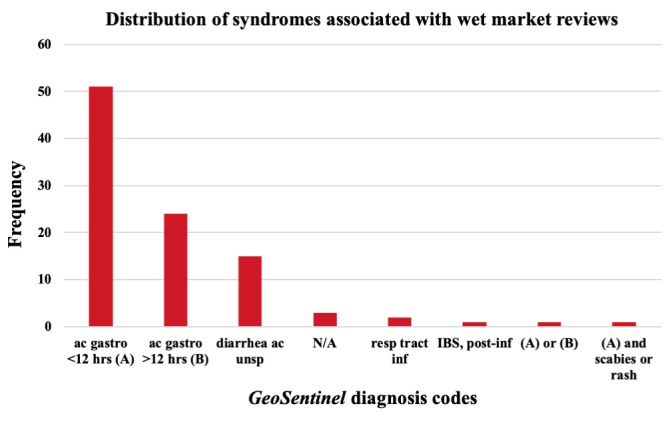
Results: Of the 1090 hits on TripAdvisor for wet market, 36.06% (393/1090) conformed to the query's definition; wet markets were heterogeneously distributed: Asia concentrated 62.6% (246/393) of them, Europe 19.3% (76/393), North America 7.9% (31/393), Oceania 5.1% (20/393), Africa 3.1% (12/393), and South America 2.0% (8/393). Syndromic information was available for 14.5% (57/393) of wet markets. The most frequently occurring syndrome among visitors to these wet markets was food poisoning, accounting for 54% (51/95) of diagnoses. Cases of this syndrome were identified in 56% (22/39) of wet markets with syndromic information in Asia, 71% (5/7) in Europe, and 71% (5/7) in North America. All wet markets in South America and Oceania reported food poisoning cases, but the number of reviews with syndromic information was very limited in these regions (n=2).
Conclusions: The map produced illustrates the potential role of touristically relevant social network data to support global epidemiological surveillance. This includes the possibility to approximate the global distribution of wet markets and to identify diseases (ie, food poisoning) that are most prevalent in such settings.
Keywords: agriculture; epidemiology; foodborne diseases; maps; social networking; travel.
©Nicole E Kogan, Isabelle Bolon, Nicolas Ray, Gabriel Alcoba, Jose L Fernandez-Marquez, Martin M Müller, Sharada P Mohanty, Rafael Ruiz de Castañeda. Originally published in JMIR Public Health and Surveillance (http://publichealth.jmir.org), 01.04.2019.
Conflict of interest statement
Conflicts of Interest: None declared.
Figures
References
-
- World Health Organization. Switzerland: WHO Press; 2006. A guide to healthy food markets http://www.who.int/foodsafety/publications/capacity/healthymarket_guide.... .
-
- Wu T, Perrings C, Kinzig A, Collins JP, Minteer BA, Daszak P. Economic growth, urbanization, globalization, and the risks of emerging infectious diseases in China: a review. Ambio. 2017 Feb;46(1):18–29. doi: 10.1007/s13280-016-0809-2. http://europepmc.org/abstract/MED/27492678 10.1007/s13280-016-0809-2 - DOI - PMC - PubMed
-
- Lee JW, McKibbin WJ. Estimating the global economic costs of SARS. In: Knobler S, Mahmoud A, Lemon S, Mack A, Sivitz L, Oberholtzer K, editors. Learning From SARS: Preparing for the Next Disease Outbreak: Workshop Summary. Washington DC: National Academies Press; 2004. - PubMed
-
- Wu J, Lu J, Faria NR, Zeng X, Song Y, Zou L, Yi L, Liang L, Ni H, Kang M, Zhang X, Huang G, Zhong H, Bowden TA, Raghwani J, He J, He X, Lin J, Koopmans M, Pybus OG, Ke C. Effect of live poultry market interventions on influenza A(H7N9) virus, Guangdong, China. Emerg Infect Dis. 2016 Dec;22(12):2104–12. doi: 10.3201/eid2212.160450. doi: 10.3201/eid2212.160450. - DOI - PMC - PubMed
-
- Grace D. Food safety in low and middle income countries. Int J Environ Res Public Health. 2015 Aug 27;12(9):10490–507. doi: 10.3390/ijerph120910490. http://www.mdpi.com/resolver?pii=ijerph120910490 ijerph120910490 - DOI - PMC - PubMed
LinkOut - more resources
Full Text Sources
