


Patient Readmission Rates For All Insurance Types After Implementation Of The Hospital Readmissions Reduction Program
- PMID: 30933582
- PMCID: PMC7137289
- DOI: 10.1377/hlthaff.2018.05412
Patient Readmission Rates For All Insurance Types After Implementation Of The Hospital Readmissions Reduction Program
Abstract
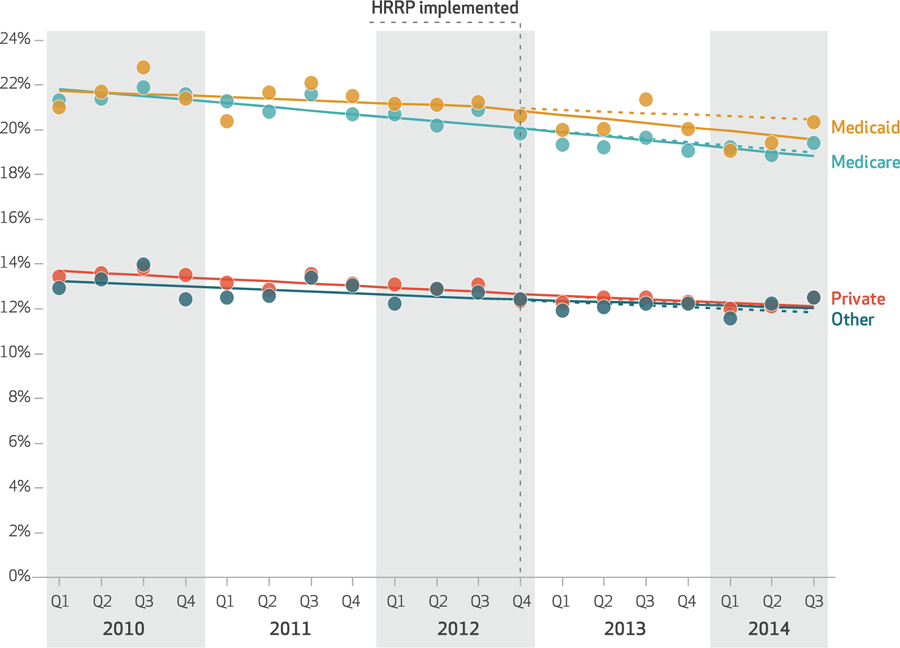
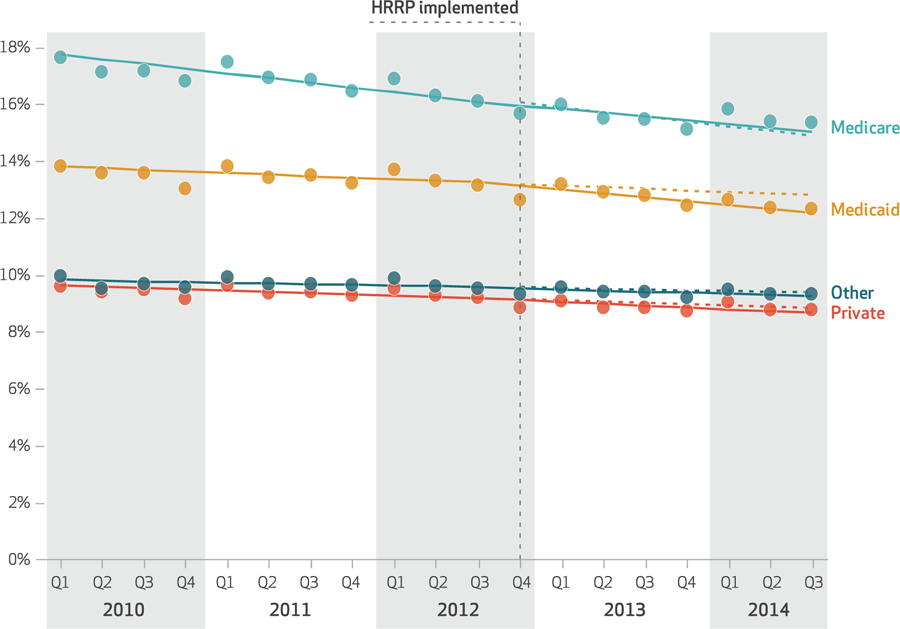
Since the implementation of the Hospital Readmissions Reduction Program (HRRP), readmissions have declined for Medicare patients with conditions targeted by the policy (acute myocardial infarction, heart failure, and pneumonia). To understand whether HRRP implementation was associated with a readmission decline for patients across all insurance types (Medicare, Medicaid, and private), we conducted a difference-in-differences analysis using information from the Nationwide Readmissions Database. We compared how quarterly readmissions for target conditions changed before (2010-12) and after (2012-14) HRRP implementation, using nontarget conditions as the control. Our results demonstrate that readmissions declined at a significantly faster rate after HRRP implementation not just for Medicare patients but also for those with Medicaid, both in the aggregate and for individual target conditions. However, composite Medicaid readmission rates remained higher than those for Medicare. Throughout the study period privately insured patients had the lowest aggregate readmission rates, which declined at a similar rate compared to nontarget conditions. The HRRP was associated with nationwide readmission reductions beyond the Medicare patients originally targeted by the policy. Further research is needed to understand the specific mechanisms by which hospitals have achieved reductions in readmissions.
Figures
Comment in
-
Penalties For Hospital Readmissions.Health Aff (Millwood). 2019 Aug;38(8):1410. doi: 10.1377/hlthaff.2019.00616. Health Aff (Millwood). 2019. PMID: 31381393 No abstract available.
References
-
- Jencks SF, Williams MV, Coleman EA. Rehospitalizations among patients in the Medicare fee-for-service program. N Engl J Med 2009; 360(14):1418–28. - PubMed
-
- Medicare Payment Advisory Commission. Report to the Congress: promoting greater efficiency in Medicare [Internet]. Washington (DC): MedPAC; 2007. June [cited 2018 Dec 28]. Available from: http://www.medpac.gov/docs/default-source/reports/Jun07_EntireReport.pdf
-
- CMS.gov Hospital Readmissions Reduction Program (HRRP) [Internet]. Baltimore (MD): Centers for Medicare and Medicaid Services; [last modified 2018. November 28; cited 2018 Dec 28]. Available from: https://www.cms.gov/medicare/medicare-fee-for-service-payment/acuteinpat...
Publication types
MeSH terms
Grants and funding
LinkOut - more resources
Full Text Sources
Medical
