Review
. 2019 Mar 25;20(6):1482.
doi: 10.3390/ijms20061482.

Glutamatergic Signaling Along The Microbiota-Gut-Brain Axis

Affiliations
Review

Glutamatergic Signaling Along The Microbiota-Gut-Brain Axis

Andreina Baj et al. Int J Mol Sci. .

Abstract

A complex bidirectional communication system exists between the gastrointestinal tract and the brain. Initially termed the "gut-brain axis" it is now renamed the "microbiota-gut-brain axis" considering the pivotal role of gut microbiota in maintaining local and systemic homeostasis. Different cellular and molecular pathways act along this axis and strong attention is paid to neuroactive molecules (neurotransmitters, i.e., noradrenaline, dopamine, serotonin, gamma aminobutyric acid and glutamate and metabolites, i.e., tryptophan metabolites), sustaining a possible interkingdom communication system between eukaryota and prokaryota. This review provides a description of the most up-to-date evidence on glutamate as a neurotransmitter/neuromodulator in this bidirectional communication axis. Modulation of glutamatergic receptor activity along the microbiota-gut-brain axis may influence gut (i.e., taste, visceral sensitivity and motility) and brain functions (stress response, mood and behavior) and alterations of glutamatergic transmission may participate to the pathogenesis of local and brain disorders. In this latter context, we will focus on two major gut disorders, such as irritable bowel syndrome and inflammatory bowel disease, both characterized by psychiatric co-morbidity. Research in this area opens the possibility to target glutamatergic neurotransmission, either pharmacologically or by the use of probiotics producing neuroactive molecules, as a therapeutic approach for the treatment of gastrointestinal and related psychiatric disorders.

Keywords: dysbiosis; glutamate; glutamate receptors; inflammatory bowel disease (IBD); irritable bowel syndrome (IBS); microbiota-gut-brain axis.


Conflict of interest statement

The authors declare no conflict of interest.

Figures
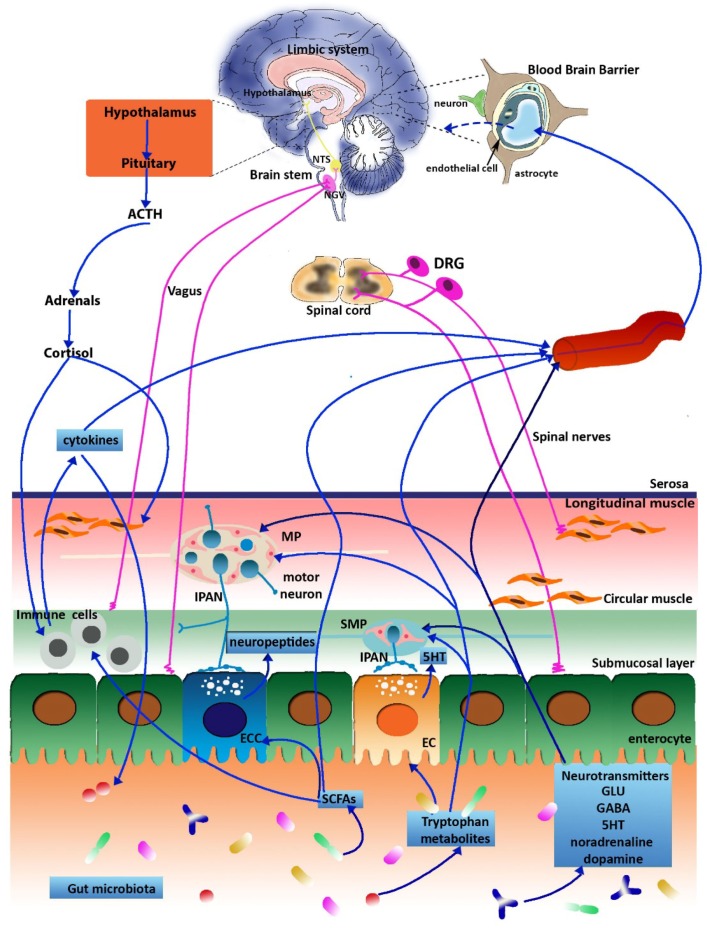
Figure 1
Figure 1
Schematic representation of the microbiota-gut-brain axis. The gut saprophytic microflora can signal to the central nervous system (CNS) and to the enteric nervous system (ENS) via different pathways, including endocrine, immune, metabolic and neuronal pathways explained throughout the text. With the exception of gamma aminobutyric acid (GABA), in normal conditions, the blood brain barrier impedes access of circulating neurotransmitters into the CNS, including Glu. However, when the blood brain barrier is disrupted, the levels of Glu, both in blood and brain markedly increase (dashed blue line). Abbreviations: NTS, nucleus of the solitary tract; NVG, nodose vagal ganglion; DRG, dorsal root ganglion; MP, myenteric plexus, IPAN, intrinsic primary afferent neurons, SMP, submucosal plexus, ECC, enteroendocrine cell; EC enterochromaffin cells, SCFA, short chain fatty acid (adapted from Mazzoli and Pessione, 2016 [8]).
Figure 2
Figure 2
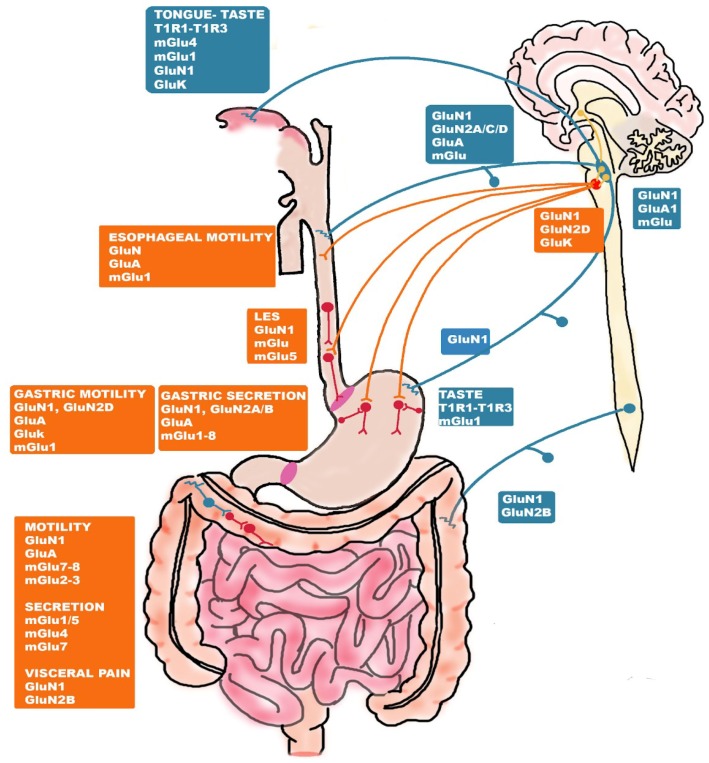
Distribution of glutamate receptors along the gut-brain axis. iGlu and mGlu receptors are located in ENS circuitries involved in the motor, secretory and sensory functions (motor neurons and interneurons in red and intrinsic primary neurons in blue). Glu receptors are present also on vagal and spinal extrinsic afferent pathways sending sensory information to the CNS (blue) and on effector pathways conveying excitatory and inhibitory inputs into the gastrointestinal tract from the CNS (orange). In the CNS, neurons (yellow) projecting from the hypothalamus to sensory vagal nuclei (nodose vagal ganglion, NVG, blue) in the brain stem and from the NVG to effector nuclei (dorsal motor nucleus, DMV, red) modulate digestive functions via activation of iGlu and mGlu receptors. Abbreviations: CNS, central nervous system; ENS, enteric nervous system (modified from Filpa et al., 2016 [10]).
Figure 3
Figure 3
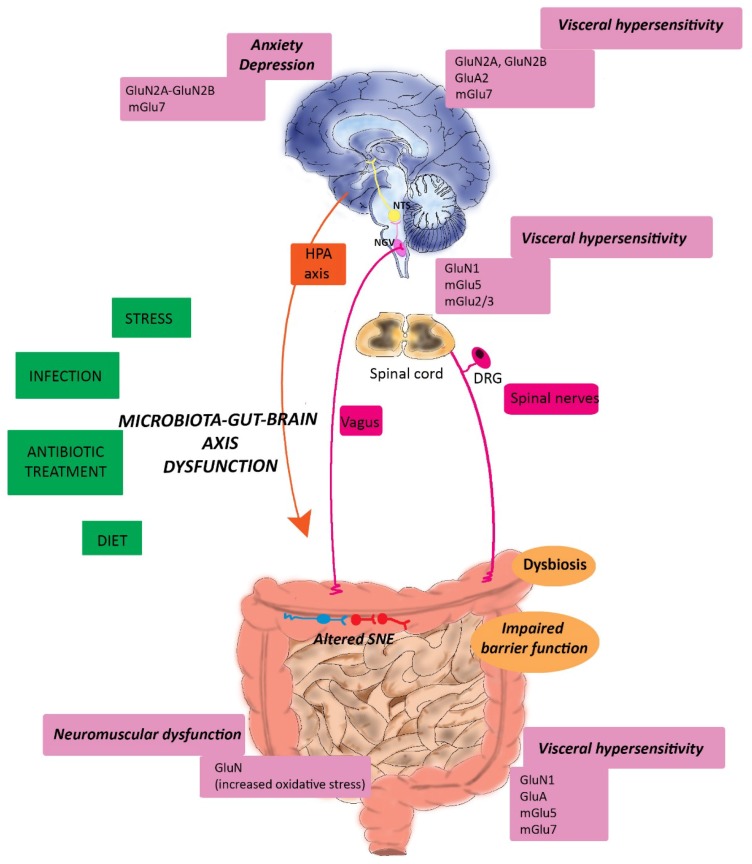
Glutamate receptors and derangement of the microbiota-gut-brain axis. Several factors, including stress, previous infection, antibiotic treatment and diet may influence the stability of the microbiota-gut-brain axis. Derangement of this bi-directional communication axis may underlay the development of major symptoms involved in the pathogenesis of gastrointestinal diseases such as IBS and IBD, including visceral pain, altered motor function and CNS disorders, such as anxiety and depression. Glu participates to development of these symptoms by activating both iGlu and mGlu receptors located peripherally, in the gut, in an intermediate station (spinal cord and brainstem) and in higher centers of the gut-brain axis. Abbreviations: DRG, dorsal root ganglion; NGV, nodose vagal ganglion; NTS, nucleus of the solitary tract; ENS, enteric nervous system, HPA, hypothalamic-pituitary axis.

References

    1. Rhee S.H., Pothoulakis C., Mayer E.A. Principles and clinical implications of the brain-gut-enteric microbiota axis. Nat. Rev. Gastroenterol. Hepatol. 2009;6:306–314. doi: 10.1038/nrgastro.2009.35. - DOI - PMC - PubMed
    1. Carabotti M., Scirocco A., Maselli M.A., Severi C. The gut-brain axis: Interactions between enteric microbiota, central and enteric nervous systems. Ann. Gastroenterol. 2015;28:203–209. - PMC - PubMed
    1. Sekirov I., Russell S.L., Caetano M., Antunes L., Finlay B.B. Gut microbiota in health and disease. Physiol. Rev. 2010;90:859–904. doi: 10.1152/physrev.00045.2009. - DOI - PubMed
    1. Borre Y.E., O’Keeffe G.W., Clarke G., Stanton C., Dinan T.G., Cryan J.F. Microbiota and neurodevelopmental windows: Implications for brain disorders. Trends Mol. Med. 2014;20:509–518. doi: 10.1016/j.molmed.2014.05.002. - DOI - PubMed
    1. Kelly J.R., Minuto C., Cryan J.F., Clarke G., Dinan T.G. Cross talk: The microbiota and neurodevelopmental disorders. Front. Neurosci. 2017;11:490. doi: 10.3389/fnins.2017.00490. - DOI - PMC - PubMed

LinkOut - more resources