


Reduction of Mycotoxins during Fermentation of Whole Grain Sorghum to Whole Grain Ting (a Southern African Food)
- PMID: 30934589
- PMCID: PMC6468468
- DOI: 10.3390/toxins11030180
Reduction of Mycotoxins during Fermentation of Whole Grain Sorghum to Whole Grain Ting (a Southern African Food)
Abstract
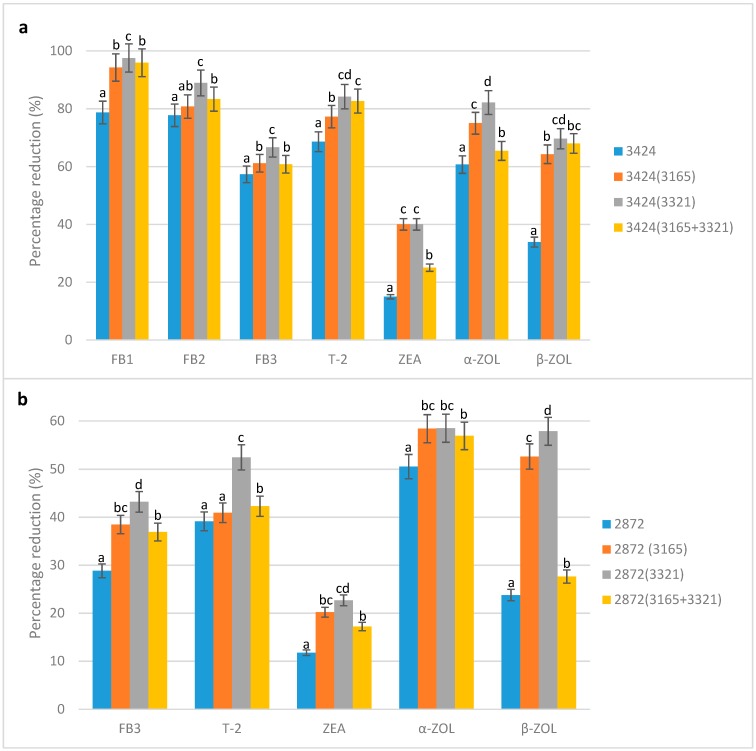
Mycotoxins are fungal secondary metabolites that pose health risks to exposed individuals, requiring necessary measures to reduce them. Using liquid chromatography-tandem mass spectrometry (LC-MS/MS), mycotoxins were quantified in whole grain sorghum and ting subsequently derived from two sorghum varieties (high and low tannin). The whole grain (WG) ting samples were obtained by fermenting sorghum with Lactobacillus fermentum strains (FUA 3165 and FUA 3321). Naturally (spontaneously) fermented WG-ting under the same conditions were equally analysed. Among the mycotoxins investigated, fumonisin B₁ (FB₁), B₂ (FB₂), B₃ (FB₃), T-2 toxin (T-2), zearalenone (ZEA), alpha-zearalenol (α-ZOL) and beta-zearalenol (β-ZOL) were detected in sorghum. Results obtained showed that mycotoxin concentrations significantly (p ≤ 0.05) reduced after fermentation. In particular, L. fermentum FUA 3321 showed the capability to significantly (p ≤ 0.05) reduce all the mycotoxins by 98% for FB₁, 84% for T-2 and up to 82% for α-ZOL, compared to raw low tannin sorghum. Fermenting with the L. fermentum strains showed potential to effectively reduce mycotoxin contamination in whole grain ting. Thus, we recommended L. fermentum FUA 3321 in particular to be used as a potential starter culture in sorghum fermentation.
Keywords: Lactobacillus fermentum; fermentation; food safety; mycotoxins; sorghum; ting.
Conflict of interest statement
The authors declare no conflict of interest.
Figures
References
-
- Udomkun P., Wiredu A.N., Nagle M., Bandyopadhyay R., Müller J., Vanlauwe B. Mycotoxins in sub-Saharan Africa: Present situation, socio-economic impact, awareness, and outlook. Food Cont. 2017;72:110–122. doi: 10.1016/j.foodcont.2016.07.039. - DOI
-
- IARC . Improving Public Health through Mycotoxin Control. In: Pitt J.I., Wild C.P., Baan R.A., Gelderblom W.C.A., Miller J.D., Riley R.T., Wu F., editors. IARC Scientific Publication No. 158. International Agency for Research on Cancer; Lyon, France: 2012.
-
- Gbashi S., Madala N.E., De Saeger S., De Boevre M., Adekoya I., Adebo O.A., Njobeh P.B. The socio-economic impact of mycotoxin contamination in Africa. In: Njobeh P.B., Stepman F., editors. Fungi and Mycotoxins—Their Occurrence, Impact on Health and the Economy as well as Pre- and Postharvest Management Strategies. InTech; Rijeka, Croatia: 2019.
Publication types
MeSH terms
Substances
LinkOut - more resources
Full Text Sources
