Review
. 2019 Mar 30;7(2):26.
doi: 10.3390/biomedicines7020026.

Stem Cell-Based Therapies for Multiple Sclerosis: Current Perspectives

Affiliations
Review

Stem Cell-Based Therapies for Multiple Sclerosis: Current Perspectives

Fernando X Cuascut et al. Biomedicines. .

Abstract

Multiple sclerosis (MS) is an inflammatory and neurodegenerative autoimmune disease of the central nervous system (CNS). Disease-modifying therapies (DMT) targeting inflammation have been shown to reduce disease activity in patients with relapsing⁻remitting MS (RRMS). The current therapeutic challenge is to find an effective treatment to halt disease progression and reverse established neural damage. Stem cell-based therapies have emerged to address this dilemma. Several types of stem cells have been considered for clinical use, such as autologous hematopoietic (aHSC), mesenchymal (MSC), neuronal (NSC), human embryonic (hESC), and induced pluripotent (iPSC) stem cells. There is convincing evidence that immunoablation followed by hematopoietic therapy (aHSCT) has a high efficacy for suppressing inflammatory MS activity and improving neurological disability in patients with RRMS. In addition, MSC therapy may be a safe and tolerable treatment, but its clinical value is still under evaluation. Various studies have shown early promising results with other cellular therapies for CNS repair and decreasing inflammation. In this review, we discuss the current knowledge and limitations of different stem cell-based therapies for the treatment of patients with MS.

Keywords: autologous hematopoietic; human embryonic; induced pluripotent; mesenchymal; multiple sclerosis; neuronal; stem cells.


Conflict of interest statement

The authors declare no conflict of interest.

Figures
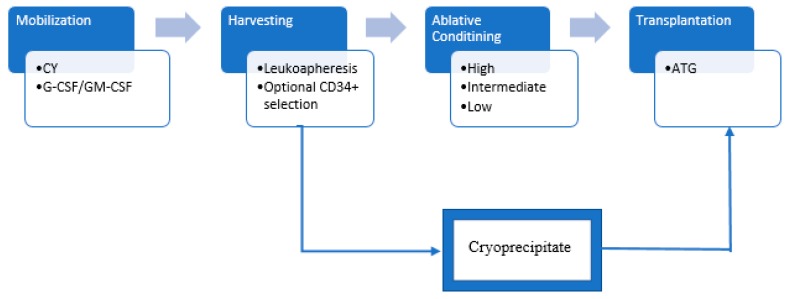
Figure 1
Figure 1
Immunoablation followed by autologous hematopoietic stem cell transplantation. First, HSC are mobilized, typically from peripheral blood, by using granulocyte colony-stimulating factor (G-CSF) or granulocyte-macrophage colony-stimulating factor (GM-CSF), with or without cyclophosphamide (CY). The HSC are then harvested and cryopreserved until the patient is ready for transplantation. The HSC can be positively selected for CD34+ cells ex vivo. The next step is to eliminate autoreactive cells (ablative conditioning) using either a high-, intermediate (BEAM), or low-intensity regimen. After the conditioning regimen, the cryopreserved cells are thawed and then infused back into the patient. Anti-thymocyte globulin (ATG) is administered before or after the aHSC infusion to primarily remove any autoreactive T cells that might have escaped prior conditioning procedures. Subsequently, the patient enters an aplastic phase, characterized by an extremely low level of hematopoietic blood cells requiring prophylactic treatment with antivirals and antibiotics.

References

    1. Frischer J.M., Steiner J.P., Dal-Bianco A., Dal-Bianco A., Lucchinetti C.F., Rauschka H., Schmidbauer M., Laursen H., Sorensen P.S., Lassmann H. The relation between inflammation and neurodegeneration in multiple sclerosis brains. Brain. 2009;132:1175–1189. doi: 10.1093/brain/awp070. - DOI - PMC - PubMed
    1. Reingold S.C., Steiner J.P., Polman C.H., Cohen J.A., Freedman M.S., Kappos L., Thompson A.J., Wolinsky J.S. The challenge of follow-on biologics for treatment of multiple sclerosis. Neurology. 2009;73:552–559. doi: 10.1212/WNL.0b013e3181b2a6ce. - DOI - PubMed
    1. Wingerchuk D.M., Carter J.L. Multiple sclerosis: Current and emerging disease-modifying therapies and treatment strategies. Mayo Clin. Proc. 2014;89:225–240. doi: 10.1016/j.mayocp.2013.11.002. - DOI - PubMed
    1. Freedman M.S., Selchen D., Arnold D.L., Prat A., Banwell B., Yeung M., Morgenthau D., Lapierre Y. Treatment optimization in MS: Canadian MS Working Group updated recommendations. Can. J. Neurol. Sci. 2013;40:307–323. doi: 10.1017/S0317167100014244. - DOI - PubMed
    1. Sormani M.P., Li D.K., Bruzzi P., Stubinski B., Cornelisse P., Rocak S., De Stefano N. Combined MRI lesions and relapses as a surrogate for disability in multiple sclerosis. Neurology. 2011;77:1684–1690. doi: 10.1212/WNL.0b013e31823648b9. - DOI - PubMed

LinkOut - more resources
