


Coarse-Fine Convolutional Deep-Learning Strategy for Human Activity Recognition
- PMID: 30935117
- PMCID: PMC6480225
- DOI: 10.3390/s19071556
Coarse-Fine Convolutional Deep-Learning Strategy for Human Activity Recognition
Abstract
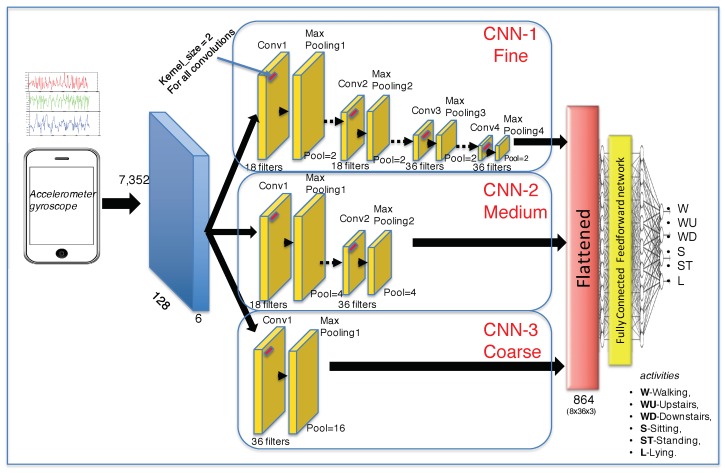
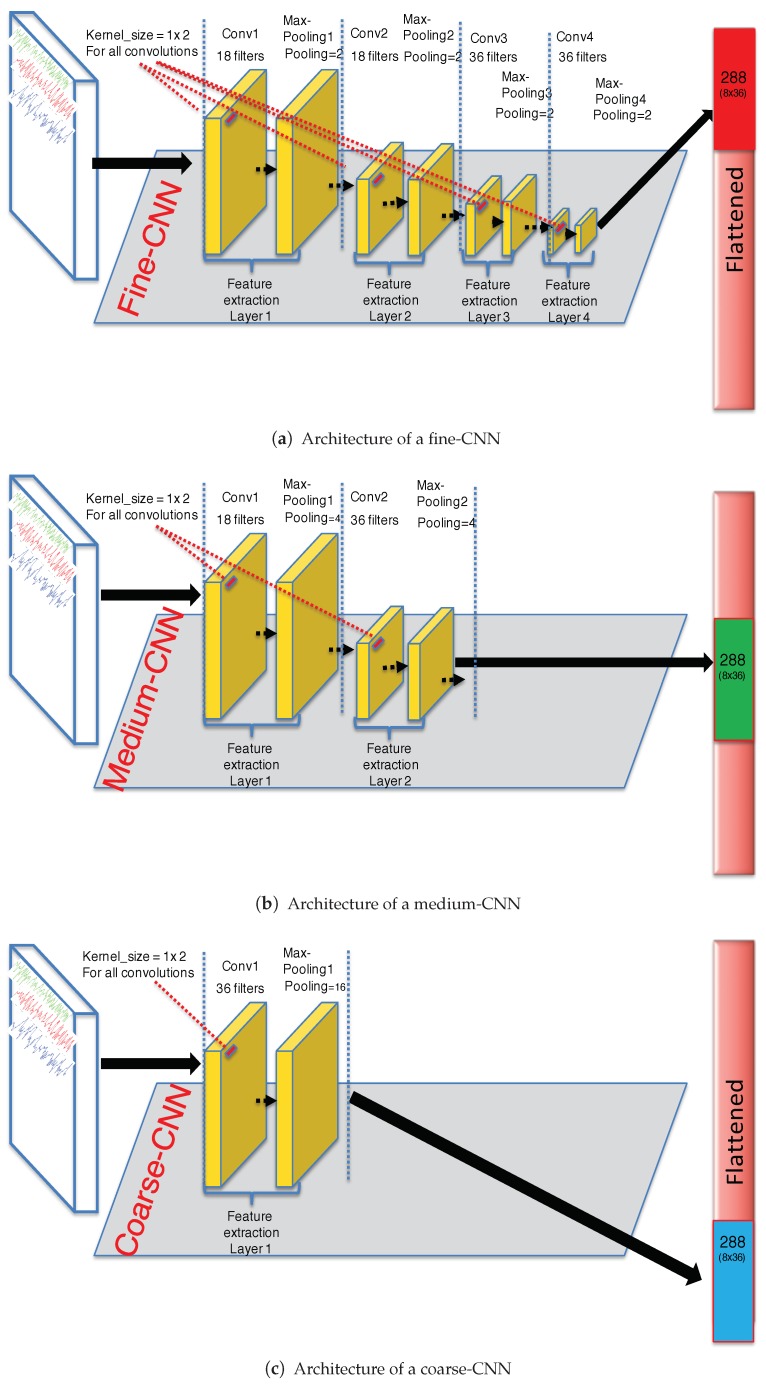
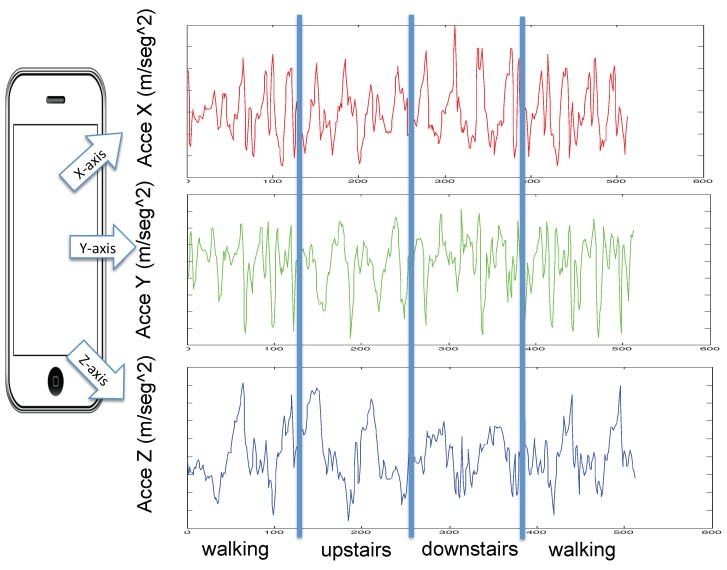
In the last decade, deep learning techniques have further improved human activity recognition (HAR) performance on several benchmark datasets. This paper presents a novel framework to classify and analyze human activities. A new convolutional neural network (CNN) strategy is applied to a single user movement recognition using a smartphone. Three parallel CNNs are used for local feature extraction, and latter they are fused in the classification task stage. The whole CNN scheme is based on a feature fusion of a fine-CNN, a medium-CNN, and a coarse-CNN. A tri-axial accelerometer and a tri-axial gyroscope sensor embedded in a smartphone are used to record the acceleration and angle signals. Six human activities successfully classified are walking, walking-upstairs, walking-downstairs, sitting, standing and laying. Performance evaluation is presented for the proposed CNN.
Keywords: CNN; classification; deep-learning; human action recognition.
Conflict of interest statement
The authors declare that there is no conflict of interests regarding the publication of this paper.
Figures
References
-
- Lara O., Labrador M. A survey on human activity recognition using wearable sensors. IEEE Commun. Surv. Tutor. 2013;15:1192–1209. doi: 10.1109/SURV.2012.110112.00192. - DOI
-
- Chen L., Hoey J., Nugent C., Cook D., Yu Z. Sensor-based activity recognition. IEEE Trans. Syst. Man Cybern. Part C Appl. Rev. 2012;42:790–808. doi: 10.1109/TSMCC.2012.2198883. - DOI
-
- Anguita D., Ghio A., Oneto L., Parra X., Reyes-Ortiz J.L. A Public Domain Dataset for Human Activity Recognition Using Smartphones; Proceedings of the European Symposium on Artificial Neural Networks, Computational Intelligence and Machine Learning (ESANN 2013); Bruges, Belgium. 24–26 April 2013;
-
- Le T.D., Nguyen C.V. Human Activity Recognition by smartphone; Proceedings of the 2nd National Foundation for Science and Technology Development Conference on Information and Computer Science; Ho Chi Minh City, Vietnam. 16–18 September 2015; pp. 219–224.
-
- Liang Y., Zhou X., YU Z., Guo B. Energy-Efficient Motion Related Activity Recognition on Mobile Devices for Pervasive Healthcare. Mob. Netw. Appl. 2014;19:303–317. doi: 10.1007/s11036-013-0448-9. - DOI
MeSH terms
LinkOut - more resources
Full Text Sources
Other Literature Sources
Miscellaneous
