. 2019 May 21;87(6):e00871-18.
doi: 10.1128/IAI.00871-18. Print 2019 Jun.

A Genomic Approach To Identify Klebsiella pneumoniae and Acinetobacter baumannii Strains with Enhanced Competitive Fitness in the Lungs during Multistrain Pneumonia

Affiliations

A Genomic Approach To Identify Klebsiella pneumoniae and Acinetobacter baumannii Strains with Enhanced Competitive Fitness in the Lungs during Multistrain Pneumonia

Mallory J Agard et al. Infect Immun. .

Abstract

Microbial competition is most often studied at the genus or species level, but interstrain competition has been less thoroughly examined. Klebsiella pneumoniae is an important pathogen in the context of hospital-acquired pneumonia, and a better understanding of strain competition in the lungs could explain why some strains of this bacterium are more frequently isolated from pneumonia patients than others. We developed a barcode-free method called "StrainSeq" to simultaneously track the abundances of 10 K. pneumoniae strains in a murine pneumonia model. We demonstrate that one strain (KPPR1) repeatedly achieved a marked numerical dominance at 20 h postinoculation during pneumonia but did not exhibit a similar level of dominance in in vitro mixed-growth experiments. The emergence of a single dominant strain was also observed with a second respiratory pathogen, Acinetobacter baumannii, indicating that the phenomenon was not unique to K. pneumoniae When KPPR1 was removed from the inoculum, a second strain emerged to achieve high numbers in the lungs, and when KPPR1 was introduced into the lungs 1 h after the other nine strains, it no longer exhibited a dominant phenotype. Our findings indicate that certain strains of K. pneumoniae have the ability to outcompete others in the pulmonary environment and cause severe pneumonia and that a similar phenomenon occurs with A. baumannii In the context of the pulmonary microbiome, interstrain competitive fitness may be another factor that influences the success and spread of certain lineages of these hospital-acquired respiratory pathogens.

Keywords: Acinetobacter baumannii; Klebsiella pneumoniae; competition; pneumonia.


Figures

FIG 1
FIG 1
The 10 K. pneumoniae isolates exhibit various degrees of virulence. (A) Mice were infected with various inocula of K. pneumoniae isolates to estimate a dose that caused prelethal illness in ∼50% of mice over 14 days (modified 50% lethal dose [mLD50]). Mouse numbers and data used to calculate mLD50 values are included in Table S1 in the supplemental material. (B) Bacterial burdens in mouse lungs resulting from infections with each K. pneumoniae isolate’s respective mLD50 were enumerated at 20 h postinfection (n = 5 mice per infection group). Statistical significance was determined by the Kruskal-Wallis test with Dunn’s multiple comparisons (***, P < 0.001).
FIG 2
FIG 2
Overview of StrainSeq workflow. (A) Whole-genome strain sequences were aligned, and strain-specific accessory sequences were identified (colored). Each line represents the genome of a different strain. (B) Mixed-strain inocula composed of equal CFU of each strain were intranasally inoculated into mice. (C) Output DNA was extracted from infected mouse lungs and enriched for prokaryotic DNA. (D) Input and output DNA samples were sequenced using an Illumina platform to generate 300-bp sequence reads. (E) Sequence reads were aligned to strain-specific accessory sequences and enumerated in input and output samples. (F) StrainSeq data were represented as the ratio of the proportion of normalized read counts in the output sample to the proportion of normalized read counts in the input sample for each strain to yield a StrainSeq index. Each experimental group is annotated by a species abbreviation (“Kp” for K. pneumoniae), the number of strains in a mixed inoculum (“3”), and a letter to indicate the replicate experiment (“a” or “b,” etc.). (Left) Each experimental result (a or b, etc.) is derived from sequence data pooled from 8 to 10 mice. (Right) In some cases, the means and standard deviations of the results of different experiments (a or b, etc.) are shown. NGS, next-generation sequencing.
FIG 3
FIG 3
A dominant Klebsiella pneumoniae strain population emerges in vivo. Bacterial DNA was isolated from mice 20 h after infection with mixed inocula of K. pneumoniae strains. Each value was obtained by pooling samples from 8 to 10 mice. Results of three individual experiments are shown to convey experimental reproducibility. Statistical significance was determined by one-way ANOVA with Tukey’s multiple-comparison test (****, P < 0.0001).
FIG 4
FIG 4
StrainSeq results are similar to those obtained using a colony-based approach. K. pneumoniae strain KPPR1 was marked with an apramycin resistance cassette to generate KPPR1::Aprar, and relative numbers of KPPR1::Aprar and a group of nine other K. pneumoniae strains in the lungs of mice were determined at 20 h postinfection. (A) For the culture-based approach, lung homogenates were plated on apramycin-containing medium and on nonselective medium to quantify KPPR1::Aprar and total bacterial numbers, respectively. (Left) K. pneumoniae burdens were normalized as the percentage of each bacterial population [KPPR1::Aprar or Kp(9)] in the lung at 20 h postinfection divided by the respective percentage of each bacterial population in the inoculum. (Right) The same samples were evaluated using the StrainSeq approach. (B) Bacterial burdens in the lungs of individual mice from panel A were normalized to the inoculum size. Each symbol represents data for a mouse, and bars represent means. Data represent cumulative results from two experiments, with 8 to 10 mice per experiment.
FIG 5
FIG 5
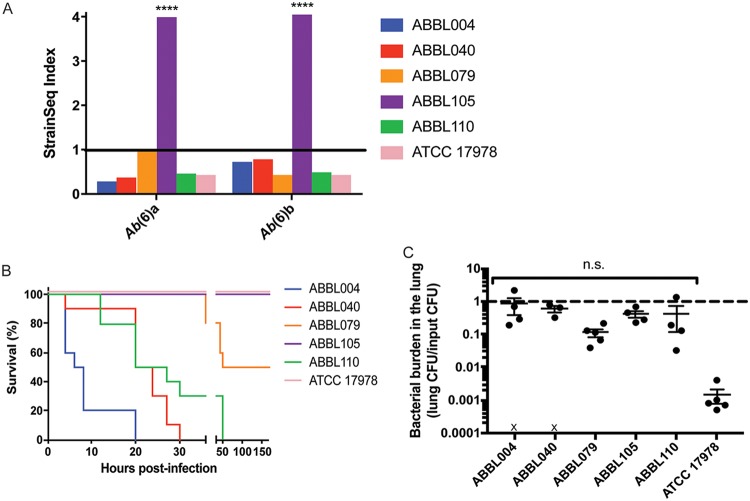
A dominant Acinetobacter baumannii strain population emerges in vivo. (A) Bacterial DNA was isolated from mice 20 h after infection with mixed inocula of A. baumannii strains. Each value was obtained by pooling samples from 8 to 10 mice. Results of two individual experiments are shown to convey experimental reproducibility. Statistical significance was determined by one-way ANOVA with Tukey’s multiple-comparison test (****, P < 0.0001). (B) Mice were intranasally infected with A. baumannii isolates (4 × 106 CFU), and survival was monitored over 7 days. (C) Bacterial burdens in mouse lungs resulting from infections with A. baumannii strains (1 × 106 CFU) were enumerated at 20 h postinfection (n = 4 to 5 mice per infection group). An “X” indicates mouse mortality. Statistical significance was determined by the Kruskal-Wallis test with Dunn’s multiple comparisons (ns, not significant).
FIG 6
FIG 6
Dominant strain populations do not emerge in vitro. (A and B) Strains of K. pneumoniae (A) or A. baumannii (B) were grown together in LB broth in vitro for 6 h (approximately 8 doublings), and StrainSeq analysis was performed. (C and D) The experiment was repeated using 12 h of growth (approximately 15 doublings).
FIG 7
FIG 7
KPPR1 emerges as the dominant strain following intranasal or endotracheal inoculation. (A) A total of 1 × 104 CFU of each K. pneumoniae strain was individually inoculated into different groups of mice by the intranasal route. Bacterial burdens in the lungs were enumerated 30 min after infection and plotted as the final burden relative to the initial inoculum. Each symbol represents data for a mouse (n = 5 mice per infection group). Statistical significance was determined by the Kruskal-Wallis test with Dunn’s multiple comparisons (ns, not statistically significant). (B and C) Mice were inoculated intranasally (B) or endotracheally (C) with the pool of 10 K. pneumoniae strains, and StrainSeq analysis was performed at either 30 min postinfection (mpi) or 20 h postinfection (hpi). Results are based on data from two experiments, each using 6 to 10 mice per time point. Statistical significance was determined by one-way ANOVA with Tukey’s multiple-comparison test (****, P < 0.0001).
FIG 8
FIG 8
Removal or delayed inoculation of a dominant strain allows a new dominant strain to emerge. (A and B) StrainSeq analysis was performed 20 h after infection with K. pneumoniae (A) or A. baumannii (B) on mice intranasally infected with mixed-strain inocula lacking a dominant isolate. (C and D) In a second set of experiments, mice were intranasally infected with mixed-strain inocula of K. pneumoniae (C) or A. baumannii (D) that lacked the previously dominant strain and then reinoculated with the dominant strain (§) at 1 h postinfection. StrainSeq analysis was performed 20 h after the initial infection (for all experiments, n = 10 mice per group). All experiments were performed twice. Statistical significance was determined by one-way ANOVA with Tukey’s multiple-comparison test (*, P < 0.05; ***, P < 0.001; ****, P < 0.0001).

References

    1. Dickson RP, Erb-Downward JR, Martinez FJ, Huffnagle GB. 2016. The microbiome and the respiratory tract. Annu Rev Physiol 78:481–504. doi:10.1146/annurev-physiol-021115-105238. - DOI - PMC - PubMed
    1. Huffnagle GB, Dickson RP, Lukacs NW. 2017. The respiratory tract microbiome and lung inflammation: a two-way street. Mucosal Immunol 10:299–306. doi:10.1038/mi.2016.108. - DOI - PMC - PubMed
    1. Venkataraman A, Bassis CM, Beck JM, Young VB, Curtis JL, Huffnagle GB, Schmidt TM. 2015. Application of a neutral community model to assess structuring of the human lung microbiome. mBio 6:e02284-14. doi:10.1128/mBio.02284-14. - DOI - PMC - PubMed
    1. Gleeson K, Eggli DF, Maxwell SL. 1997. Quantitative aspiration during sleep in normal subjects. Chest 111:1266–1272. doi:10.1378/chest.111.5.1266. - DOI - PubMed
    1. Dickson RP, Erb-Downward JR, Huffnagle GB. 2014. Towards an ecology of the lung: new conceptual models of pulmonary microbiology and pneumonia pathogenesis. Lancet Respir Med 2:238–246. doi:10.1016/S2213-2600(14)70028-1. - DOI - PMC - PubMed

Publication types