


The mixed effects of online diversity training
- PMID: 30936313
- PMCID: PMC6475398
- DOI: 10.1073/pnas.1816076116
The mixed effects of online diversity training
Abstract
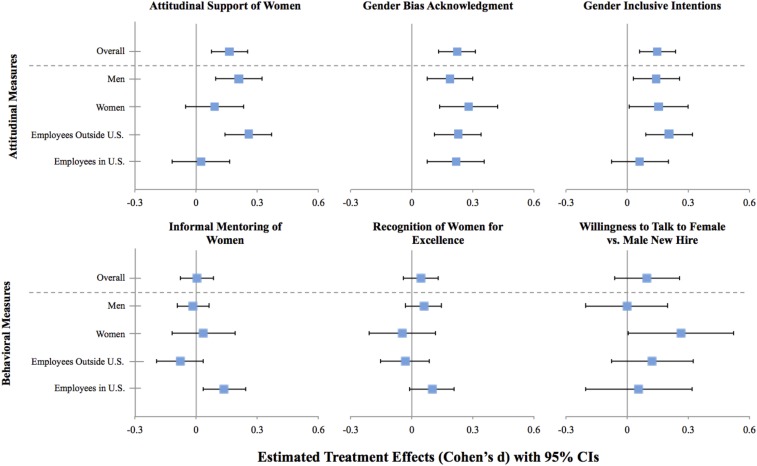
We present results from a large (n = 3,016) field experiment at a global organization testing whether a brief science-based online diversity training can change attitudes and behaviors toward women in the workplace. Our preregistered field experiment included an active placebo control and measured participants' attitudes and real workplace decisions up to 20 weeks postintervention. Among groups whose average untreated attitudes-whereas still supportive of women-were relatively less supportive of women than other groups, our diversity training successfully produced attitude change but not behavior change. On the other hand, our diversity training successfully generated some behavior change among groups whose average untreated attitudes were already strongly supportive of women before training. This paper extends our knowledge about the pathways to attitude and behavior change in the context of bias reduction. However, the results suggest that the one-off diversity trainings that are commonplace in organizations are unlikely to be stand-alone solutions for promoting equality in the workplace, particularly given their limited efficacy among those groups whose behaviors policymakers are most eager to influence.
Keywords: bias; diversity training; field experiment; gender; race.
Copyright © 2019 the Author(s). Published by PNAS.
Conflict of interest statement
Conflict of interest statement: This research was made possible, in part, by a donation by the field partner to Wharton People Analytics and by a grant from the Russell Sage Foundation. In addition, A.M.G. has a financial relationship with the field partner in which he has been paid for consulting unrelated to this research.
Figures
References
-
- Abrams R. 2018 Starbucks to close 8,000 U.S. stores for racial-bias training after arrests. NY Times. Available at https://www.nytimes.com/2018/04/17/business/starbucks-arrests-racial-bia.... Accessed May 10, 2018.
-
- Scheiber N, Abrams R. 2018 Can training eliminate biases? Starbucks will test the thesis. NY Times. Available at https://www.nytimes.com/2018/04/18/business/starbucks-racial-bias-traini.... Accessed May 10, 2018.
-
- Dobbin F, Kalev A. DIVERSITY why diversity programs fail and what works better. Harv Bus Rev. 2016;94:52–60.
-
- Paluck EL, Green DP. Prejudice reduction: What works? A review and assessment of research and practice. Annu Rev Psychol. 2009;60:339–367. - PubMed
-
- Kalev A, Dobbin F, Kelly E. Best practices or best guesses? Assessing the efficacy of corporate affirmative action and diversity policies. Am Sociol Rev. 2006;71:589–617.
Publication types
MeSH terms
LinkOut - more resources
Full Text Sources
Molecular Biology Databases
