


Asherman's syndrome: current perspectives on diagnosis and management
- PMID: 30936754
- PMCID: PMC6430995
- DOI: 10.2147/IJWH.S165474
Asherman's syndrome: current perspectives on diagnosis and management
Abstract
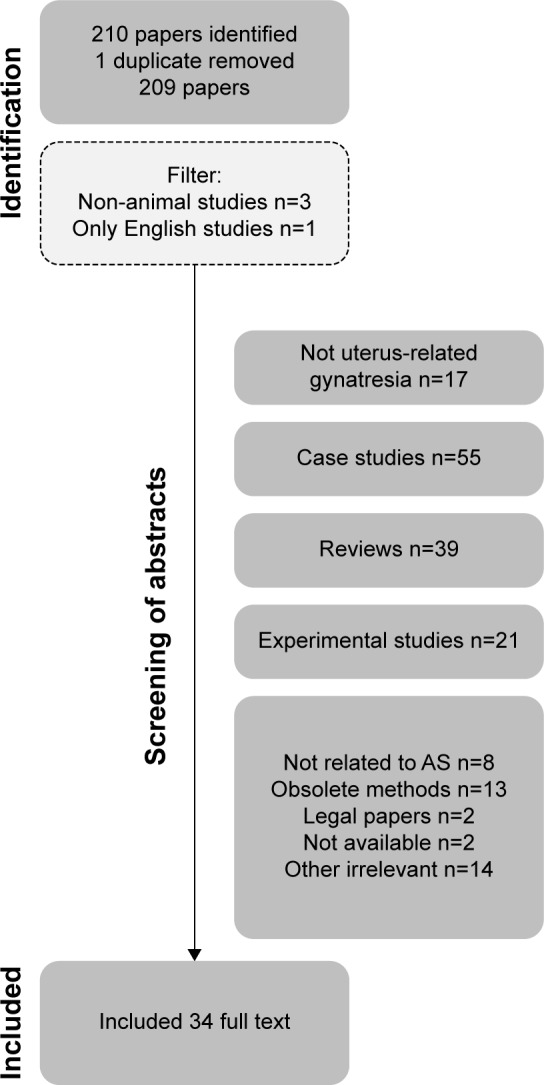
Intrauterine adhesions with symptoms like hypomenorrhea or infertility are known under the term Asherman's syndrome. Although the syndrome has been widely investigated, evidence of both prevention of the syndrome and the ideal treatment are missing. Understanding the pathogenesis of intrauterine adherences is necessary for the prevention of the formation of intrauterine scarring. Intrauterine adhesions can develop from lesion of the basal layer of the endometrium caused by curettage of the newly pregnant uterus. The syndrome may also occur after hysteroscopic surgery, uterine artery embolization or uterine tuberculosis. For initial diagnosis the less invasive contrast sonohysterography or hysterosalpingography is useful. The final diagnosis is based on hysteroscopy. Magnetic resonance imaging is required in cases with totally obliterated uterine cavity. Intrauterine adherences are classified in accordance with different classification systems based on the hysteroscopic diagnosis of severity and localization of adherences. Classification is necessary for the planning of surgery, information on prognosis and scientific purposes. Surgery is performed in symptomatic patients with either infertility or with painful periods. Intrauterine adherences are divided with a hysteroscope using scissors or a power instrument working from the central part of the uterus to the periphery. Peroperative ultrasonography is useful in an outpatient setting for the prevention of complications. Hysteroscopy with fluoroscopy is a solution in difficult cases. Use of intrauterine devices like balloon catheters or intrauterine contraceptive devices seems to be the preferred methods for the prevention of re-occurrence of adhesions after treatment. Both primary prevention after hysteroscopic surgery or curettage and secondary prevention of new adhesions after adhesiolysis have been investigated. The aim of this review was to summarize the literature on diagnosis, classification, treatment and prevention, based on a literature search with a wide range of search terms.
Keywords: Asherman’s syndrome; genital adhesions; gynatresia; intrauterine synechia.
Conflict of interest statement
Disclosure The authors report no conflicts of interest in this work.
Figures
References
-
- Fritsch H. Ein fall von volligen Schwund Der Gebärmutterhohle nACh Auskratzung. Zentralbl Gynaekol. 1894;18:1337–1342.
-
- Asherman JG. Traumatic intra-uterine adhesions. J Obstet Gynaecol Br Emp. 1950;57(6):892–896. - PubMed
-
- Schenker JG, Margalioth EJ. Intrauterine adhesions: an updated appraisal. Fertil Steril. 1982;37(5):595–610. - PubMed
-
- Hanstede MMF, van der Meij E, Goedemans L, Emanuel MH. Results of centralized Asherman surgery, 2003–2013. Fertil Steril. 2015;104(6):1561–1568. - PubMed
-
- Yu D, Wong YM, Cheong Y, Xia E, Li TC. Asherman syndrome – one century later. Fertil Steril. 2008;89(4):759–779. - PubMed
Publication types
LinkOut - more resources
Full Text Sources
Medical
