


The Psychometric Properties and Clinical Utility of the Korean Version of GAD-7 and GAD-2
- PMID: 30936840
- PMCID: PMC6431620
- DOI: 10.3389/fpsyt.2019.00127
The Psychometric Properties and Clinical Utility of the Korean Version of GAD-7 and GAD-2
Abstract
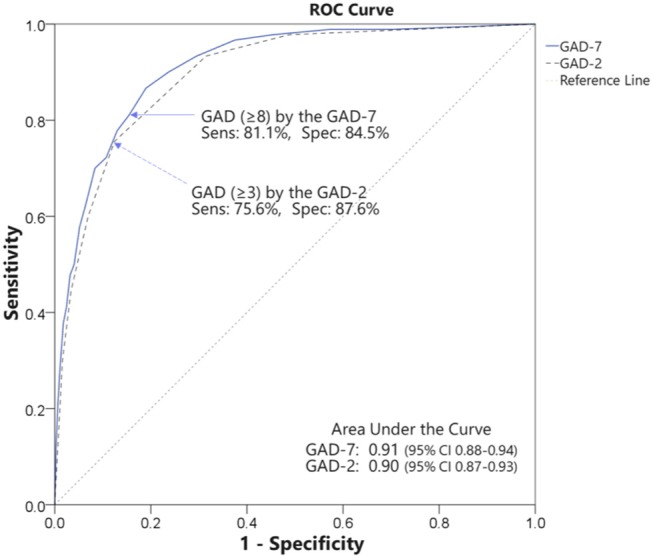
Generalized anxiety disorder (GAD) is a common but serious form of anxiety disorder. Despite this, the rate of GAD recognition in primary care remains low in both Western and Eastern countries. The GAD-7 and GAD-2 were developed to efficiently identify people with GAD, and their reliability and validity have been well-documented in Western countries. The GAD-7 and GAD-2 have also been widely utilized to screen for other anxiety disorders; however, their diagnostic utility has not been fully justified with empirical support, especially in East Asian samples. In this study, we examined the diagnostic sensitivity and specificity of these screening tools for identifying individuals with GAD or other anxiety disorders, and recommended screening cutoff scores for GAD and other anxiety disorders for use in Korea. Based on the rigorous standard suggested by the Quality Assessment of Diagnostic Accuracy Studies-2, a total of 1,157 participants randomly recruited from the community completed the GAD-7, GAD-2, and other anxiety and depression measures in a counter-balanced order. All participants were assessed, and their psychiatric diagnosis confirmed through a structured clinical interview conducted by independent clinicians blinded to the results of the self-report questionnaires. The GAD-7 and GAD-2 both showed excellent reliability and validity. Notably, both the GAD-7 and GAD-2 demonstrated acceptable diagnostic accuracy in detecting GAD with similar recommended cut-off scores as those reported in Western countries, but unacceptable diagnostic accuracy for other anxiety disorders. We conclude that given their brevity, the GAD-7 and GAD-2 can be well-utilized to identify people with GAD for preventative evaluation and treatment in Korea. Use of the GAD-7 and GAD-2 for screening other anxiety disorders should be cautioned.
Keywords: GAD-2; GAD-7; generalized anxiety disorder; screening instruments; sensitivity; specificity.
Figures
References
-
- Merikangas KR, He J-P, Burstein M, Swanson SA, Avenevoli S, Cui L, et al. Lifetime prevalence of mental disorders in US adolescents: results from the National Comorbidity Survey Replication-Adolescent Supplement (NCS-A). J Am Acad Child Adolesc Psychiatry. (2010). 49:980–9. 10.1016/j.jaac.2010.05.017 - DOI - PMC - PubMed
-
- Dutton SS. Marital Relationship Functioning in a Clinical Sample of Generalized Anxiety Disorder Clients. Dissertation. College Park, MD: University of Maryland, College Park; (2001).
LinkOut - more resources
Full Text Sources
