. 2019 Mar 18:10:547.
doi: 10.3389/fmicb.2019.00547. eCollection 2019.

Lipid Production From Waste Materials in Seawater-Based Medium by the Yeast Yarrowia lipolytica

Affiliations

Lipid Production From Waste Materials in Seawater-Based Medium by the Yeast Yarrowia lipolytica

Adam Dobrowolski et al. Front Microbiol. .

Abstract

The global limitation of fossil fuels impels scientists to search for new energy sources. A good alternative is biodiesel produced from crop plants. However, its production requires huge quantities of farmland, fertilizers and fresh water, which is in conflict with the human demand for water for consumption and land for food production. Thus, production of single cell oil (SCO) by oleaginous microorganisms remains the best solution for the coming years. Whereas most microorganisms require fresh water for proper cell metabolism, in this study we demonstrate that the unconventional yeast Yarrowia lipolytica is able to produce huge quantities of fatty acid in seawater-based medium. Here we shown that Y. lipolytica is able to produce fatty acids in medium based on seawater and crude glycerol as the main carbon source, which allows for low-cost production of SCO, is beneficial for industrial application and is ecologically friendly.

Keywords: Yarrowia lipolytica; crude glycerol; lipid production; seawater; single cell oil.


Figures

FIGURE 1
FIGURE 1
Growth curves of Yarrowia lipolytica A 101 in medium based on freshwater (dark gray) and seawater (light gray) based medium. Strains were grown on YPD medium (A) containing 2% glucose or YPGly medium (B) containing 2% glycerol as carbon source. The seawater based medium contain 36 g/L of sea salts mixture. Experiment was performed at 28°C under constant agitation using Bioscreen C.
FIGURE 2
FIGURE 2
Shake-flask experiment for lipid (light gray bars) and biomass (dark gray bars) production by Y. lipolytica A 101 and AJD pAD-DGA1 strains grown in culture media containing glucose (A) and glycerol (B) as a carbon source prepared on freshwater or seawater basis (SW). The seawater based medium contain 36 g/L of sea salts mixture. Error bars indicate SD from three independent biological replicates.
FIGURE 3
FIGURE 3
Shake-flask experiment for lipid (gray bars) and biomass (black bars) production by Y. lipolytica AJD pAD-DGA1 strain, grown in culture media containing crude glycerol prepared on freshwater or seawater basis (SW). The seawater based medium contain 36 g/L of sea salts mixture. Error bars indicate SD from three independent biological replicates.
FIGURE 4
FIGURE 4
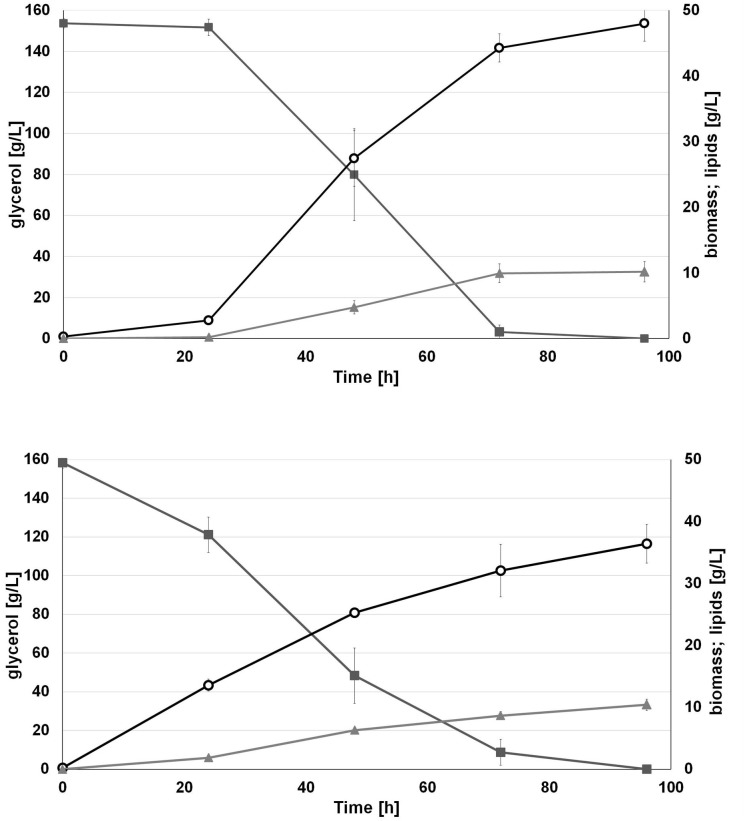
Batch bioreactor fermentation of Y. lipolytica AJD pAD-DGA1 strain in seawater (SW-CG upper panel) based medium and control-freshwater (FW-CG bottom panel) based medium. Time profiles of glycerol (formula image), biomass (formula image), lipids (formula image). The seawater based medium contain 36 g/L of sea salts mixture. Error bars indicate SD from three independent biological replicates.

References

    1. Abdel-Mawgoud A. M., Markham K. A., Palmer C. M., Liu N., Stephanopoulos G., Alper H. S. (2018). Metabolic engineering in the host Yarrowia lipolytica. Metab. Eng. 50 192–208. 10.1016/j.ymben.2018.07.016 - DOI - PubMed
    1. André A., Chatzifragkou A., Diamantopoulou P., Sarris D., Philippoussis A., Galiotou-Panayotou M., et al. (2009). Biotechnological conversions of bio-dieselderived crude glycerol by Yarrowia lipolytica strains. Eng. Life Sci. 9 468–478. 10.1002/elsc.200900063 - DOI
    1. Athenstaedt K. (2011). YALI0E32769g (DGA1) and YALI0E16797g (LRO1) encode major triacylglycerol synthases of the oleaginous yeast Yarrowia lipolytica. Biochim. Biophys. Acta 1811 587–596. 10.1016/j.bbalip.2011.07.004 - DOI - PMC - PubMed
    1. Blazeck J., Hill A., Liu L., Knight R., Miller J., Pan A., et al. (2014). Harnessing Yarrowia lipolytica lipogenesis to create a platform for lipid and biofuel production. Nat. Commun. 5:3131. 10.1038/ncomms4131 - DOI - PubMed
    1. Browse J., McCourt P. J., Somerville C. R. (1986). Fatty acid composition of leaf lipids determined after combined digestion and fatty acid methyl ester formation from fresh tissue. Anal. Biochem. 152 141–145. 10.1016/0003-2697(86)90132-6 - DOI - PubMed

LinkOut - more resources