. 2019 Apr 2;16(1):69.
doi: 10.1186/s12974-019-1455-y.

Elevated circulating TGFβ1 during acute liver failure activates TGFβR2 on cortical neurons and exacerbates neuroinflammation and hepatic encephalopathy in mice

Affiliations

Elevated circulating TGFβ1 during acute liver failure activates TGFβR2 on cortical neurons and exacerbates neuroinflammation and hepatic encephalopathy in mice

Matthew McMillin et al. J Neuroinflammation. .

Abstract

Background: Acute liver failure resulting from drug-induced liver injury can lead to the development of neurological complications called hepatic encephalopathy (HE). Hepatic transforming growth factor beta 1 (TGFβ1) is upregulated due to liver failure in mice and inhibiting circulating TGFβ reduced HE progression. However, the specific contributions of TGFβ1 on brain cell populations and neuroinflammation during HE are not known. Therefore, the aim of this study was to characterize hepatic and brain TGFβ1 signaling during acute liver failure and its contribution to HE progression using a combination of pharmacological and genetic approaches.

Methods: C57Bl/6 or neuron-specific transforming growth factor beta receptor 2 (TGFβR2) null mice (TGFβR2ΔNeu) were treated with azoxymethane (AOM) to induce acute liver failure and HE. The activity of circulating TGFβ1 was inhibited in C57Bl/6 mice via injection of a neutralizing antibody against TGFβ1 (anti-TGFβ1) prior to AOM injection. In all mouse treatment groups, liver damage, neuroinflammation, and neurological deficits were assessed. Inflammatory signaling between neurons and microglia were investigated in in vitro studies through the use of pharmacological inhibitors of TGFβ1 signaling in HT-22 and EOC-20 cells.

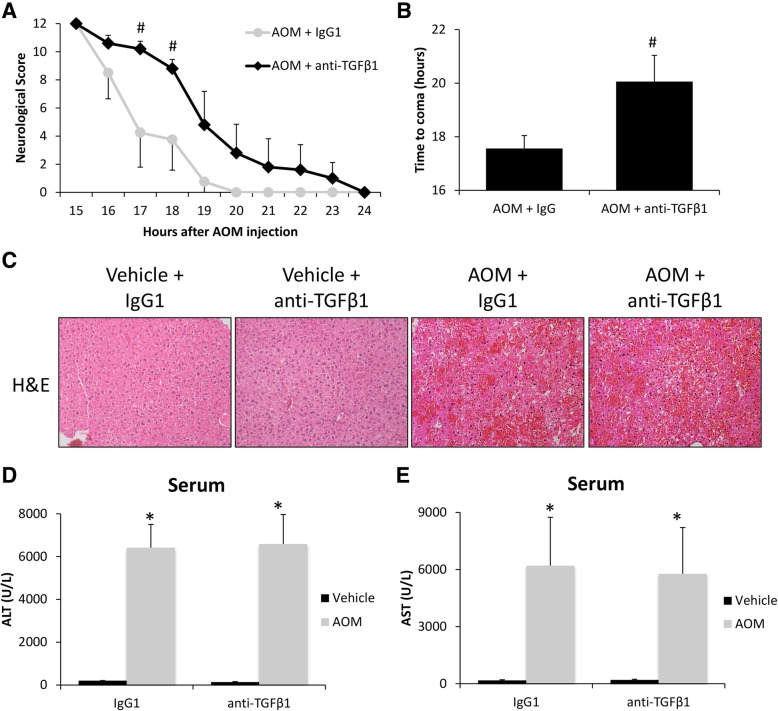
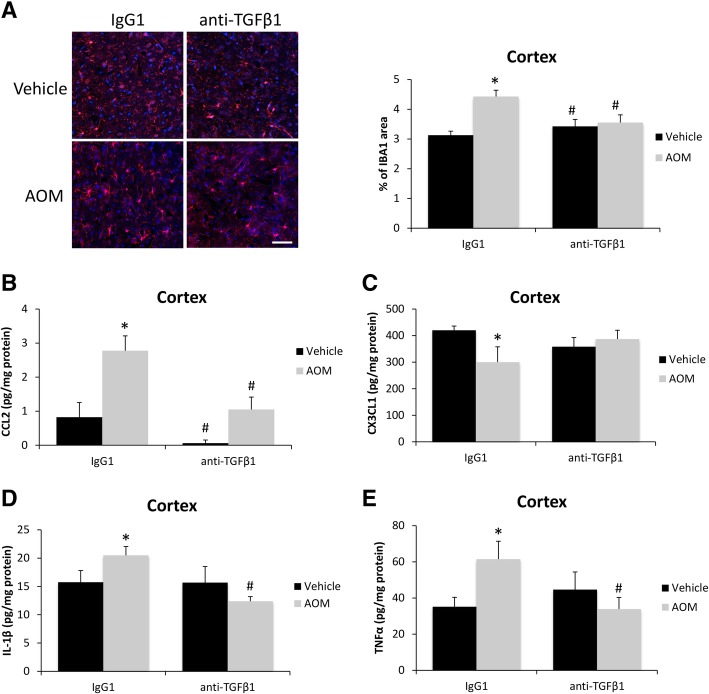
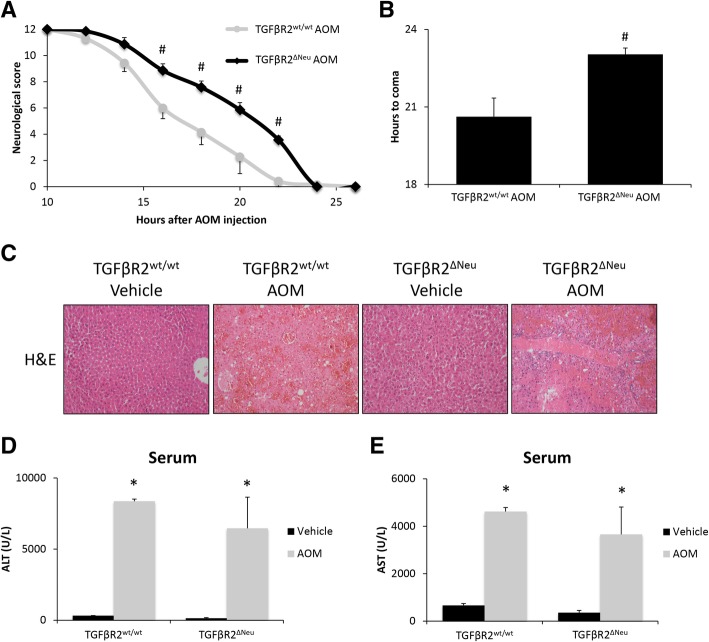
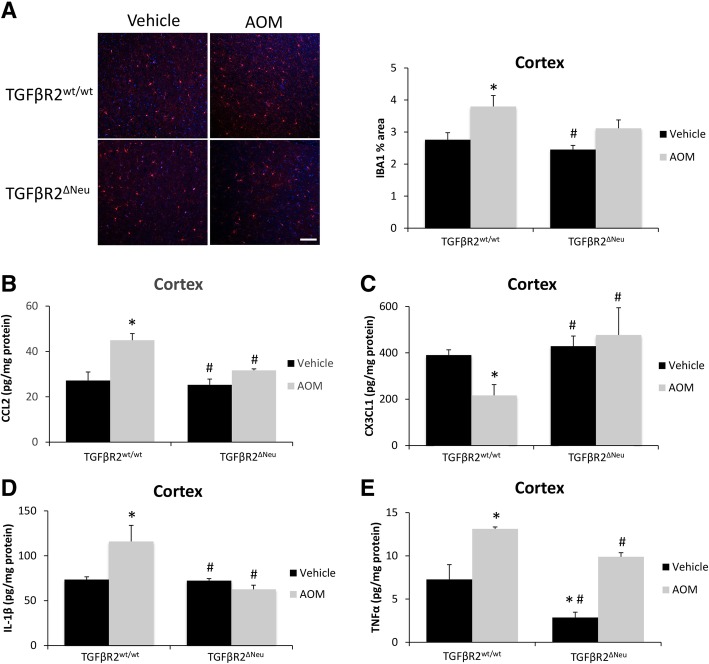
Results: TGFβ1 was expressed and upregulated in the liver following AOM injection. Pharmacological inhibition of TGFβ1 after AOM injection attenuated neurological decline, microglia activation, and neuroinflammation with no significant changes in liver damage. TGFβR2ΔNeu mice administered AOM showed no effect on liver pathology but significantly reduced neurological decline compared to control mice. Microglia activation and neuroinflammation were attenuated in mice with pharmacological inhibition of TGFβ1 or in TGFβR2ΔNeu mice. TGFβ1 increased chemokine ligand 2 (CCL2) and decreased C-X3-C motif ligand 1 (CX3CL1) expression in HT-22 cells and reduced interleukin-1 beta (IL-1ß) expression, tumor necrosis factor alpha (TNFα) expression, and phagocytosis activity in EOC-20 cells.

Conclusion: Increased circulating TGFβ1 following acute liver failure results in activation of neuronal TGFβR2 signaling, driving neuroinflammation and neurological decline during AOM-induced HE.

Keywords: Acute liver failure; Azoxymethane; Microglia; Necrosis; Neuroinflammation.


Conflict of interest statement

Ethics approval and consent to participate

All animal experiments in this study were performed in accordance with the Animal Welfare Act, and the Guide for the care and use of Laboratory Animals, and were approved by the Baylor Scott & White Health IACUC committee (#2011-052R).

Consent for publication

Not applicable.

Competing interests

The authors declare that they have no competing interests.

Publisher’s Note

Springer Nature remains neutral with regard to jurisdictional claims in published maps and institutional affiliations.

Figures
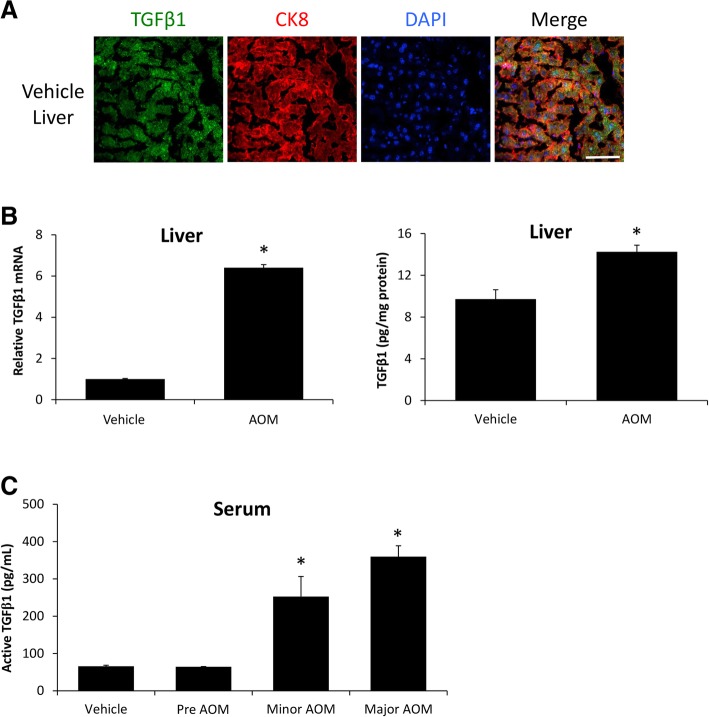
Fig. 1
Fig. 1
Hepatic TGFβ1 is increased during AOM-induced HE. a Immunofluorescence for TGFβ1 (green) and CK8 (red) in mice injected with saline. Scale bar indicates 50 μM. b Relative TGFβ1 mRNA expression in the livers from vehicle- and AOM-treated mice. c Concentration of active TGFβ1 levels in liver homogenates normalized by total protein concentration in vehicle and AOM-treated mice. d Serum active TGFβ1 concentration measured in picograms per milliliter of serum from vehicle and AOM-treated time course mice. *p < 0.05 compared to vehicle-treated mice. n = 3 for TGFβ1 mRNA analyses and n = 4 for ELISA analyses
Fig. 2
Fig. 2
TGFβ1 contributes to HE-induced neurological decline. a Neurological score analyses as assessed by reflex scores and ataxia at the indicated hours post-AOM injection in AOM-treated mice pre-treated with IgG1 or anti-TGFβ1. b Time taken to progress to coma in hours of AOM-treated mice infused with IgG1 or anti-TGFβ1. c Representative H&E images from the livers of vehicle- or AOM-treated mice pre-treated with IgG1 or anti-TGFβ1. d Serum ALT levels of vehicle- or AOM-treated mice pre-treated with IgG1 or anti-TGFβ1. e Serum AST levels of vehicle- or AOM-treated mice pre-treated with IgG1 or anti-TGFβ1. *p < 0.05 compared to vehicle and IgG1-treated mice, #p < 0.05 compared to AOM- and IgG1-treated mice. For all analyses, n = 4 for AOM-treated with IgG1 groups and n = 5 for AOM and anti-TGFβ1 groups.
Fig. 3
Fig. 3
TGFβ1 promotes microglia proliferation and neuroinflammation. a Representative staining and quantification for IBA1 (red) in the cortex from IgG1 or anti-TGFβ1 mice administered saline (vehicle) or AOM. DAPI (blue) was used to stain nuclei. Scale bar indicates 50 μM. b CCL2 protein expression normalized by total protein concentration in the cortex of IgG1 or anti-TGFβ1 mice administered vehicle or AOM. c CX3CL1 protein expression normalized by total protein concentration in the cortex of IgG1 or anti-TGFβ1 mice administered vehicle or AOM. d IL-1β protein expression normalized by total protein concentration in the cortex of IgG1 or anti-TGFβ1 mice administered vehicle or AOM. e TNFα protein expression normalized by total protein concentration in the cortex of IgG1 or anti-TGFβ1 mice administered vehicle or AOM. *p < 0.05 compared to vehicle- and IgG1-treated mice, #p < 0.05 compared to AOM- and IgG1-treated mice. n = 3 for all analyses
Fig. 4
Fig. 4
Neuronal TGFβR2 mediates AOM-induced neurological decline. a Neurological score analyses as assessed by reflex scores and ataxia at the indicated hours post-AOM injection in TGFβR2wt/wt and TGFβR2ΔNeu mice. b Time taken to progress to coma in TGFβR2wt/wt and TGFβR2ΔNeu mice administered AOM. c Representative H&E images from the livers of TGFβR2wt/wt and TGFβR2ΔNeu mice administered vehicle or AOM. d Serum ALT levels of TGFβR2wt/wt and TGFβR2ΔNeu mice administered vehicle or AOM. e Serum AST levels of TGFβR2wt/wt and TGFβR2ΔNeu mice administered vehicle or AOM. *p < 0.05 compared to TGFβR2wt/wt vehicle-treated mice, #p < 0.05 compared to TGFβR2wt/wt AOM-treated mice. n = 4 for all analyses
Fig. 5
Fig. 5
Neuroinflammation during AOM-induced HE is driven by TGFβR2 in neurons. a Representative staining and quantification for IBA1 (red) in the cortex from of TGFβR2wt/wt and TGFβR2ΔNeu mice administered vehicle or AOM. DAPI (blue) was used to stain nuclei. Scale bar indicates 75 μM. b CCL2 protein expression normalized by total protein concentration in the cortex of TGFβR2wt/wt and TGFβR2ΔNeu mice administered vehicle or AOM. c CX3CL1 protein expression normalized by total protein concentration in the cortex of TGFβR2wt/wt and TGFβR2ΔNeu mice administered vehicle or AOM. d IL-1β protein expression normalized by total protein concentration in the cortex of TGFβR2wt/wt and TGFβR2ΔNeu mice administered vehicle or AOM. e TNFα protein expression normalized by total protein concentration in the cortex of TGFβR2wt/wt and TGFβR2ΔNeu mice administered vehicle or AOM. *p < 0.05 compared to TGFβR2wt/wt vehicle-treated mice, #p < 0.05 compared to TGFβR2wt/wt AOM-treated mice. n = 3 for all analyses
Fig. 6
Fig. 6
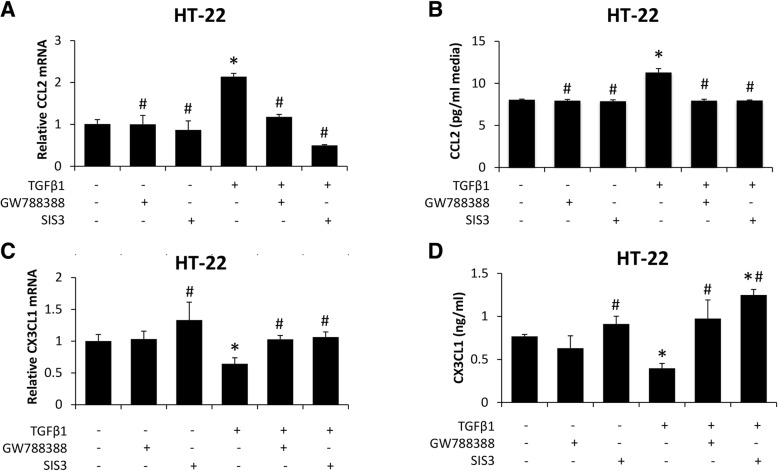
Neuronal CCL2 and CX3CL1 expression is modulated by TGFβ1-mediated signaling. a Relative CCL2 mRNA expression of HT-22 cells treated with recombinant TGFβ1, GW788388, or SIS3. b CCL2 concentrations in HT-22 cell media treated with recombinant TGFβ1, GW788388, or SIS3. c Relative CX3CL1 mRNA expression of HT-22 cells treated with recombinant TGFβ1, GW788388, or SIS3. d CX3CL1 concentrations in HT-22 cell media treated with recombinant TGFβ1, GW788388, or SIS3. *p < 0.05 compared to basal HT-22 cells. #p < 0.05 compared to TGFβ1-treated HT-22 cells. n = 3 for mRNA analyses and n = 4 for ELISA analyses
Fig. 7
Fig. 7
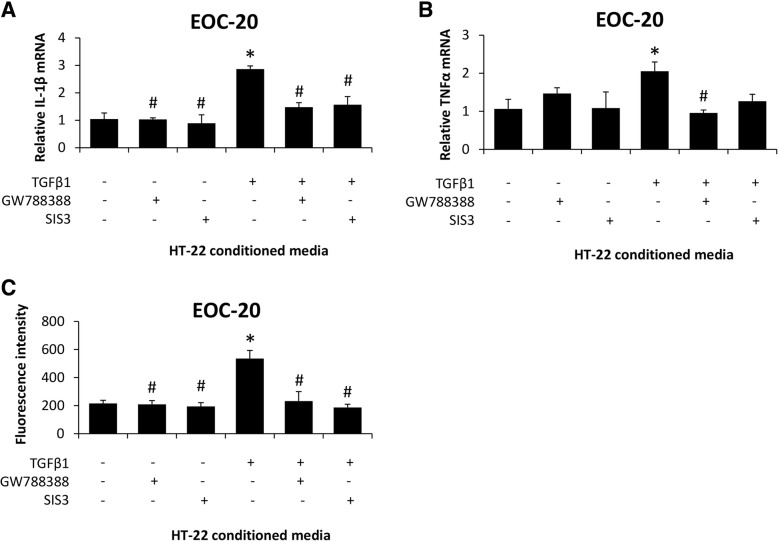
Microglia activation is induced by secreted factors from TGFβ1-stimulated neurons. a Relative IL-1β and (b) TNFα mRNA expression in EOC-20 cells supplemented with conditioned media from HT-22 cells treated with recombinant TGFβ1, GW788388, or SIS3. c Phagocytosis activity, reported as fluorescence intensity of phagocytized E. coli bioparticles, in EOC-20 cells supplemented with conditioned media from HT-22 cells treated with recombinant TGFβ1, GW788388, or SIS3. *p < 0.05 compared to EOC-20 supplemented with basal HT-22 conditioned media. #p < 0.05 compared to EOC-20 supplemented with TGFβ1-treated HT-22 conditioned media. n = 3 for mRNA analyses and n = 7 for phagocytosis activity assay
Fig. 8
Fig. 8
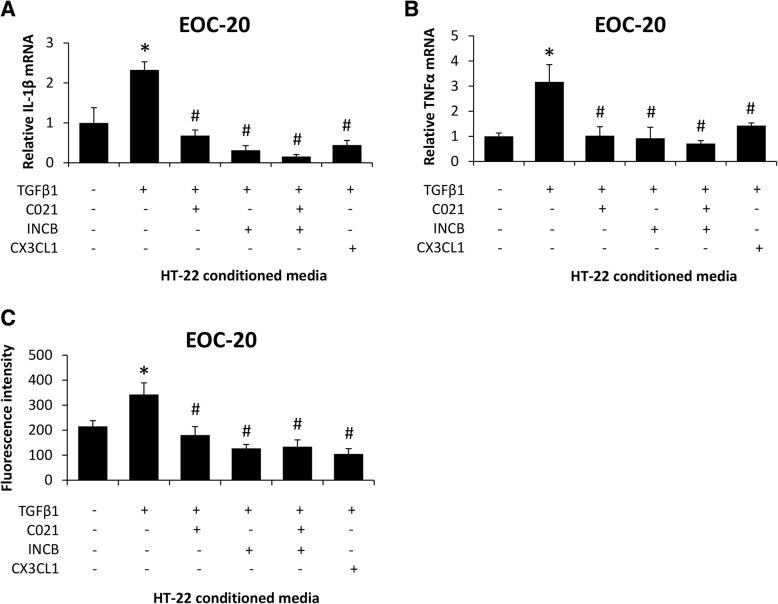
TGFβ1-induced CCL2 and CX3CL1 modulation in neurons promote microglia activation. a Relative IL-1β and (b) TNFα mRNA expression in EOC-20 cells treated with C021, INCB, or recombinant CX3CL1 following supplementation with conditioned media from HT-22 cells treated with recombinant TGFβ1. c Phagocytosis activity, reported as fluorescence intensity of phagocytized E. coli bioparticles, in EOC-20 cells treated with C021, INCB, or recombinant CX3CL1 following supplementation with conditioned media from HT-22 cells treated with recombinant TGFβ1. *p < 0.05 compared to EOC-20 supplemented with basal HT-22 conditioned media. #p < 0.05 compared to EOC-20 supplemented with TGFβ1-treated HT-22 conditioned media. n = 3 for mRNA analyses and n = 7 for phagocytosis activity assay
Fig. 9
Fig. 9
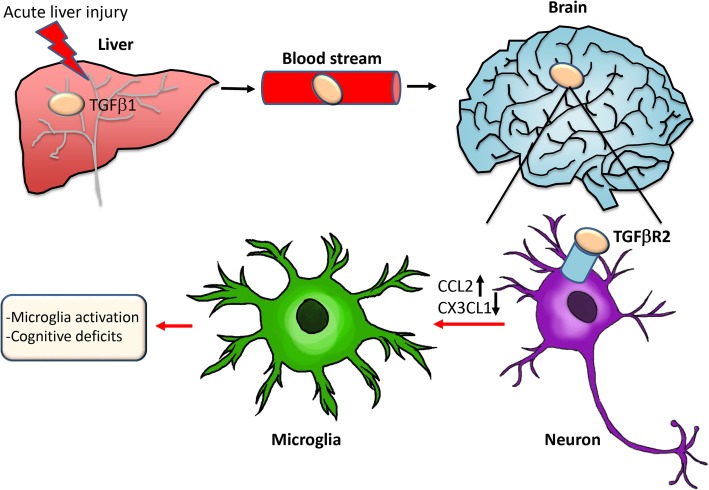
Working model of TGFβ1 signaling during AOM-induced HE. AOM-induced liver failure leads to an increase of hepatic TGFβ1 that enters the bloodstream, crosses the blood–brain barrier, and enters the brain. This results in the activation of TGFβR2 on neurons leading to increased expression and secretion of CCL2 and decreased expression and secretion of CX3CL1 from neurons. This imbalance of CCL2 and CX3CL1 leads to changes in chemokine receptor-mediated signaling in microglia, which ultimately results in microglia activation and worse HE outcomes

References

    1. Kaplowitz N. Drug-induced liver disorders: implications for drug development and regulation. Drug Saf. 2001;24(7):483–490. doi: 10.2165/00002018-200124070-00001. - DOI - PubMed
    1. American Association for the Study of Liver D, European Association for the Study of the L Hepatic encephalopathy in chronic liver disease: 2014 practice guideline by the European Association for the Study of the liver and the American Association for the Study of Liver Diseases. J Hepatol. 2014;61(3):642–659. doi: 10.1016/j.jhep.2014.05.042. - DOI - PubMed
    1. Bernal W, Auzinger G, Dhawan A, Wendon J. Acute liver failure. Lancet. 2010;376(9736):190–201. doi: 10.1016/S0140-6736(10)60274-7. - DOI - PubMed
    1. Hazell AS, Butterworth RF. Hepatic encephalopathy: an update of pathophysiologic mechanisms. Proc Soc Exp Biol Med. 1999;222(2):99–112. doi: 10.1046/j.1525-1373.1999.d01-120.x. - DOI - PubMed
    1. Matkowskyj KA, Marrero JA, Carroll RE, Danilkovich AV, Green RM, Benya RV. Azoxymethane-induced fulminant hepatic failure in C57BL/6J mice: characterization of a new animal model. Am J Phys. 1999;277(2):G455–G462. - PubMed

MeSH terms

Substances