


Acetylation & Co: an expanding repertoire of histone acylations regulates chromatin and transcription
- PMID: 30940741
- PMCID: PMC6484784
- DOI: 10.1042/EBC20180061
Acetylation & Co: an expanding repertoire of histone acylations regulates chromatin and transcription
Abstract
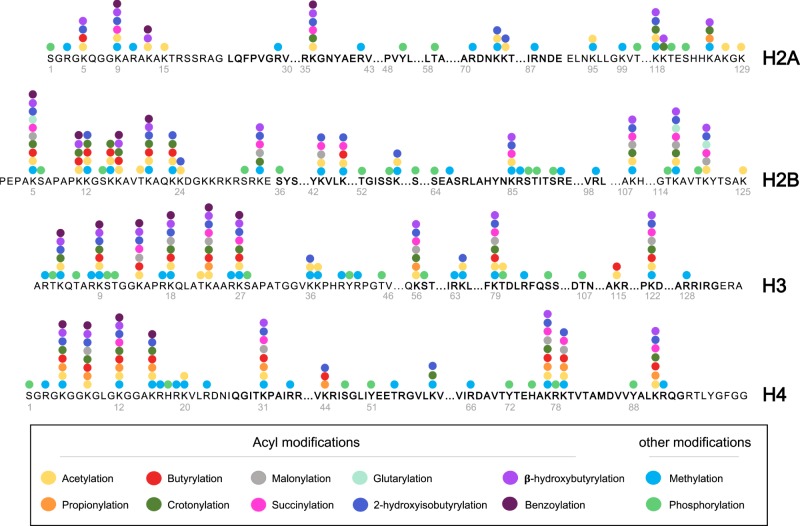
Packaging the long and fragile genomes of eukaryotic species into nucleosomes is all well and good, but how do cells gain access to the DNA again after it has been bundled away? The solution, in every species from yeast to man, is to post-translationally modify histones, altering their chemical properties to either relax the chromatin, label it for remodelling or make it more compact still. Histones are subject to a myriad of modifications: acetylation, methylation, phosphorylation, ubiquitination etc. This review focuses on histone acylations, a diverse group of modifications which occur on the ε-amino group of Lysine residues and includes the well-characterised Lysine acetylation. Over the last 50 years, histone acetylation has been extensively characterised, with the discovery of histone acetyltransferases (HATs) and histone deacetylases (HDACs), and global mapping experiments, revealing an association of hyperacetylated histones with accessible, transcriptionally active chromatin. More recently, there has been an explosion in the number of unique short chain 'acylations' identified by MS, including: propionylation, butyrylation, crotonylation, succinylation, malonylation and 2-hydroxyisobutyrylation. These novel modifications add a range of chemical environments to histones, and similar to acetylation, appear to accumulate at transcriptional start sites and correlate with gene activity.
Keywords: Acetylation; Chromatin; Histone; Transcription.
© 2019 The Author(s).
Conflict of interest statement
The authors declare that there are no competing interests associated with the manuscript.
Figures
References
Publication types
MeSH terms
Substances
Grants and funding
LinkOut - more resources
Full Text Sources
Molecular Biology Databases
