


Association of Suicide Risk With Headache Frequency Among Migraine Patients With and Without Aura
- PMID: 30941087
- PMCID: PMC6433743
- DOI: 10.3389/fneur.2019.00228
Association of Suicide Risk With Headache Frequency Among Migraine Patients With and Without Aura
Abstract
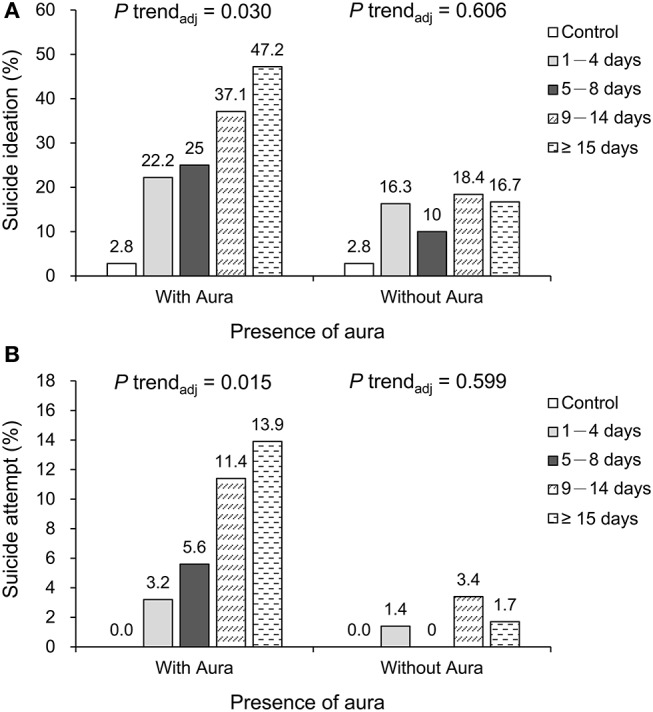
Background: Migraines with aura have been associated with suicide in adolescents and young adults, but the association between suicide and migraine frequency has not been determined. This study investigated suicidal ideation and suicide attempts among patients with varying frequencies of migraines, with and without auras. Methods: This cross-sectional study analyzed 528 patients aged between 20 and 60 years from a headache outpatient clinic in Taiwan. All patients completed a set of questionnaires, including a demographic questionnaire, the Migraine Disability Assessment questionnaire, the Hospital Anxiety and Depression Scale, the Beck Depression Inventory, and the Pittsburgh Sleep Quality Index. Suicide risk was evaluated by self-reported lifetime suicidal ideation and attempts. Patients were divided into low-frequency (1-4 days/month), moderate-frequency (5-8 days/month), high-frequency (9-14 days/month), and chronic (≥15 days/month) migraine groups. The association between migraine frequency and suicidality was investigated using multivariable linear regression and logistic regression. Results: The rates of suicidal ideation and suicide attempts were the highest for chronic migraine with aura (ideation: 47.2%; attempts: 13.9%) and lowest in migraine-free controls (2.8%). Migraine frequency was an independent risk factor for suicidal ideation and attempts in patients with aura (both P trend < 0.001), but not in patients without auras. Migraine aura and depression were associated with higher risks of suicidal ideation and suicide attempts in patients with migraine. Conclusion: High migraine frequency has a correlation with high suicide risk in patients who experience an aura, but not in other patients with migraine.
Keywords: depression; migraine; suicidal ideation; suicide; suicide attempts.
Figures
References
-
- Global Burden of Disease Study C Global, regional, and national incidence, prevalence, and years lived with disability for 301 acute and chronic diseases and injuries in 188 countries, 1990-2013: a systematic analysis for the Global Burden of Disease Study 2013. Lancet. (2015) 386:743–800. 10.1016/S0140-6736(15)60692-4 - DOI - PMC - PubMed
LinkOut - more resources
Full Text Sources
Miscellaneous
