


Anti-H7N9 avian influenza A virus activity of interferon in pseudostratified human airway epithelium cell cultures
- PMID: 30944006
- PMCID: PMC6448296
- DOI: 10.1186/s12985-019-1146-4
Anti-H7N9 avian influenza A virus activity of interferon in pseudostratified human airway epithelium cell cultures
Abstract
Background: Since H7N9 influenza A virus (H7N9) was first reported in 2013, five waves of outbreaks have occurred, posing a huge threat to human health. In preparation for a potential H7N9 epidemic, it is essential to evaluate the efficacy of anti-H7N9 drugs with an appropriate model.
Methods: Well-differentiated pseudostratified human airway epithelium (HAE) cells were grown at the air-liquid interface, and the H7N9 cell tropism and cytopathic effect were detected by immunostaining and hematoxylin-eosin (HE) staining. The H7N9 replication kinetics and anti-H7N9 effect of recombinant human α2b (rhIFN-α2b) and rhIFN-λ1 were compared with different cell lines. The H7N9 viral load and interferon-stimulated gene (ISG) expression were quantified by real-time PCR assays.
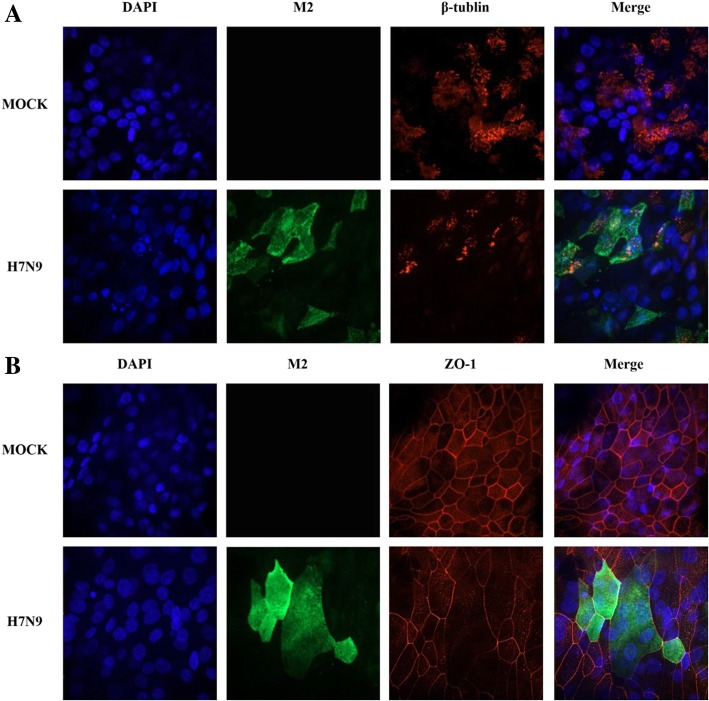
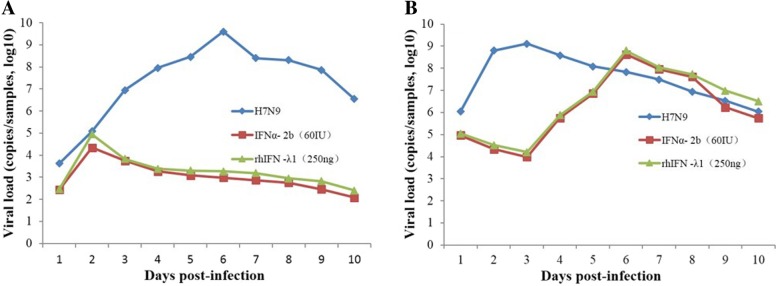
Results: H7N9 could infect both ciliated and non-ciliated cells within the three-dimensional (3D) HAE cell culture, which reduced the number of cilia and damaged the airways. The H7N9 replication kinetics differed between traditional cells and 3D HAE cells. Interferon had antiviral activity against H7N9 and alleviated epithelial cell lesions; the antiviral activity of rhIFN-α2b was slightly better than that of rhIFN-λ1. In normal cells, rhIFN-α2b induced a greater amount of ISG expression (MX1, OAS1, IFITM3, and ISG15) compared with rhIFN-λ1, but in 3D HAE cells, this trend was reversed.
Conclusions: Both rhIFN-α2b and rhIFN-λ1 had antiviral activity against H7N9, and this protection was related to the induction of ISGs. The 3D cell culture model is suitable for evaluating interferon antiviral activity because it can demonstrate realistic in vivo-like effects.
Keywords: Avian influenza A virus; H7N9; Human airway epithelium; Interferon; Interferon-stimulated genes.
Conflict of interest statement
Ethics approval and consent to participate
The project was approved by the Ethical Committee of National Institute for Viral Disease Control and Prevention, China CDC.
Consent for publication
No applicable.
Competing interests
The authors declare that they have no competing interests.
Publisher’s Note
Springer Nature remains neutral with regard to jurisdictional claims in published maps and institutional affiliations.
Figures


References
-
- Osterlund P, Pirhonen J, Ikonen N, Ronkko E, Strengell M, Makela SM, et al. Pandemic H1N1 2009 influenza A virus induces weak cytokine responses in human macrophages and dendritic cells and is highly sensitive to the antiviral actions of interferons. J Virol. 2010;84(3):1414–1422. doi: 10.1128/JVI.01619-09. - DOI - PMC - PubMed
Publication types
MeSH terms
Substances
LinkOut - more resources
Full Text Sources
Medical
Miscellaneous
