


Mosquito biodiversity and mosquito-borne viruses in the United Arab Emirates
- PMID: 30944019
- PMCID: PMC6448230
- DOI: 10.1186/s13071-019-3417-8
Mosquito biodiversity and mosquito-borne viruses in the United Arab Emirates
Abstract
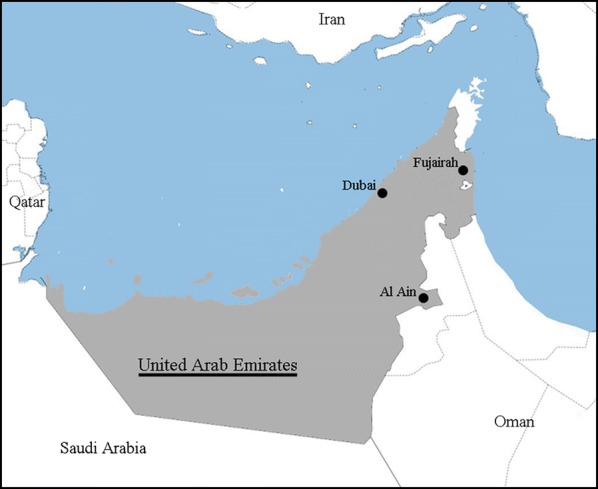
Background: In the last 50 years, the United Arab Emirates (UAE) has experienced rapid population growth and urbanization. Urbanization is known to influence biodiversity, and there appears to be a link between the emergence of arboviruses and urban growth. Very little is known about the UAE mosquito species richness and dominant vectors. We performed a mosquito survey comparing peri-urban sites in Dubai and Al Ain to a protected, natural site in Fujairah emirate. We measured mosquito biodiversity and species composition, and screened mosquito pools for common arboviruses to measure arbovirus activity in the region.
Results: We report ten species of mosquitoes from the UAE, with highest species diversity in the natural site, a protected wadi near the eastern coast. The predominant mosquito was Culex perexiguus, and was associated with peri-urban habitats. The site with lowest mosquito species diversity but relatively high species richness was the peri-urban site of Al Ain Zoo, where we identified Bagaza virus and Barkedji virus, two flaviviruses, in pools of Cx. perexiguus.
Conclusions: Decreased mosquito biodiversity was associated with increased levels of urbanization. The predominance of two species at peri-urban sites was related to the availability of their larval habitats. Arboviruses were associated with the presence of a single predominant mosquito species, Cx. perexiguus.
Keywords: Bagaza virus; Barkedji virus; Flavivirus; Urbanization.
Conflict of interest statement
The authors declare that they have no competing interests.
Figures
References
-
- Nassar AK, Alan Blackburn G, Duncan Whyatt J. Developing the desert: the pace and process of urban growth in Dubai. Comput Environ Urban Syst. 2014;45:50–62. doi: 10.1016/j.compenvurbsys.2014.02.005. - DOI
-
- Sharaf SA, Serra P, Saurí D. A district and sector land-use and landscape analysis of urban sprawl in Al Ain municipality (United Arab Emirates): just a quick conversion from sand to a built-up environment? Appl Geogr. 2018;95:88–100. doi: 10.1016/j.apgeog.2018.04.008. - DOI
-
- Issa S, Al Shuwaihi A. Characterization of Al Ain city urban growth using multi-temporal remote sensing data and GIS. Int Geoinformatics Res Dev J. 2012;3:1–17.
-
- McKinney M. Effects of urbanization on species richness: a review of plants and animals. Urban Ecosyst. 2008;11:161–176. doi: 10.1007/s11252-007-0045-4. - DOI
-
- Frankie G, Ehler L. Ecology of insects in urban environments. Annu Rev Entomol. 1978;23:367–387. doi: 10.1146/annurev.en.23.010178.002055. - DOI
MeSH terms
LinkOut - more resources
Full Text Sources
Medical
