


Multicentre, randomised controlled trial of PDSAFE, a physiotherapist-delivered fall prevention programme for people with Parkinson's
- PMID: 30944149
- PMCID: PMC6585265
- DOI: 10.1136/jnnp-2018-319448
Multicentre, randomised controlled trial of PDSAFE, a physiotherapist-delivered fall prevention programme for people with Parkinson's
Abstract
Objective: To estimate the effect of a physiotherapist-delivered fall prevention programme for people with Parkinson's (PwP).
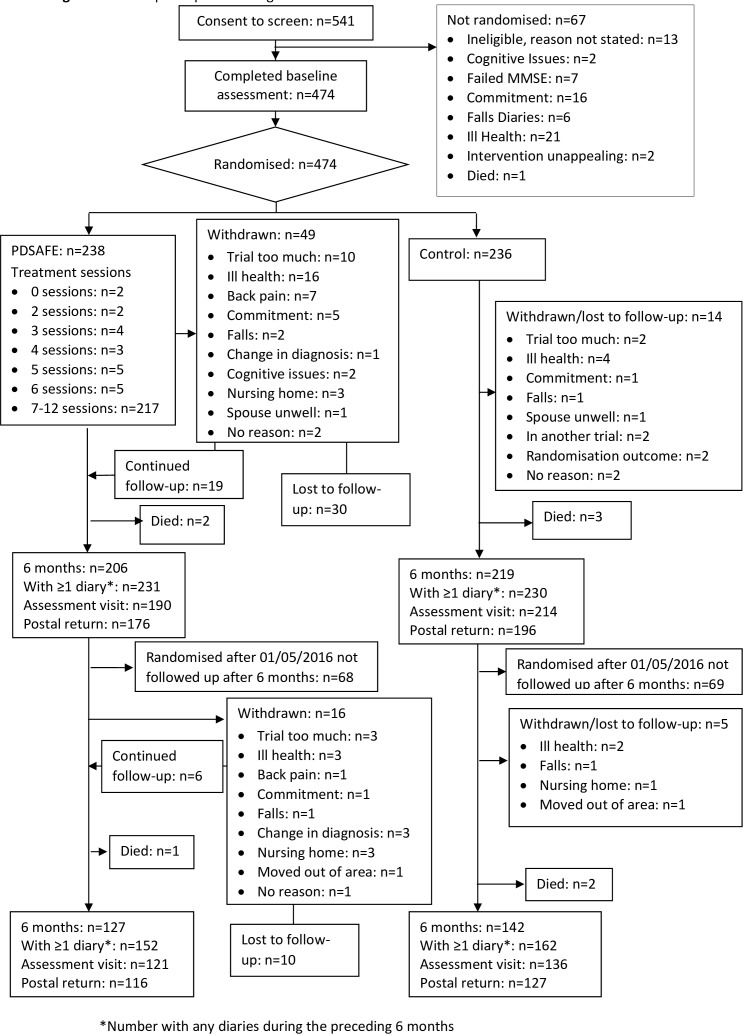
Methods: People at risk of falls with confirmed Parkinson's were recruited to this multicentre, pragmatic, investigator blind, individually randomised controlled trial with prespecified subgroup analyses. 474 PwP (Hoehn and Yahr 1-4) were randomised: 238 allocated to a physiotherapy programme and 236 to control. All participants had routine care; the control group received a DVD about Parkinson's and single advice session at trial completion. The intervention group (PDSAFE) had an individually tailored, progressive home-based fall avoidance strategy training programme with balance and strengthening exercises. The primary outcome was risk of repeat falling, collected by self-report monthly diaries, 0-6 months after randomisation. Secondary outcomes included Mini-BESTest for balance, chair stand test, falls efficacy, freezing of gait, health-related quality of life (EuroQol EQ-5D), Geriatric Depression Scale, Physical Activity Scale for the Elderly and Parkinson's Disease Questionnaire, fractures and rate of near falling.
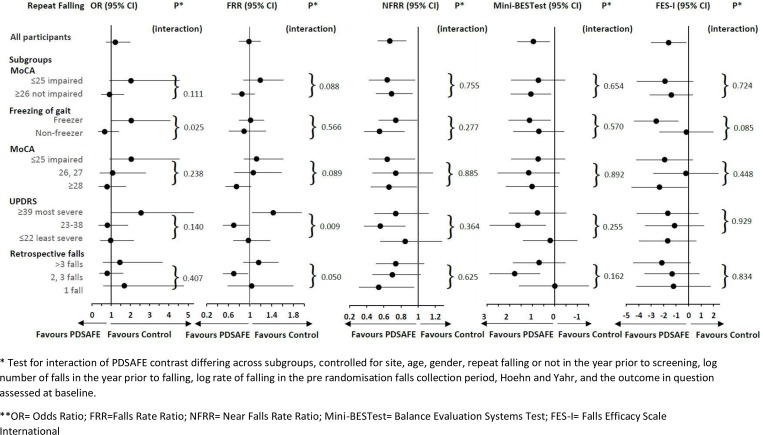
Results: Average age is 72 years and 266 (56%) were men. By 6 months, 116 (55%) of the control group and 125 (61.5%) of the intervention group reported repeat falls (controlled OR 1.21, 95% CI 0.74 to 1.98, p=0.447). Secondary subgroup analyses suggested a different response to the intervention between moderate and severe disease severity groups. Balance, falls efficacy and chair stand time improved with near falls reduced in the intervention arm.
Conclusion: PDSAFE did not reduce falling in this pragmatic trial of PwP. Other functional tasks improved and reduced fall rates were apparent among those with moderate disease.
Trial registration number: ISRCTN48152791.
Keywords: Cognition; Disease severity; Fall prevention; Freezing of gait; Parkinson's; Physiotherapy.
© Author(s) (or their employer(s)) 2019. Re-use permitted under CC BY-NC. No commercial re-use. See rights and permissions. Published by BMJ.
Conflict of interest statement
Competing interests: LR reports grants from Newcastle University during the conduct of the study; grants from Parkinson’s UK, grants from EU Marie Curie Training Network, grants from MRC, grants from EPSRC, grants from Wellcome Trust, from Stroke Association, outside the submitted work. CB is a member of the Primary Care Community and Preventive Interventions HTA group and the associated Methods group. VG reports grants from the National Institute for Health Research, during the conduct of the study. SEL reports grants from the NIHR Health Technology Assessment Programme during the conduct of this study. SEL was a member of the HTA Additional Capacity Funding Board, HTA End of Life Care and Add-on Studies, HTA Prioritisation Group, HTA Trauma Board during this study. All other authors have nothing to disclose.
Figures
References
-
- Mirelman A, Rochester L, Maidan I, et al. Addition of a non-immersive virtual reality component to treadmill training to reduce fall risk in older adults (V-TIME): a randomised controlled trial. Lancet 2016;388:1170–82. - PubMed
Publication types
MeSH terms
Grants and funding
LinkOut - more resources
Full Text Sources
Medical
