. 2019 May 24;57(6):e00190-19.
doi: 10.1128/JCM.00190-19. Print 2019 Jun.

hicap: In Silico Serotyping of the Haemophilus influenzae Capsule Locus

Affiliations

hicap: In Silico Serotyping of the Haemophilus influenzae Capsule Locus

Stephen C Watts et al. J Clin Microbiol. .

Abstract

Haemophilus influenzae exclusively colonizes the human nasopharynx and can cause a variety of respiratory infections as well as invasive diseases, including meningitis and sepsis. A key virulence determinant of H. influenzae is the polysaccharide capsule, of which six serotypes are known, each encoded by a distinct variation of the capsule biosynthesis locus (cap-a to cap-f). H. influenzae type b (Hib) was historically responsible for the majority of invasive H. influenzae disease, and its prevalence has been markedly reduced in countries that have implemented vaccination programs targeting this serotype. In the postvaccine era, nontypeable H. influenzae emerged as the most dominant group causing disease, but in recent years a resurgence of encapsulated H. influenzae strains has also been observed, most notably serotype a. Given the increasing incidence of encapsulated strains and the high frequency of Hib in countries without vaccination programs, there is growing interest in genomic epidemiology of H. influenzae Here we present hicap, a software tool for rapid in silico serotype prediction from H. influenzae genome sequences. hicap is written using Python3 and is freely available at https://github.com/scwatts/hicap under the GNU General Public License v3 (GPL3). To demonstrate the utility of hicap, we used it to investigate the cap locus diversity and distribution in 691 high-quality H. influenzae genomes from GenBank. These analyses identified cap loci in 95 genomes and confirmed the general association of each serotype with a unique clonal lineage, and they also identified occasional recombination between lineages that gave rise to hybrid cap loci (2% of encapsulated strains).

Keywords: Haemophilus influenzae; capsule; genomics; serotyping; surveillance.


Figures

FIG 1
FIG 1
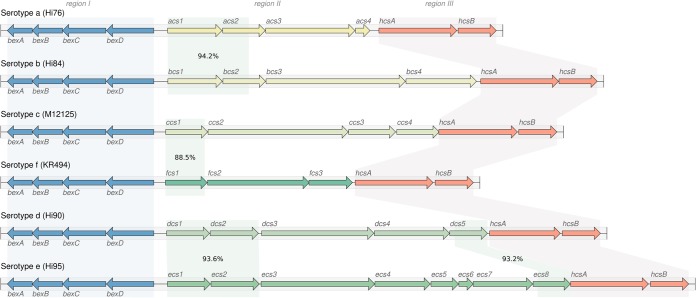
Schematic representation of the six known H. influenzae cap loci. Capsule nucleotide sequences and annotations were collected from genome assemblies representing each of the six serotypes. Shading indicates homologous regions between reference loci as determined by BLAST identity values shown in region II. Regions I and III are homologous across the entire sequence for all loci, with nucleotide identities of ≥87% and ≥90%, respectively.
FIG 2
FIG 2
Summary of the hicap serotype prediction method. hicap takes an assembled genome in FASTA format as input and detects all open reading frames (ORFs) using Prodigal. Constituent cap genes and IS1016 copies are identified by performing alignments of either the ORF sequence or input assembly sequence against the reference database using BLAST+. The identified cap genes and IS1016 alignments are then used to inform structural composition of the locus. Serotype is predicted using the gene complement information of region II.
FIG 3
FIG 3
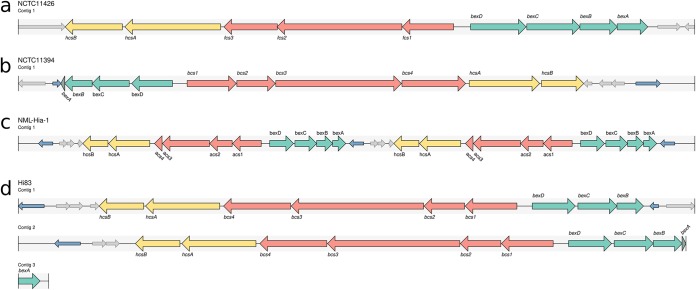
Examples of hicap visualization for selected genomes. cap locus genes are annotated as large arrows with the direction representing the strand. Genes of the cap locus are colored to indicate region (region I, green; region II, red; region III, yellow). A truncated cap gene is given a darker shade of color for the respective region. Copies of IS1016 are denoted as small blue arrows, and open reading frames that do not generally belong to the cap locus are show as small gray arrows. (a) The complete and contiguous annotation of the NCTC 11426 cap-f locus. (b) The NCTC 11394 cap-b locus, which contains a truncated bexA gene and two copies of IS1016. (c) A duplication of the cap-a locus is observed in the assembly of NML-Hia-1. (d) The cap-b locus of Hi83 is also duplicated but is present across multiple contigs in the input assembly, as represented by multiple tracks.
FIG 4
FIG 4
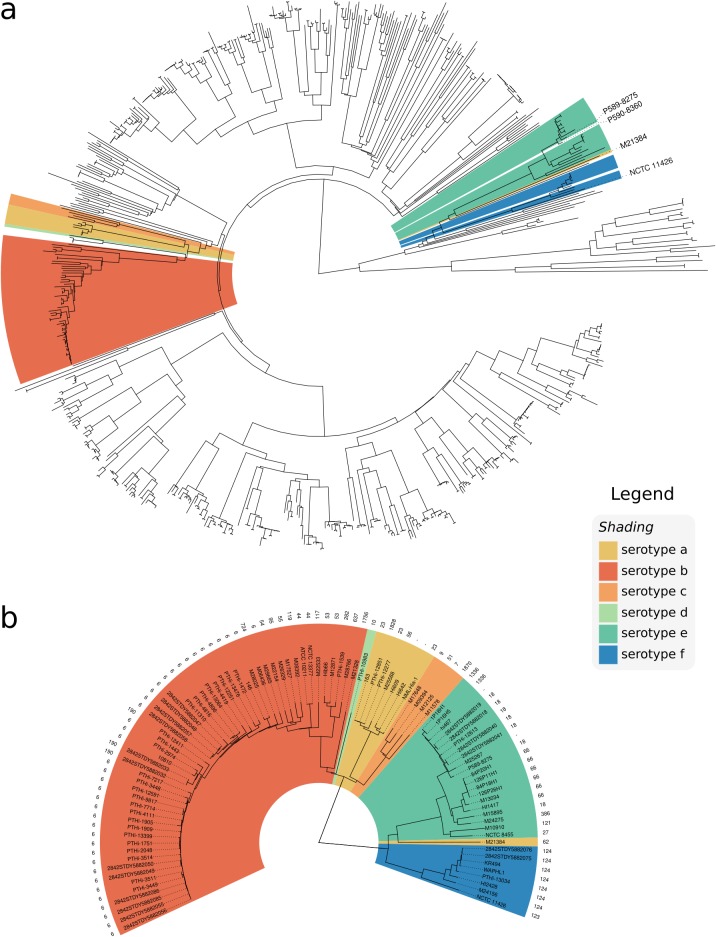
Whole-genome neighbor-joining phylogeny inferred from MASH distances of assemblies in the GenBank data set. Isolates are annotated with the respective serotype as predicted by hicap. (a) Distribution of capsular serotypes in the complete data set. (b) The phylogeny subtree including only isolates that contained a cap locus, additionally annotated with the sequence type.
FIG 5
FIG 5
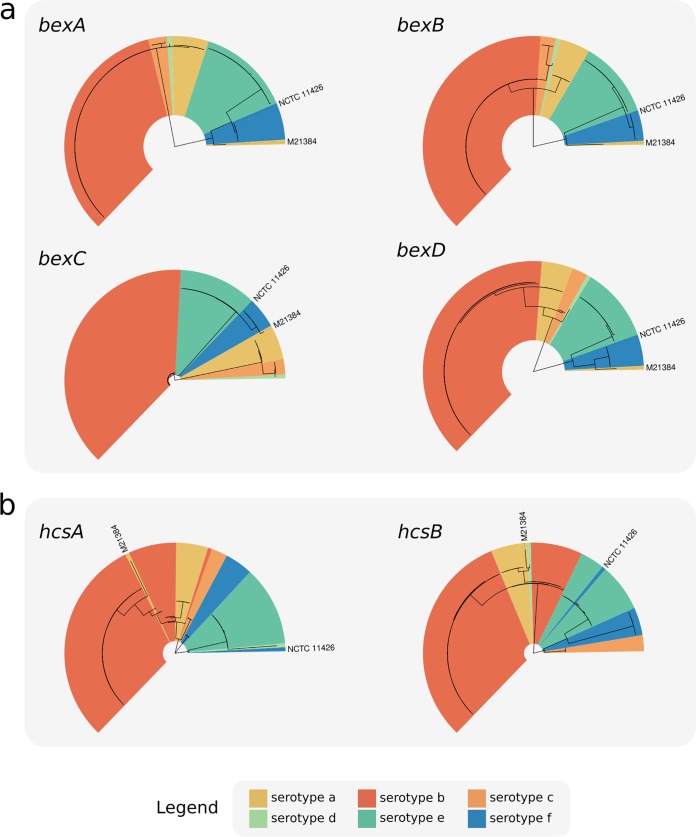
Phylogenies of all complete cap locus region I (a) and III (b) genes identified in the GenBank data set. FastTree was used to recover phylogenies from MAFFT gene nucleotide sequence alignments, and isolates were annotated using the serotype as predicted by hicap.
FIG 6
FIG 6
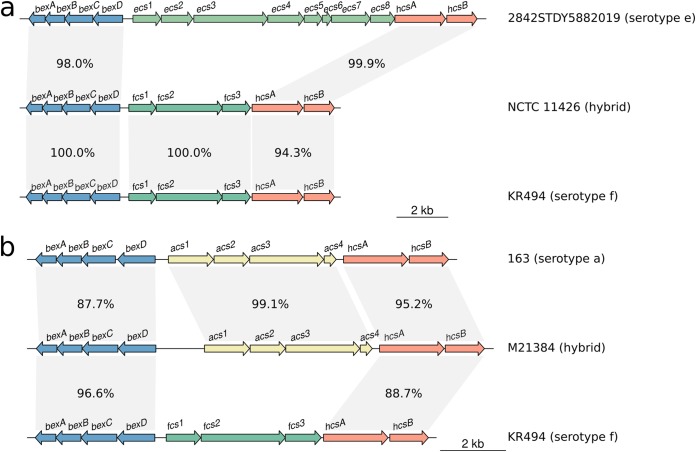
Homology plots generated using R and genoPlotR, showing the cap loci of two isolates which appear to have been subject to recombination. Different regions of the NCTC 11426 (a) and M21384 (b) cap loci show varying homology to different reference cap loci, suggesting a recombinogenic ancestry.

References

    1. Fleischmann RD, Adams MD, White O, Clayton RA, Kirkness EF, Kerlavage AR, Bult CJ, Tomb JF, Dougherty BA, Merrick JM. 1995. Whole-genome random sequencing and assembly of Haemophilus influenzae Rd. Science 269:496–512. doi:10.1126/science.7542800. - DOI - PubMed
    1. Pittman M. 1931. Variation and type specificity in the bacterial species Hemophilus influenzae. J Exp Med 53:471–492. doi:10.1084/jem.53.4.471. - DOI - PMC - PubMed
    1. Kroll JS, Loynds B, Brophy LN, Moxon ER. 1990. The bex locus in encapsulated Haemophilus influenzae: a chromosomal region involved in capsule polysaccharide export. Mol Microbiol 4:1853–1862. doi:10.1111/j.1365-2958.1990.tb02034.x. - DOI - PubMed
    1. Sukupolvi-Petty S, Grass S, St Geme JW. 2006. The Haemophilus influenzae type b hcsA and hcsB gene products facilitate transport of capsular polysaccharide across the outer membrane and are essential for virulence. J Bacteriol 188:3870–3877. doi:10.1128/JB.01968-05. - DOI - PMC - PubMed
    1. Follens A, Veiga-da-Cunha M, Merckx R, van Schaftingen E, van Eldere J. 1999. acs1 of Haemophilus influenzae type a capsulation locus region II encodes a bifunctional ribulose 5-phosphate reductase-CDP-ribitol pyrophosphorylase. J Bacteriol 181:2001–2007. - PMC - PubMed

Publication types

LinkOut - more resources