Meta-Analysis
. 2019 Apr 16;92(16):e1899-e1911.
doi: 10.1212/WNL.0000000000007313. Epub 2019 Apr 3.

Large-scale plasma metabolome analysis reveals alterations in HDL metabolism in migraine

Affiliations
Meta-Analysis

Large-scale plasma metabolome analysis reveals alterations in HDL metabolism in migraine

Gerrit L J Onderwater et al. Neurology. .

Abstract

Objective: To identify a plasma metabolomic biomarker signature for migraine.

Methods: Plasma samples from 8 Dutch cohorts (n = 10,153: 2,800 migraine patients and 7,353 controls) were profiled on a 1H-NMR-based metabolomics platform, to quantify 146 individual metabolites (e.g., lipids, fatty acids, and lipoproteins) and 79 metabolite ratios. Metabolite measures associated with migraine were obtained after single-metabolite logistic regression combined with a random-effects meta-analysis performed in a nonstratified and sex-stratified manner. Next, a global test analysis was performed to identify sets of related metabolites associated with migraine. The Holm procedure was applied to control the family-wise error rate at 5% in single-metabolite and global test analyses.

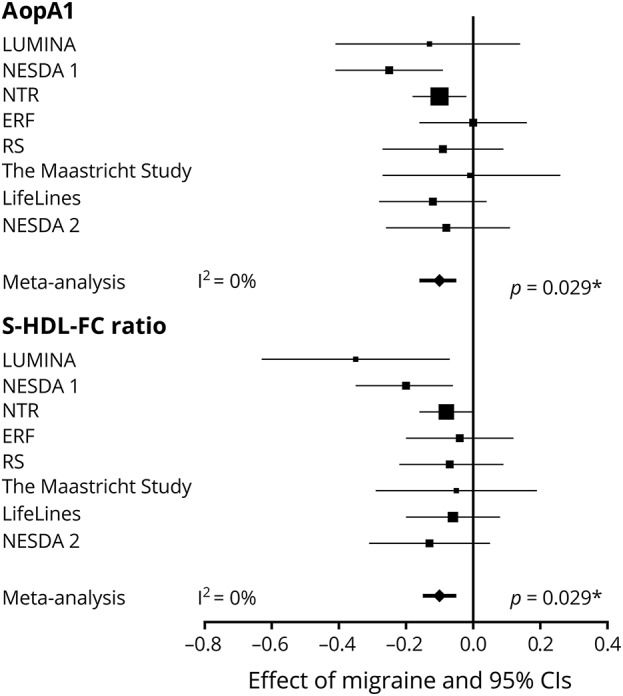
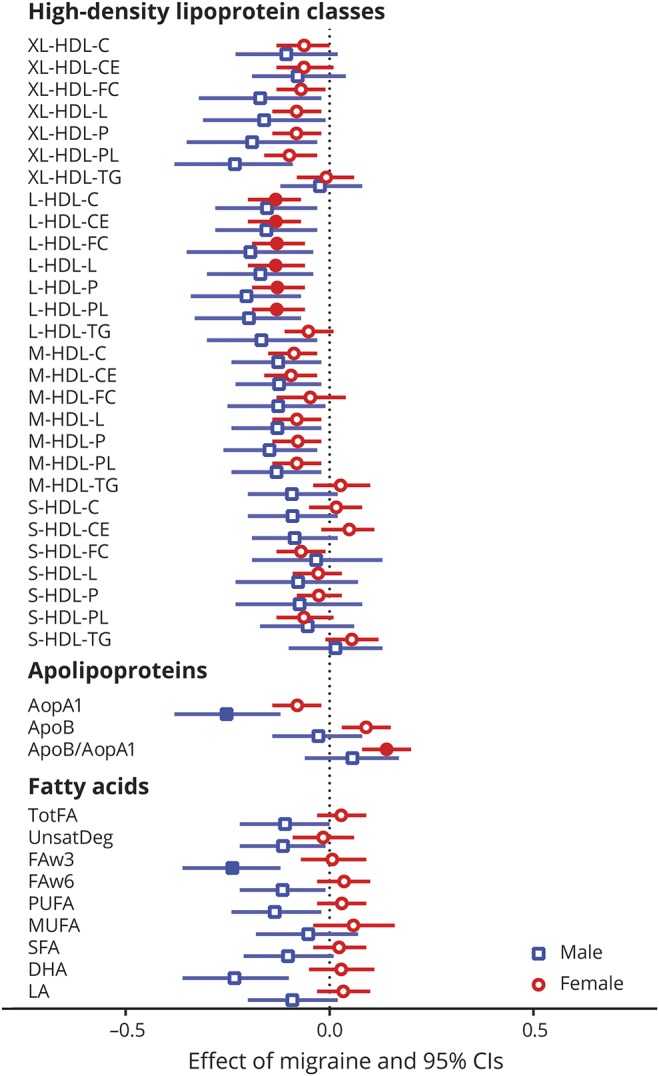
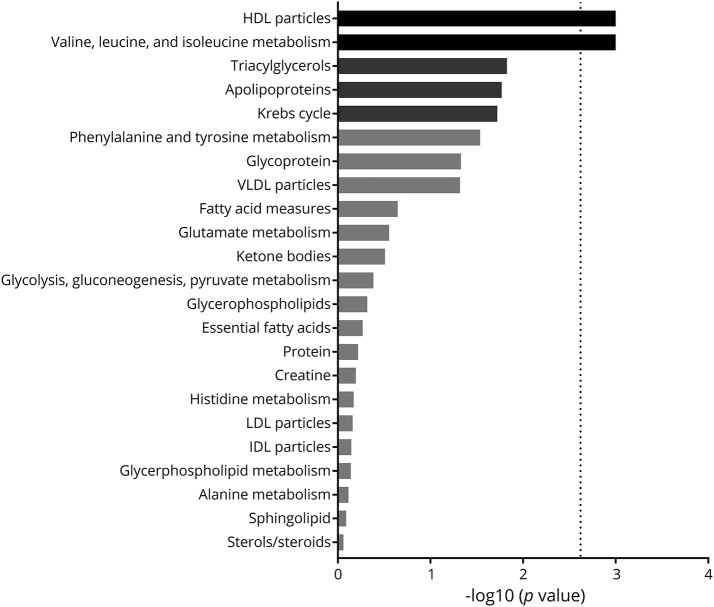
Results: Decreases in the level of apolipoprotein A1 (β -0.10; 95% confidence interval [CI] -0.16, -0.05; adjusted p = 0.029) and free cholesterol to total lipid ratio present in small high-density lipoprotein subspecies (HDL) (β -0.10; 95% CI -0.15, -0.05; adjusted p = 0.029) were associated with migraine status. In addition, only in male participants, a decreased level of omega-3 fatty acids (β -0.24; 95% CI -0.36, -0.12; adjusted p = 0.033) was associated with migraine. Global test analysis further supported that HDL traits (but not other lipoproteins) were associated with migraine status.

Conclusions: Metabolic profiling of plasma yielded alterations in HDL metabolism in migraine patients and decreased omega-3 fatty acids only in male migraineurs.


Figures

Figure 1
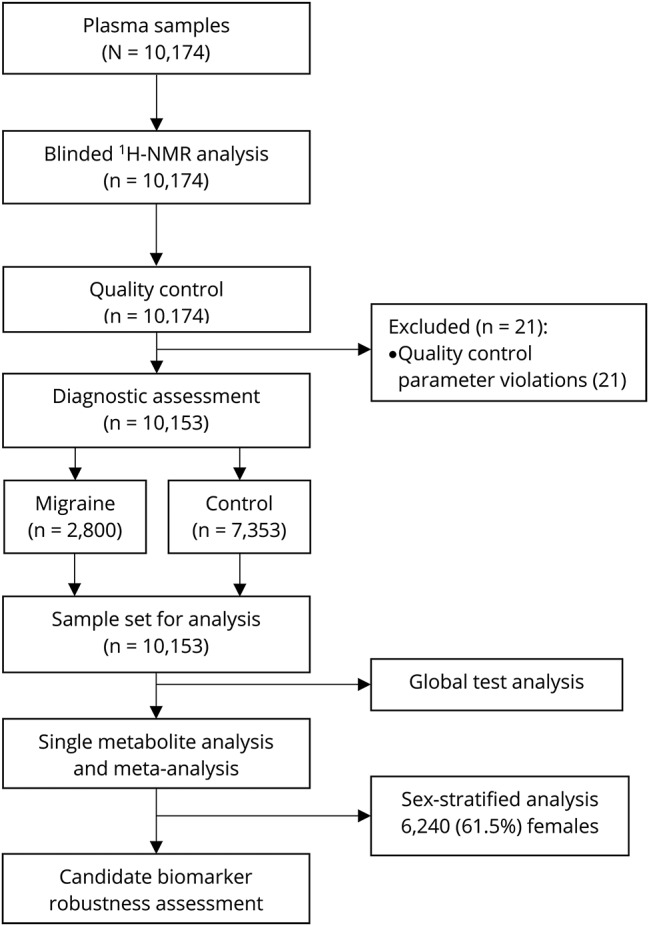
Figure 1. Study flowchart
Determination of the sample set used for data analysis and the different data analysis approaches performed in the current study. 1H-NMR = proton nuclear magnetic resonance.
Figure 2
Figure 2. Forest plots of candidate migraine biomarkers apolipoprotein A1 (apoA1) and the free cholesterol to total lipid ratio in small high-density lipoprotein ratio (S-HDL-FC)
Associations with migraine in random-effects meta-analyses. The effect sizes and 95% confidence intervals (CIs) for apoA1 and S-HDL-FC are presented per cohort and in a random-effects meta-analysis. Values from logistic regression with metabolite levels, sex, and age as independent variables and migraine status as dependent variable. Error bars denote 95% CIs. To facilitate the interpretation of the effect sizes (β coefficients), we calculated the odds ratio (OR) for having migraine for a typical low metabolite score (z score = −1, 1 SD below average) and a typical high metabolite score: β −0.10, OR 1.22; β −0.20, OR 1.49; β −0.30, OR 1.82; β −0.40, OR 2.22; β −0.50, OR 2.72. *p Values after Holm-Bonferroni (p < 0.0002) multiple testing correction. ERF = Erasmus Rucphen Family study; I2 = measure of heterogeneity; LUMINA = Leiden University Migraine Neuro-Analysis; NESDA = Netherlands Study of Depression and Anxiety 1 and 2; NTR = Netherlands Twin Registry; RS = Rotterdam Study.
Figure 3
Figure 3. Sex-stratified metabolite associations with migraine
Metabolite associations with migraine in male (blue squares) and female (red circles) participants in a random-effects meta-analysis comprised of 8 cohorts. The effect sizes and 95% confidence intervals (CIs) are shown. Values are from logistic regression with metabolite levels, sex, age, body mass index, and lipid-lowering medication usage as independent variables and migraine status as dependent variable. Error bars denote 95% CIs, filled squares (male participants ) or circles (female participants ) indicate significance after Holm-Bonferroni (p < 0.0002) multiple testing correction. All other metabolite classes without significant metabolites after Holm-Bonferroni correction as well as I2 values can be found in table e-5 (doi.org/10.5061/dryad.p698mn7). To facilitate the interpretation of the effect sizes (β coefficients), we calculated the odds ratio (OR) for having migraine for a typical low metabolite score (z score = −1, 1 SD below average) and a typical high metabolite score: β −0.10, OR 1.22; β −0.20, OR 1.49; β −0.30, OR 1.82; β −0.40, OR 2.22; β −0.50, OR 2.72. All metabolite abbreviations can be found in tables e-1 and e-2 (doi.org/10.5061/dryad.p698mn7).
Figure 4
Figure 4. Global test analysis
Meta-analysis of the results of the 23 sets of (functionally) related metabolites tested in 8 cohorts for their association with migraine. The analysis using the global test framework has been adjusted for a sex, age, body mass index, and lipid-lowering medication usage. Glutamate metabolism does not include results from the Netherlands Twin Registry as glutamine levels could not be determined in this cohort. Bars denote −log10 of the p value (Fisher combination of global test p values for the individual cohorts) per pathway, where only the black bars remain significant after multiple testing correction using Holm-Bonferroni. The threshold for withstanding multiple testing correction is indicated by a dotted line. IDL = intermediate-density lipoprotein; LDL = low-density lipoprotein; VLDL = very low-density lipoprotein.

Comment in

References

    1. Launer LJ, Terwindt GM, Ferrari MD. The prevalence and characteristics of migraine in a population-based cohort: the GEM study. Neurology 1999;53:537–542. - PubMed
    1. Stovner LJ, Zwart JA, Hagen K, Terwindt GM, Pascual J. Epidemiology of headache in Europe. Eur J Neurol 2006;13:333–345. - PubMed
    1. Jensen R, Stovner LJ. Epidemiology and comorbidity of headache. Lancet Neurol 2008;7:354–361. - PubMed
    1. GBD 2016 Disease and Injury Incidence and Prevalence Collaborators. Global, regional, and national incidence, prevalence, and years lived with disability for 328 diseases and injuries for 195 countries, 1990–2016: a systematic analysis for the Global Burden of Disease Study 2016. Lancet 2017;390:1211–1259. - PMC - PubMed
    1. Kurth T, Schürks M, Logroscino G, Gaziano JM, Buring JE. Migraine, vascular risk, and cardiovascular events in women: prospective cohort study. BMJ 2008;337:a636. - PMC - PubMed

Publication types