


Mobile health interventions to promote physical activity and reduce sedentary behaviour in the workplace: A systematic review
- PMID: 30944728
- PMCID: PMC6437332
- DOI: 10.1177/2055207619839883
Mobile health interventions to promote physical activity and reduce sedentary behaviour in the workplace: A systematic review
Abstract
Objective: This systematic review aimed to assess the effectiveness, feasibility and acceptability of mobile health (mHealth) technology (including wearable activity monitors and smartphone applications) for promoting physical activity (PA) and reducing sedentary behaviour (SB) in workplace settings.
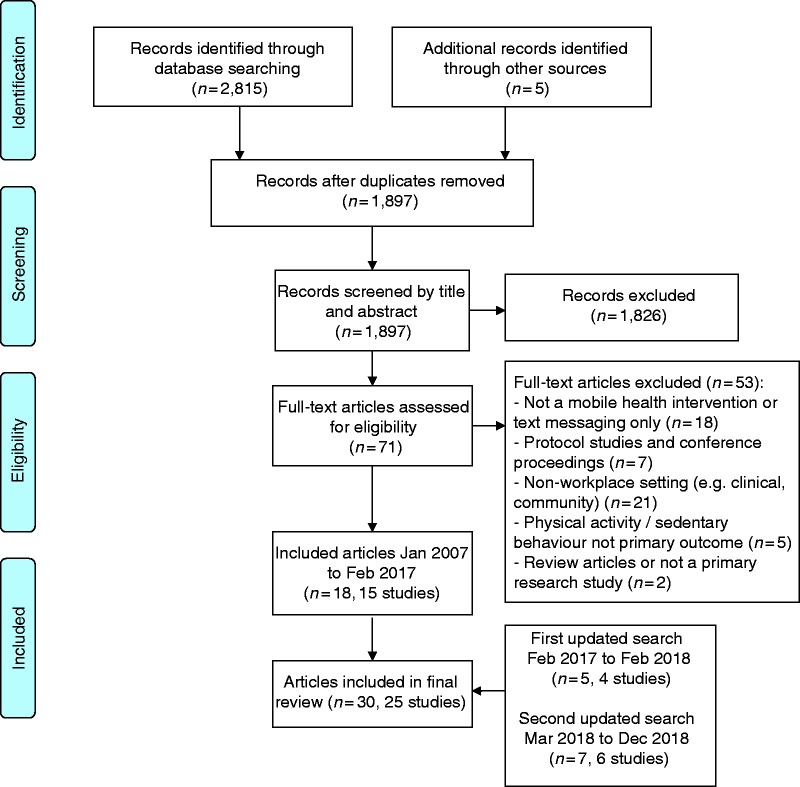
Methods: Systematic searches were conducted in seven electronic databases (MEDLINE, SPORTDiscus, Scopus, EMBASE, PsycINFO, Web of Science and the Cochrane library). Studies were included if mHealth was a major intervention component, PA/SB was a primary outcome, and participants were recruited and/or the intervention was delivered in the workplace. Study quality was assessed using the Effective Public Health Practice Project (EPHPP) tool. Interventions were coded for behaviour change techniques (BCTs) using the Coventry, Aberdeen and London - Refined (CALO-RE) taxonomy.
Results: Twenty-five experimental and quasi-experimental studies were included. Studies were highly heterogeneous and only one was rated as 'strong' methodological quality. Common BCTs included self-monitoring, feedback, goal-setting and social comparison. A total of 14/25 (56%) studies reported a significant increase in PA, and 4/10 (40%) reported a significant reduction in sedentary time; 11/16 (69%) studies reported a significant impact on secondary outcomes including reductions in weight, systolic blood pressure and total cholesterol. While overall acceptability was high, a large decline in technology use and engagement was observed over time.
Conclusions: While methodological quality was generally weak, there is reasonable evidence for mHealth in a workplace context as a feasible, acceptable and effective tool to promote PA. The impact in the longer term and on SB is less clear. Higher quality, mixed methods studies are needed to explore the reasons for decline in engagement with time and the longer-term potential of mHealth in workplace interventions.Protocol registration: The review protocol was registered with PROSPERO: CRD42017058856.
Keywords: Systematic review; behaviour change; mobile health; occupational health; physical activity; sedentary behaviour; workplace.
Figures
References
-
- Blair SN. Physical inactivity: the biggest public health problem of the 21st century. Br J Sports Med 2009; 43: 1–2. - PubMed
-
- Wannamethee SG, Shaper AG. Physical activity in the prevention of cardiovascular disease: an epidemiological perspective. Sports Med 2001; 31: 101–114. - PubMed
-
- Liu L, Shi Y, Li T, et al. Leisure time physical activity and cancer risk: evaluation of the WHO's recommendation based on 126 high-quality epidemiological studies. Br J Sports Med 2016; 50: 372–378. - PubMed
Publication types
LinkOut - more resources
Full Text Sources
