Review
doi: 10.14218/JCTH.2018.00042.
Epub 2019 Mar 25.
Mechanisms of Hepatic Cholestatic Drug Injury
Affiliations
- PMID: 30944824
- PMCID: PMC6441637
- DOI: 10.14218/JCTH.2018.00042
Item in Clipboard
Review
Mechanisms of Hepatic Cholestatic Drug Injury
J Clin Transl Hepatol.
.
Abstract
Drug-induced cholestasis represents a form of drug-induced liver disease that can lead to severe impairment of liver function. Numerous drugs have been shown to cause cholestasis and consequently bile duct toxicity. However, there is still lack of therapeutic tools that can prevent progression to advanced stages of liver injury. This review focuses on the various pathological mechanisms by which drugs express their hepatotoxic effects, as well as consequences of increased bile acid and toxin accumulation in the hepatocytes.
Keywords: Bile acids; Cholestasis; Drug-induced liver injury.
Conflict of interest statement
The authors have no conflict of interests related to this publication.
Figures
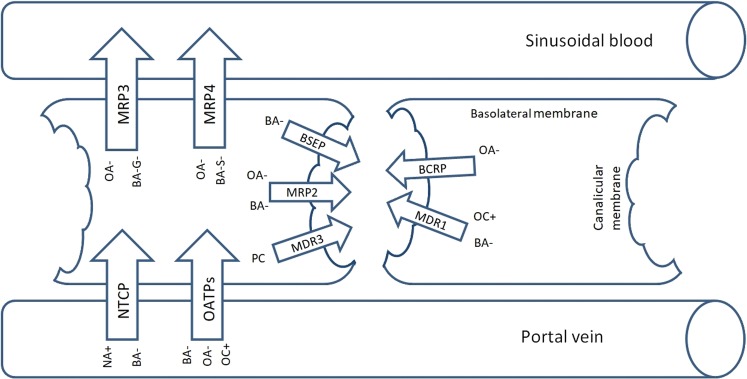
Abbreviations: MRP3, multidrug resistance-associated protein 3; MRP4, multidrug resistance-associated protein 4; NTCP, sodium-taurocholate cotransporter; OATPs, organic anion transporting polypeptides; BSEP, bile salt export pump; MRP2, multidrug resistance-associated protein 2; MDR3, multidrug resistance protein-3; BCRP, breast cancer resistance protein; MDR1, multidrug resistance protein 1; OA, organic anion; BA-G, bile acid glucuronide; BA-S, bile acid sulfate; NA, sodium; BA, bile acid; OC, organic cation; PC, phosphatidylcholine.
References
Publication types
LinkOut - more resources
Full Text Sources