


Physician Use of Electronic Health Records: Survey Study Assessing Factors Associated With Provider Reported Satisfaction and Perceived Patient Impact
- PMID: 30946023
- PMCID: PMC6470463
- DOI: 10.2196/10949
Physician Use of Electronic Health Records: Survey Study Assessing Factors Associated With Provider Reported Satisfaction and Perceived Patient Impact
Abstract
Background: The effect electronic health record (EHR) implementation has on physician satisfaction and patient care remains unclear. A better understanding of physician perceptions of EHRs and factors that influence those perceptions is needed to improve the physician and patient experience when using EHRs.
Objective: The objective of this study was to determine provider and clinical practice factors associated with physician EHR satisfaction and perception of patient impact.
Methods: We surveyed a random sample of physicians, including residents and fellows, at a US quaternary care academic hospital from February to March 2016. The survey assessed provider demographics, clinical practice factors (ie, attending, fellow, or resident), and overall EHR experience. The primary outcomes assessed were provider satisfaction and provider perceptions of impact to patient care. Responses on the satisfaction and patient impact questions were recorded on a continuous scale initially anchored at neutral (scale range 0 to 100: 0 defined as "extremely negatively" and 100 as "extremely positively"). Independent variables assessed included demographic and clinical practice factors, including perceived efficiency in using the EHR. One-way analysis of variance or the Kruskal-Wallis test was used for bivariate comparisons, and linear regression was used for multivariable modeling.
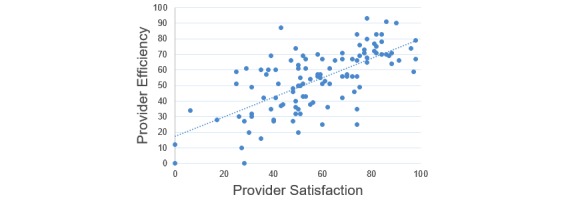
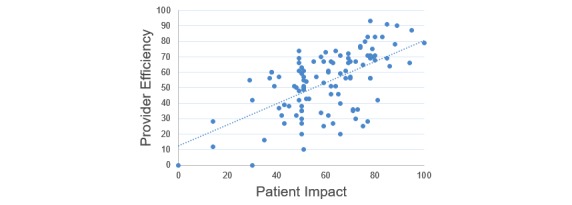
Results: Of 157 physicians, 111 (70.7%) completed the survey; 51.4% (57/111) of the respondents were attending physicians, and of those, 71.9% (41/57) reported a >50% clinical full-time-equivalency and half reported supervising residents >50% of the time. A total of 50.5% (56/111) of the respondents were primary care practitioners, previous EHR experience was evenly distributed, and 12.6% (14/111) of the total sample were EHR super-users. Responses to how our current EHR affects satisfaction were rated above the neutral survey anchor point (mean 58 [SD 22]), as were their perceptions as to how the EHR impacts the patient (mean 61 [SD 18]). In bivariate comparisons, only physician age, clinical role (resident, fellow, or attending), and perceived efficiency were associated with EHR satisfaction. In the linear regression models, physicians with higher reported perceived efficiency reported higher overall satisfaction and patient impact after controlling for other variables in the model.
Conclusions: Physician satisfaction with EHRs and their perception of its impact on clinical care were generally positive, but physician characteristics, greater age, and attending level were associated with worse EHR satisfaction. Perceived efficiency is the factor most associated with physician satisfaction with EHRs when controlling for other factors. Understanding physician perceptions of EHRs may allow targeting of technology resources to ensure efficiency and satisfaction with EHR system use during clinical care.
Keywords: efficiency; electronic health records; physician survey; user satisfaction.
©Daniel Clay Williams, Robert W Warren, Myla Ebeling, Annie L Andrews, Ronald J Teufel II. Originally published in JMIR Medical Informatics (http://medinform.jmir.org), 04.04.2019.
Conflict of interest statement
Conflicts of Interest: None declared.
Figures
References
-
- Silow-Carroll S, Edwards JN, Rodin D. Using electronic health records to improve quality and efficiency: the experiences of leading hospitals. Issue Brief (Commonw Fund) 2012 Jul;17:1–40. - PubMed
-
- Kazley AS, Simpson AN, Simpson KN, Teufel R. Association of electronic health records with cost savings in a national sample. Am J Manag Care. 2014 Jun 01;20(6):e183–e190. http://www.ajmc.com/pubMed.php?pii=85579 - PubMed
-
- Jamoom EW, Patel V, Furukawa MF, King J. EHR adopters vs. non-adopters: impacts of, barriers to, and federal initiatives for EHR adoption. Healthc (Amst) 2014 Mar;2(1):33–39. doi: 10.1016/j.hjdsi.2013.12.004. http://europepmc.org/abstract/MED/26250087 - DOI - PMC - PubMed
-
- Zlabek JA, Wickus JW, Mathiason MA. Early cost and safety benefits of an inpatient electronic health record. J Am Med Inform Assoc. 2011;18(2):169–172. doi: 10.1136/jamia.2010.007229. http://jamia.oxfordjournals.org/cgi/pmidlookup?view=long&pmid=21292703 - DOI - PMC - PubMed
LinkOut - more resources
Full Text Sources
