Potentially Avoidable Hospital Readmissions in Patients With Advanced Cancer
- PMID: 30946642
- PMCID: PMC7846058
- DOI: 10.1200/JOP.18.00595
Potentially Avoidable Hospital Readmissions in Patients With Advanced Cancer
Abstract
Purpose: Patients with cancer often prefer to avoid time in the hospital; however, data are lacking on the prevalence and predictors of potentially avoidable readmissions (PARs) among those with advanced cancer.
Methods: We enrolled patients with advanced cancer from September 2, 2014, to November 21, 2014, who had an unplanned hospitalization and assessed their patient-reported symptom burden (Edmonton Symptom Assessment System) at the time of admission. For 1 year after enrollment, we reviewed patients' health records to determine the primary reason for every hospital readmission and we classified readmissions as PARs using adapted Graham's criteria. We examined predictors of PARs using nonlinear mixed-effects models with binomial distribution.
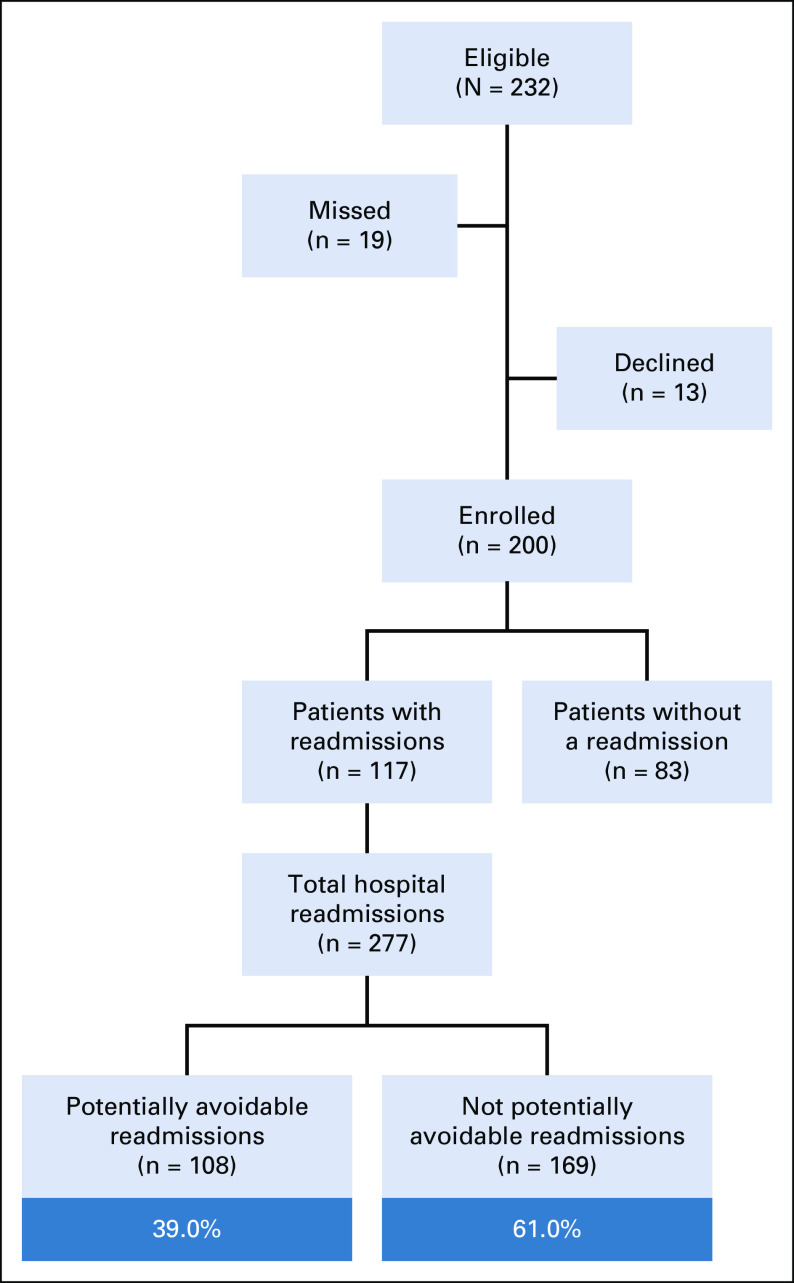
Results: We enrolled 200 (86.2%) of 232 patients who were approached. For these 200 patients, we reviewed 277 total hospital readmissions and identified 108 (39.0%) of these as PARs. The most common reasons for PARs were premature discharge from a prior hospitalization (30.6%) and failure of timely follow-up (28.7%). PAR hospitalizations were more likely than non-PAR hospitalizations to experience symptoms as the primary reason for admission (28.7% v 13.0%; P = .001). We found that married patients were less likely to experience PARs (odds ratio, 0.30; 95% CI, 0.15 to 0.57; P < .001) and that those with a higher physical symptom burden were more likely to experience PARs (odds ratio, 1.03; 95% CI, 1.01 to 1.05; P = .012).
Conclusion: We observed that a substantial proportion of hospital readmissions are potentially avoidable and found that patients' symptom burdens predict PARs. These findings underscore the need to assess and address the symptom burden of hospitalized patients with advanced cancer in this highly symptomatic population.
Conflict of interest statement
Potentially Avoidable Hospital Readmissions in Patients With Advanced Cancer
The following represents disclosure information provided by authors of this manuscript. All relationships are considered compensated. Relationships are self-held unless noted. I = Immediate Family Member, Inst = My Institution. Relationships may not relate to the subject matter of this manuscript. For more information about ASCO's conflict of interest policy, please refer to
Joseph A. Greer
Ephraim P. Hochberg
Jennifer S. Temel
No other potential conflicts of interest were reported.
References
-
- Tuggey EM, Lewin WH: A multidisciplinary approach in providing transitional care for patients with advanced cancer. Ann Palliat Med 3:139-1432014 - PubMed
-
- Walsh D, Donnelly S, Rybicki L: The symptoms of advanced cancer: Relationship to age, gender, and performance status in 1,000 patients. Support Care Cancer 8:175-1792000 - PubMed
-
- Higginson IJ, Costantini M: Dying with cancer, living well with advanced cancer. Eur J Cancer 44:1414-14242008 - PubMed
-
- Earle CC, Park ER, Lai B, et al. : Identifying potential indicators of the quality of end-of-life cancer care from administrative data. J Clin Oncol 21:1133-11382003 - PubMed
Publication types
MeSH terms
Grants and funding
LinkOut - more resources
Full Text Sources
Miscellaneous