Review
. 2019 Jun:7:135-137.
doi: 10.1016/j.pvr.2019.03.004. Epub 2019 Apr 1.

The endocytic trafficking pathway of oncogenic papillomaviruses

Affiliations
Review

The endocytic trafficking pathway of oncogenic papillomaviruses

Snježana Mikuličić et al. Papillomavirus Res. 2019 Jun.

Abstract

Over the last two decades many host cell proteins have been described to be involved in the process of infectious entry of oncogenic human papillomaviruses (HPV). After initial binding and priming of the capsid, a sequence of events on the cell surface precedes the formation of the HPV entry platform. It has been shown that the virus-associated entry complex consists of membrane organizers, tetraspanins CD151 and CD63, and their associated partner proteins such as integrins, growth factor receptors, and the annexin A2 heterotetramer. Further recruitment of cytoplasmic factors such as the obscurin-like protein 1 and actin results in a non-canonical clathrin-independent endocytosis of the virus. Internalized viruses are then routed to multivesicular bodies for capsid disassembly. This early trafficking again involves annexins, and tetraspanin proteins. In this review, we summarize the current knowledge about HPV16 endocytosis and the subsequent endosomal trafficking. Moreover, we propose a model on how tetraspanins and annexins organize the spatial accumulation of HPV16-associated molecules, the recruitment of cytoplasmic trafficking factors, and the L2 membrane penetration to trigger virus entry.

Keywords: Annexin; Endocytosis; Entry receptor complex; Tetraspanin; Trafficking; Virus.


Figures

Fig. 1
Fig. 1
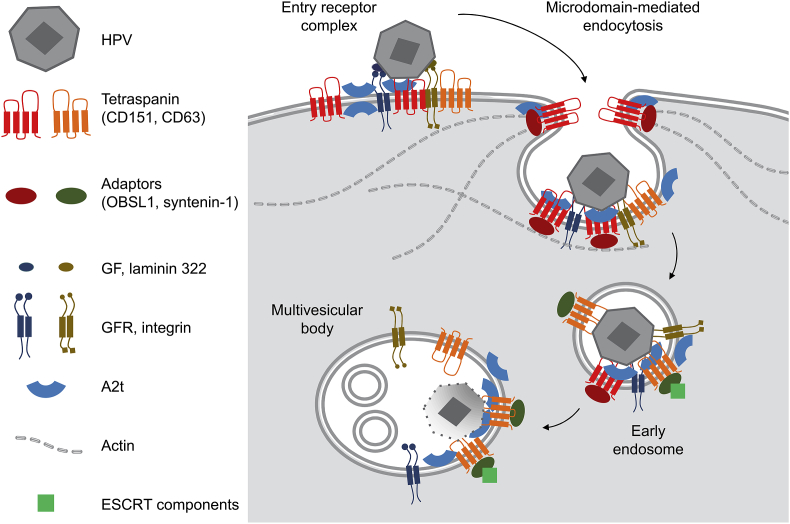
Schematic diagram of HPV16 endocytosis and trafficking to multivesicular bodies. After priming and activation of signaling cascades, the HPV16 capsid interacts with the entry receptor complex composed of growth factor receptors, laminin-binding integrins, tetraspanins and annexins. Upon HPV binding to this complex, a non-canonical and clathrin independent endocytic process is initiated, which involves actin, the cytoskeletal adaptor protein OBSL1, the annexin A2 heterotetramer and tetraspanin CD151. Internalized viruses are then routed to acidified multivesicular bodies. This early trafficking again involves annexins, and a complex of tetraspanin CD63, syntenin-1 and ESCRT components. Therefore, tetraspanins and annexins might organize the spatial accumulation of HPV16-associated molecules and recruitment of cytoplasmic trafficking factors until capsid disassembly and L2 membrane insertion/penetration ensures virus interaction with cytoplasmic partner proteins and subsequent trafficking towards and into the nucleus.

References

    1. Evander M., Frazer I.H., Payne E., Qi Y.M., Hengst K., McMillan N.A. vol 71. 1997. pp. 2449–2456. (Identification of the Alpha6 Integrin as a Candidate Receptor for Papillomaviruses). - PMC - PubMed
    1. Scheffer K.D., Gawlitza A., Spoden G.A., Zhang X.A., Lambert C., Berditchevski F. vol 87. 2013. pp. 3435–3446. (Tetraspanin CD151 Mediates Papillomavirus Type 16 Endocytosis). - PMC - PubMed
    1. Surviladze Z., Dziduszko A., Ozbun M.A. Essential roles for soluble virion-associated heparan sulfonated proteoglycans and growth factors in human papillomavirus infections. PLoS Pathog. 2012;8 Imperiale M, editor. - PMC - PubMed
    1. Dziduszko A., Ozbun M.A. vol 87. 2013. pp. 7502–7515. (Annexin A2 and S100A10 Regulate Human Papillomavirus Type 16 Entry and Intracellular Trafficking in Human Keratinocytes). - PMC - PubMed
    1. Woodham A.W., Da Silva D.M., Skeate J.G., Raff A.B., Ambroso M.R., Brand H.E. The S100A10 subunit of the annexin A2 heterotetramer facilitates L2-mediated human papillomavirus infection. PLoS One. 2012;7 - PMC - PubMed

Publication types