Meta-Analysis
. 2019 Apr 4;10(1):1534.
doi: 10.1038/s41467-019-09462-w.

Meta-analysis of genome-wide association studies provides insights into genetic control of tomato flavor

Affiliations
Meta-Analysis

Meta-analysis of genome-wide association studies provides insights into genetic control of tomato flavor

Jiantao Zhao et al. Nat Commun. .

Abstract

Tomato flavor has changed over the course of long-term domestication and intensive breeding. To understand the genetic control of flavor, we report the meta-analysis of genome-wide association studies (GWAS) using 775 tomato accessions and 2,316,117 SNPs from three GWAS panels. We discover 305 significant associations for the contents of sugars, acids, amino acids, and flavor-related volatiles. We demonstrate that fruit citrate and malate contents have been impacted by selection during domestication and improvement, while sugar content has undergone less stringent selection. We suggest that it may be possible to significantly increase volatiles that positively contribute to consumer preferences while reducing unpleasant volatiles, by selection of the relevant allele combinations. Our results provide genetic insights into the influence of human selection on tomato flavor and demonstrate the benefits obtained from meta-analysis.


Conflict of interest statement

The authors declare no competing interests.

Figures
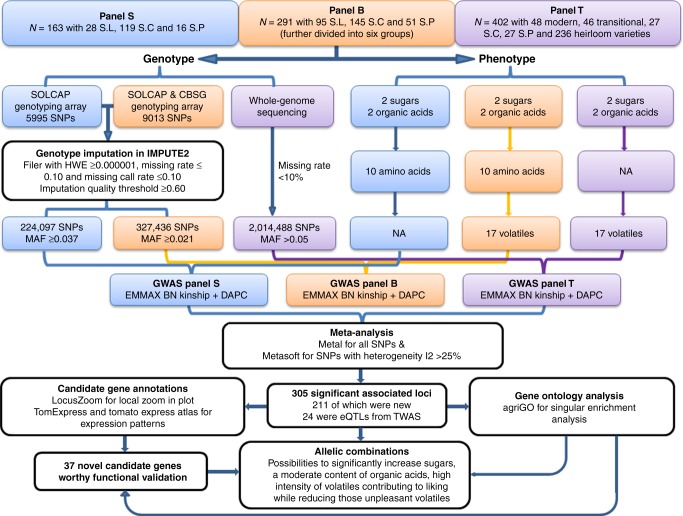
Fig. 1
Fig. 1
Overview of study design. N, the number of individuals; S.L, S. lycopersicum; S.C, S. lycopersicum var cerasiforme; S.P, S. pimpinellifolium; Genotyping arrays: SOLCAP, Solanaceae Coordinated Agricultural Project; CBSG, Centre of Biosystems Genomics consortium; HWE, Hardy–Weinberg equilibrium; MAF, minor allele frequency; GWAS, genome-wide association study; EMMAX, Efficient Mixed-Model Association eXpedited; DAPC, Discriminant Analysis of Principal Components; eQTL, expression quantitative trait locus; TWAS, transcriptome-wide association study
Fig. 2
Fig. 2
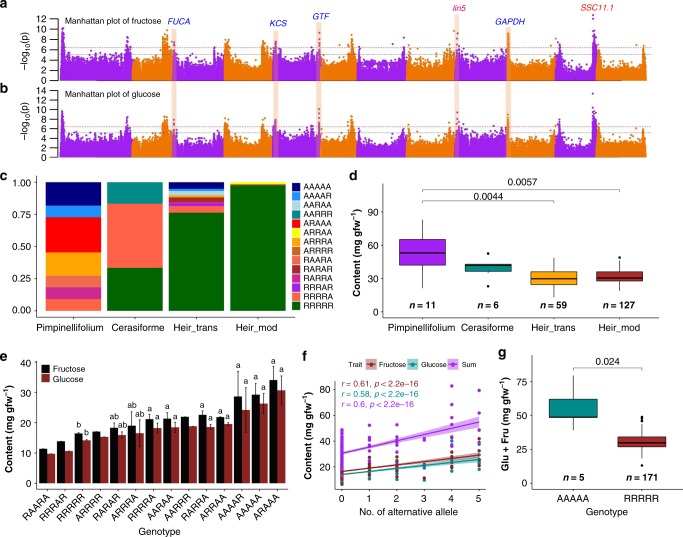
Combinations of fructose and glucose alleles for the improvement of tomato sugar content. Only alleles that were significantly associated both with fructose and glucose were analyzed. a, b Manhattan plot for meta-analysis of genome-wide association analysis of fructose (a) and glucose (b) content. Candidates and previously identified genes were labeled in blue and red, respectively. FUCA, alpha-L-fucosidase 1; KCS, fatty acid elongase 3-ketoacyl-CoA synthase; GTF, glucosyltransferase; GADPH, glyceraldehyde-3-phosphate dehydrogenase. c Allele distribution of fructose/glucose content at positions: chr3:1,506,106, chr5:3,403,706, chr5:63,485,334, chr9:3,477,979, and chr10:422,707 that were both significantly associated with fructose and glucose in S. lycopersicum var cerasiforme (cerasiforme), heirloom + transitional (heir_trans), heir + modern (heir_mod), and the closest wild species S. pimpinellifolium (pimpinellifolium) tomato accessions (see detailed information about groups in online methods). d Comparison of sugar content (fructose + glucose) between different tomato types in cerasiforme, heir_trans, heir_mod, and pimpinellifolium tomato accessions. e Mean (±SE) content of fructose (black) and glucose (brown) at different allele combinations in cerasiforme, heir_trans, heir_mod, and pimpinellifolium tomato accessions. Significant t-test P values are also provided. f Correlation between the number of alternative alleles and sugar content. Fructose, glucose, and the sum of fructose + glucose were colored in brown4, cyan4, and purple. g Comparison of sugar content (fructose + glucose) between all alternative and reference allele combinations at position chr3: 1,506,106, chr5: 3,403,706, chr5: 63,485,334, chr9: 3,477,979, and chr10: 422,707. Center line and limits of box were the mean and interquartile ranges. Error bars represent the maximum and minimum values. Whiskers indicate variability outside the upper and lower quartiles. Significant t-test P values are also provided. Source data of Fig. 2c–g are provided in a Source Data file
Fig. 3
Fig. 3
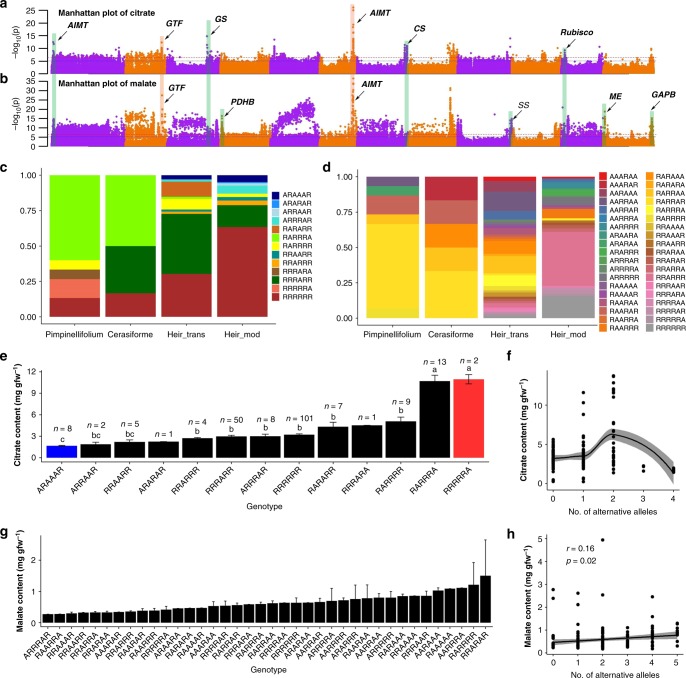
Combinations of citrate and malate alleles for the improvement of tomato organic acid content. a, b Manhattan plot for meta-analysis of genome-wide association analysis of citrate (a) and malate (b) content. AIMT, Aluminum-activated malate transporter; GTF, Glycosyl transferase group 1; GS, Glycogen synthase; AIMT, Aluminum-activated malate transporter; CS, Citrate synthase; Rubisco, Ribulose-1 5-bisphosphate carboxylase/oxygenase activase 1; PDHB, Pyruvate dehydrogenase E1 component subunit beta; SS, Sucrose synthase; ME, Malic enzyme; GAPB, Glyceraldehyde-3-phosphate dehydrogenase B. c Allele distribution of citrate content at positions: chr1:1749084, chr2: 47,904,426, chr3: 52,998,165, chr6: 44,955,568, chr7: 63,601,724, and chr10: 65,378,714 in cerasiforme, heir_trans, heir_mod, and pimpinellifolium tomato accessions. d Allele distribution of malate content at positions: chr2: 48,509,791, chr4: 2,156,747, chr6: 44,999,916, chr9: 72,364,359, chr12: 1,824,226, and chr12: 64,816,056 in cerasiforme, heir_trans, heir_mod, and pimpinellifolium tomato accessions. e Mean (±SE, standard error) content of citrate content at different allele combinations in cerasiforme, heir_trans, heir_mod, and pimpinellifolium tomato accessions. f Correlation between the number of alternative alleles and citrate content. g Mean (±SE) content of malate content at different allele combinations in cerasiforme, heir_trans, heir_mod, and pimpinellifolium tomato accessions. h Correlations between the number of alternative alleles and malate content. Source data of Fig. 3c–h are provided in a Source Data file
Fig. 4
Fig. 4
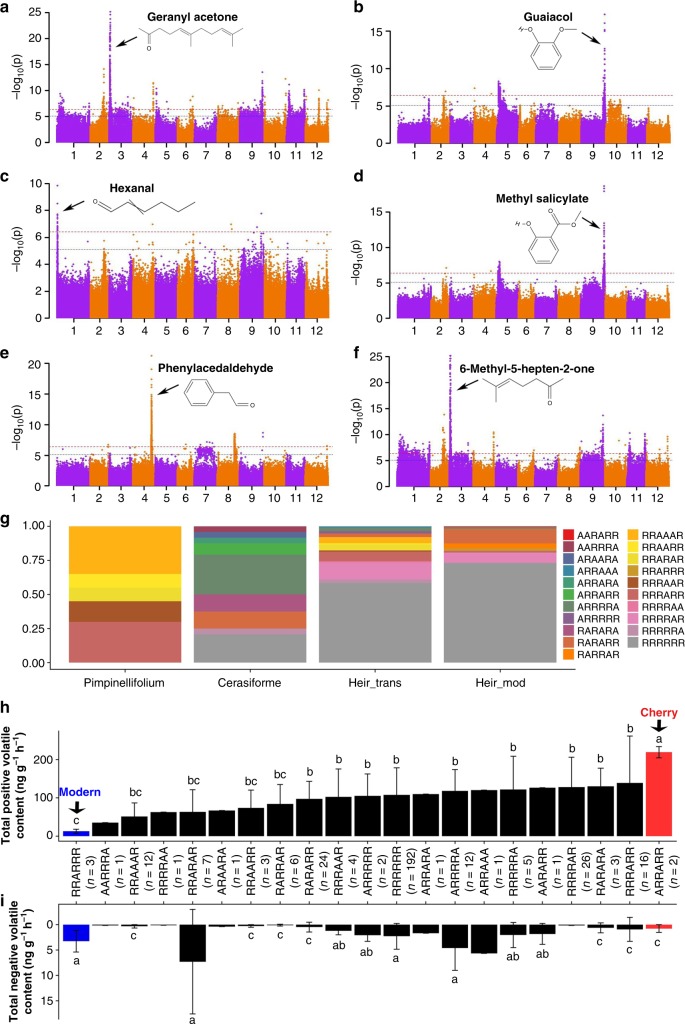
Combinations of six volatile alleles for the improvement of tomato volatile content. af Manhattan plot for meta-analysis of genome-wide association analysis of geranyl acetone (a), guaiacol (b), hexanal (c), methyl salicylate (d), phenylacetaldehyde (e), and 6-methyl-5-hepten-2-one (f) content. g Allele distribution of six volatiles content at positions: chr3: 4,328,514 (geranyl acetone), chr9: 69,299,940 (guaiacol), chr1: 1,083,181 (hexanal), chr9: 69,293,875 (methyl salicylate), chr4: 55,635,636 (phenylacetaldehyde), and chr3: 3,212,583 (6-methyl-5-hepten-2-one) in cerasiforme, heir_trans, heir_mod, and pimpinellifolium tomato accessions. h, i Mean (±SE, standard error) content of total content of the four positive volatiles (geranyl acetone, hexanal, phenylacetaldehyde and 6-methyl-5-hepten-2-one) (h) and two unpleasant volatiles (lower panel, guaiacol and methyl salicylate) (i) at different allele combinations in cerasiforme, heir_trans, heir_mod and pimpinellifolium tomato accessions. Source data of Fig. 4g–i are provided in a Source Data file

References

    1. Klee HJ, Tieman DM. The genetics of fruit flavour preferences. Nat. Rev. Genet. 2018;19,:347–356. doi: 10.1038/s41576-018-0002-5. - DOI - PubMed
    1. Tieman D, et al. The chemical interactions underlying tomato flavor preferences. Curr. Biol. 2012;22:1035–1039. doi: 10.1016/j.cub.2012.04.016. - DOI - PubMed
    1. Causse M, et al. Consumer preferences for fresh tomato at the European scale: a common segmentation on taste and firmness. J. Food Sci. 2010;75:S531–S541. doi: 10.1111/j.1750-3841.2010.01841.x. - DOI - PubMed
    1. Baldwin EA, Scott JW, Shewmaker CK, Schuch W. Flavor trivia and tomato aroma: biochemistry and possible mechanisms for control of important aroma components. HortScience. 2000;35:1013–1022. doi: 10.21273/HORTSCI.35.6.1013. - DOI
    1. Goff SA, Klee HJ. Plant volatile compounds: sensory cues for health and nutritional value? Science. 2006;311:815–819. doi: 10.1126/science.1112614. - DOI - PubMed

Publication types