


Combined Tumor Sequencing and Case-Control Analyses of RAD51C in Breast Cancer
- PMID: 30949688
- PMCID: PMC6910168
- DOI: 10.1093/jnci/djz045
Combined Tumor Sequencing and Case-Control Analyses of RAD51C in Breast Cancer
Abstract
Background: Loss-of-function variants in RAD51C are associated with familial ovarian cancer, but its role in hereditary breast cancer remains unclear. The aim of this study was to couple breast tumor sequencing with case-control data to clarify the contribution of RAD51C to hereditary breast cancer.
Methods: RAD51C was sequenced in 3080 breast cancer index cases that were negative in BRCA1/2 clinical tests and 4840 population-matched cancer-free controls. Pedigree and pathology data were analyzed. Nine breast cancers and one ovarian cancer from RAD51C variant carriers were sequenced to identify biallelic inactivation of RAD51C, copy number variation, mutational signatures, and the spectrum of somatic mutations in breast cancer driver genes. The promoter of RAD51C was analyzed for DNA methylation.
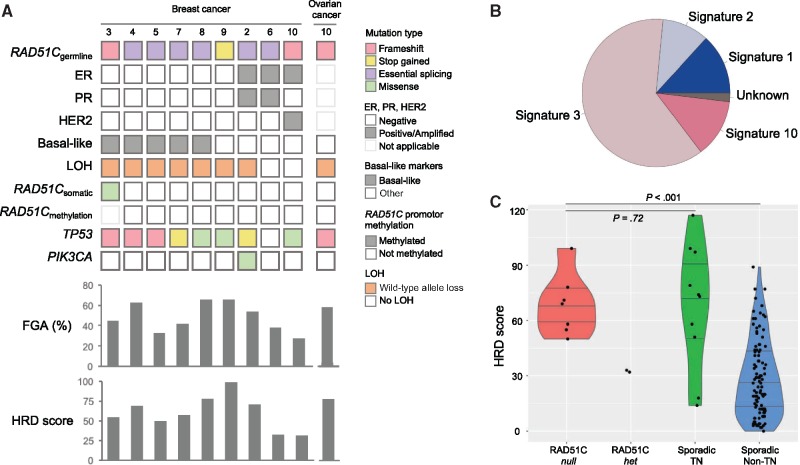
Results: A statistically significant excess of loss-of-function variants was identified in 3080 cases (0.4%) compared with 2 among 4840 controls (0.04%; odds ratio = 8.67, 95% confidence interval = 1.89 to 80.52, P< .001), with more than half of the carriers having no personal or family history of ovarian cancer. In addition, the association was highly statistically significant among cases with estrogen-negative (P <. 001) or triple-negative cancer (P < .001), but not in estrogen-positive cases. Tumor sequencing from carriers confirmed bi-allelic inactivation in all the triple-negative cases and was associated with high homologous recombination deficiency scores and mutational signature 3 indicating homologous recombination repair deficiency.
Conclusions: This study provides evidence that germline loss-of-function variants of RAD51C are associated with hereditary breast cancer, particularly triple-negative type. RAD51C-null breast cancers possess similar genomic and clinical features to BRCA1-null cancers and may also be vulnerable to DNA double-strand break inducing chemotherapies and poly ADP-ribose polymerase inhibitors.
© The Author(s) 2019. Published by Oxford University Press. All rights reserved. For permissions, please email: journals.permissions@oup.com.
Figures
References
-
- Vaz F, Hanenberg H, Schuster B, et al. Mutation of the RAD51C gene in a Fanconi anemia-like disorder. Nat Gen. 2010;42(5):406–409. - PubMed
-
- Meindl A, Hellebrand H, Wiek C, et al. Germline mutations in breast and ovarian cancer pedigrees establish RAD51C as a human cancer susceptibility gene. Nat Genet. 2010;42(5):410–414. - PubMed
-
- Blanco A, Gutierrez ES, Santamarina M, et al. RAD51C germline mutations found in Spanish site-specific breast cancer and breast-ovarian cancer families. Breast Cancer Res Treat. 2014;147(1):133–143. - PubMed
-
- Loveday C, Turnbull C, Ruark E, et al. Germline RAD51C mutations confer susceptibility to ovarian cancer. Nat Genet. 2012;44(5):475–476; author reply 476. - PubMed
-
- Thompson ER, Boyle SE, Johnson J, et al. Analysis of RAD51C germline mutations in high-risk breast and ovarian cancer families and ovarian cancer patients. Hum Mutat. 2012;33(1):95–99. - PubMed
Publication types
MeSH terms
Substances
Supplementary concepts
LinkOut - more resources
Full Text Sources
Medical
Research Materials
Miscellaneous
