. 2019 Jun 28;70(12):3313-3328.
doi: 10.1093/jxb/erz146.

Aethionema arabicum: a novel model plant to study the light control of seed germination

Affiliations

Aethionema arabicum: a novel model plant to study the light control of seed germination

Zsuzsanna Mérai et al. J Exp Bot. .

Abstract

The timing of seed germination is crucial for seed plants and is coordinated by internal and external cues, reflecting adaptations to different habitats. Physiological and molecular studies with lettuce and Arabidopsis thaliana have documented a strict requirement for light to initiate germination and identified many receptors, signaling cascades, and hormonal control elements. In contrast, seed germination in several other plants is inhibited by light, but the molecular basis of this alternative response is unknown. We describe Aethionema arabicum (Brassicaceae) as a suitable model plant to investigate the mechanism of germination inhibition by light, as this species has accessions with natural variation between light-sensitive and light-neutral responses. Inhibition of germination occurs in red, blue, or far-red light and increases with light intensity and duration. Gibberellins and abscisic acid are involved in the control of germination, as in Arabidopsis, but transcriptome comparisons of light- and dark-exposed A. arabicum seeds revealed that, upon light exposure, the expression of genes for key regulators undergo converse changes, resulting in antipodal hormone regulation. These findings illustrate that similar modular components of a pathway in light-inhibited, light-neutral, and light-requiring germination among the Brassicaceae have been assembled in the course of evolution to produce divergent pathways, likely as adaptive traits.

Keywords: Aethionema arabicum; light inhibition; model plant; natural variation; seed germination; transcriptional regulation.


Figures

Fig. 1.
Fig. 1.
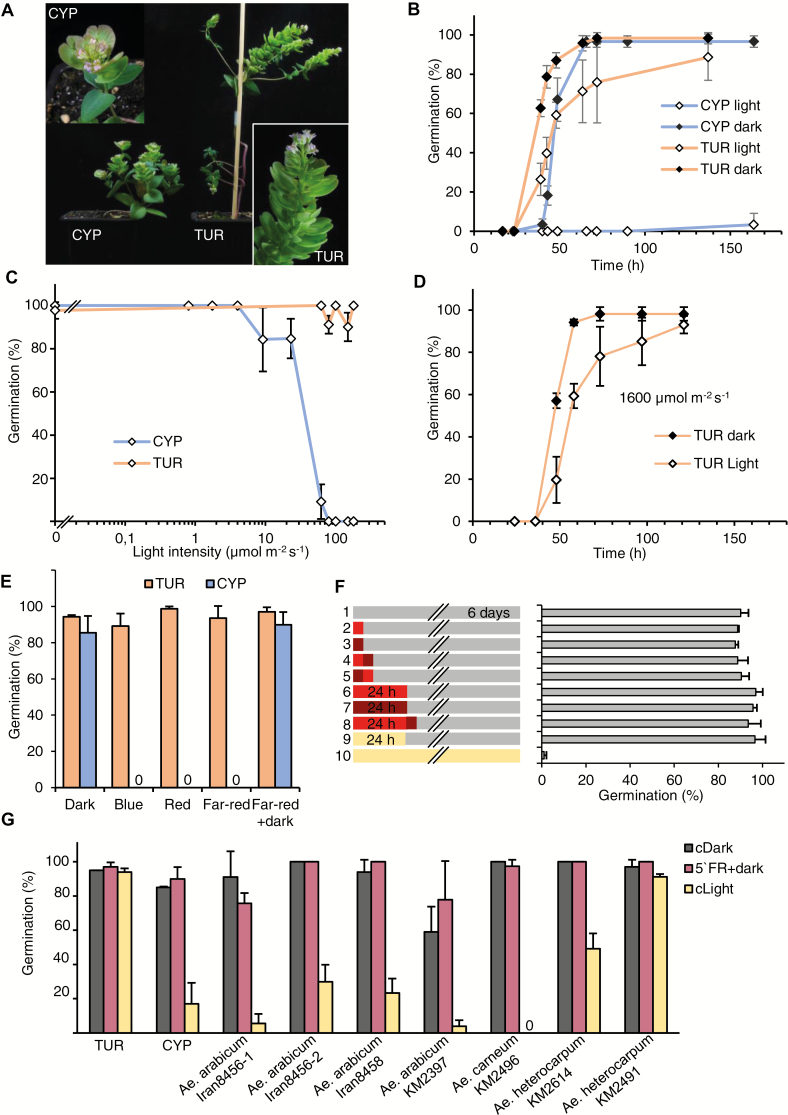
Light inhibition of seed germination in Aethionema arabicum accession CYP. (A) Eight-week-old A. arabicum TUR (Turkey) and CYP (Cyprus) plants grown in a growth chamber. (B) Percentage of germinating seeds kept in darkness or under 100 μmol m−2 s−1 white light, scored over time. (C) Percentage of germinating seeds kept at various light intensities: (0.8, 1.74, 4, 9.2,23, 62, 80, 100, 150 and 180 μmol m−2 s−1 white light) or in darkness (indicated as 0 μmol m−2 s−1), scored after 6 d. (D) Percentage of germinating TUR seeds kept in darkness or under 1600 μmol m−2 s−1 white light, scored over time. (E) Percentage of germinating seeds in continuous white, red, blue, or far-red light, dark, or exposed to 5 min far-red light followed by darkness, scored after 6 d. (F) Percentage of germinating CYP seeds after various light treatments. The left panel indicates the treatment; the right panel indicates the percentage of germinating seeds, scored after 6 d. Red, dark red, and cream rectangles indicate red, far-red, and white light exposure, respectively. Grey bars indicate dark periods. Short and long red/far-red rectangles indicate 5 min and 24 h exposure, respectively. (G) Percentage of germinating seeds from different A. arabicum accessions and closely related species, kept in the dark (black columns), light (yellow columns), or in the dark after a 5 min far-red pulse at imbibition (red columns), scored after 6 d. Error bars represent SD (three independent replicates).
Fig. 2.
Fig. 2.
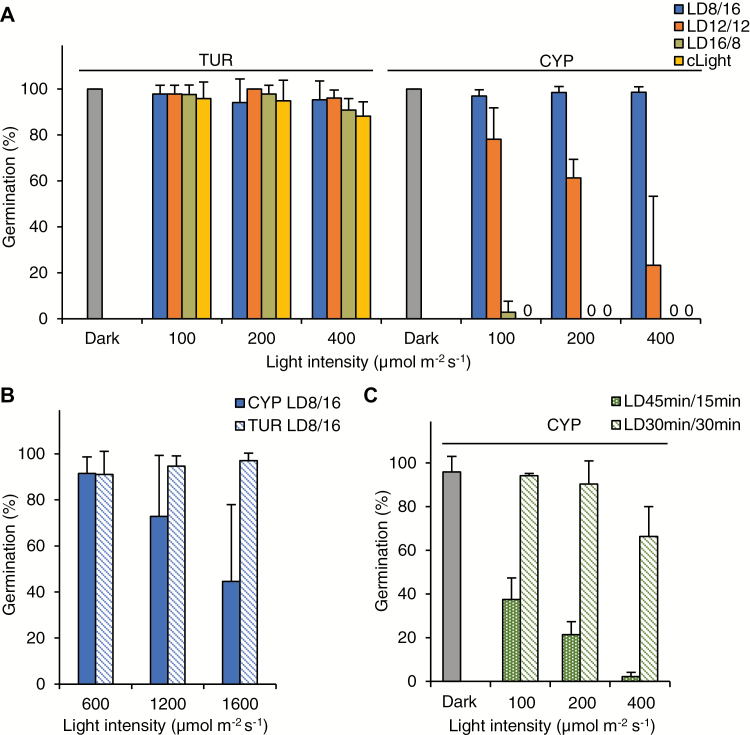
Diurnal regulation of CYP seed germination. (A) Percentage of germinating CYP and TUR seeds kept under different diurnal regimes, scored after 6 d. LD8/16, 8 h light/16 h dark; LD12/12, 12 h light/12 h dark, LD16/8, 16 h light/8 h dark. In addition, seeds were kept under continuous dark (Dark) or light (cLight). (B) Percentage of germinating CYP and TUR seeds kept under different light intensities with a LD8/16 regime. 0 indicates no germination. (C) Percentage of germinating CYP seeds under continuously repeated 30 min light/30 min dark cycles (LD30min/30min) or 45 min light and 15 min dark cycles (LD45min/45min), scored after 6 d. Error bars represent SD (three independent replicates).
Fig. 3.
Fig. 3.
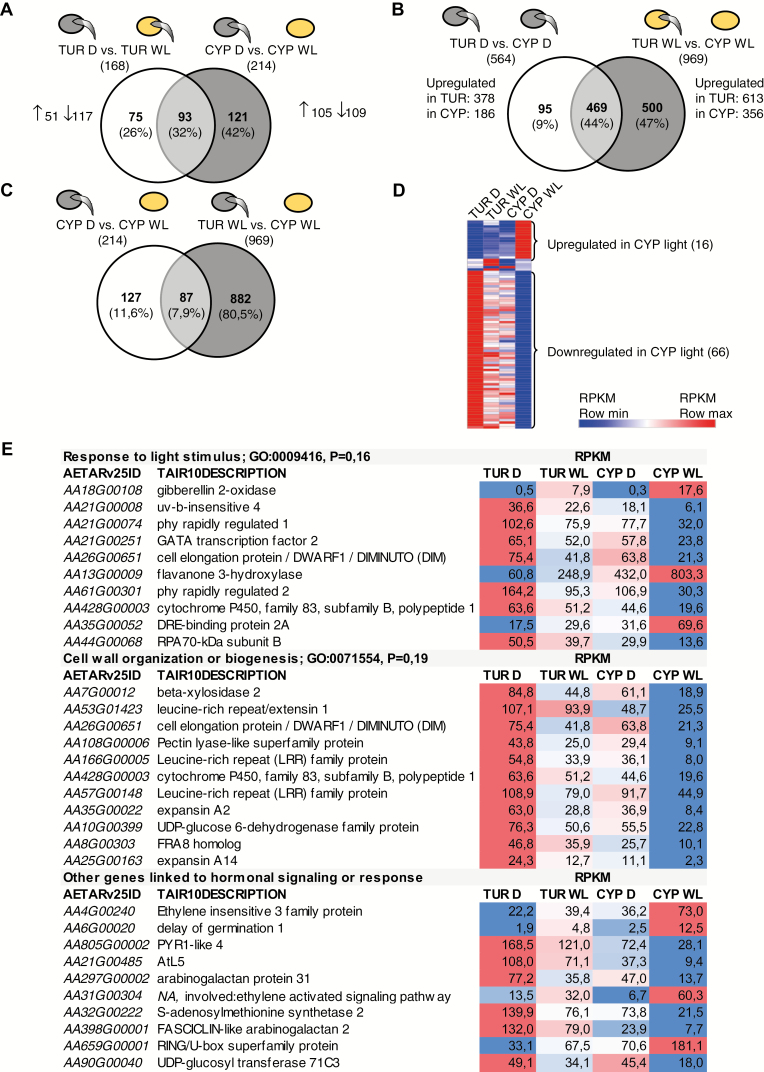
Transcriptome analysis of Aethionema TUR and CYP seeds by RNA-Seq. (A–C) Number of differentially expressed genes and Venn diagrams showing the proportion of overlapping genes in pairwise comparisons between TUR and CYP, and between exposure to darkness (D, grey seed icon), or white light (WL, yellow icon). Icons showing germinating seeds indicate the capability of samples for germination; note that the seeds had not yet germinated at the point of sampling. (D) Heatmap indicating the relative expression of the overlapping 87 genes in the four treatments. Coloring is based on reads per kilobase of transcript per million mapped reads (RPKM) values. A detailed list is provided in Supplementary Fig. S1. (E) Gene list of three selected GO terms with average RPKM values and relative expression differences, indicated by shades of blue (lowest RPKM value) or red (highest RPKM value).
Fig. 4.
Fig. 4.
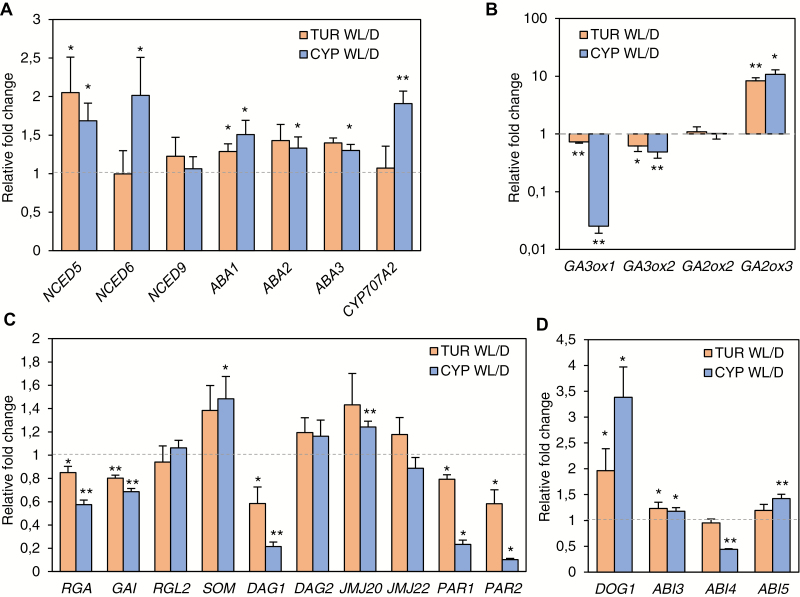
Analysis of the Aethionema light-regulated transcriptome network in the TUR and CYP accessions. (A–D) Quantitative RT–PCR for selected genes. The expression level under white light (WL) is presented as fold change relative to the average expression level in darkness (D), which is set to a value of 1 (indicated by the grey dashed line). Asterisks indicate significant differences between the WL and D expression level of a gene, based on the Welch test: *P<0.05, **P<0.01. Error bars represent SD (three independent biological replicates).
Fig. 5.
Fig. 5.
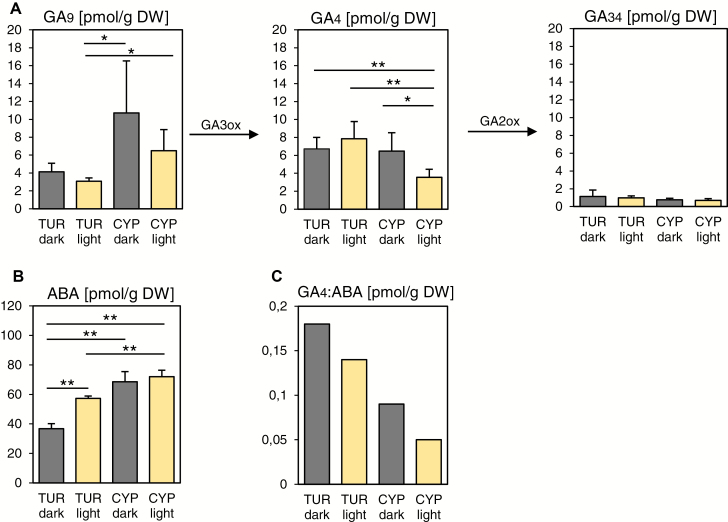
Decreased GA:ABA hormone ratio in light-exposed Aethionema CYP seeds. Hormone concentrations [in pmol g–1 dry weight (DW)] of GA9 precursor, bioactive GA4, and GA34 catabolite (A) and ABA (B) are shown for dark-exposed (grey columns) and light-exposed (cream columns) TUR and CYP seeds. (C) Ratio of the averages from GA4 and ABA measurements. Significance was tested using the Welch test in pairwise comparisons; asterisks indicate significant differences: *P<0.05, **<0.01. Error bars represent SD (five independent replicates). Values for other GA metabolites are presented in Supplementary Fig. S4.
Fig. 6.
Fig. 6.
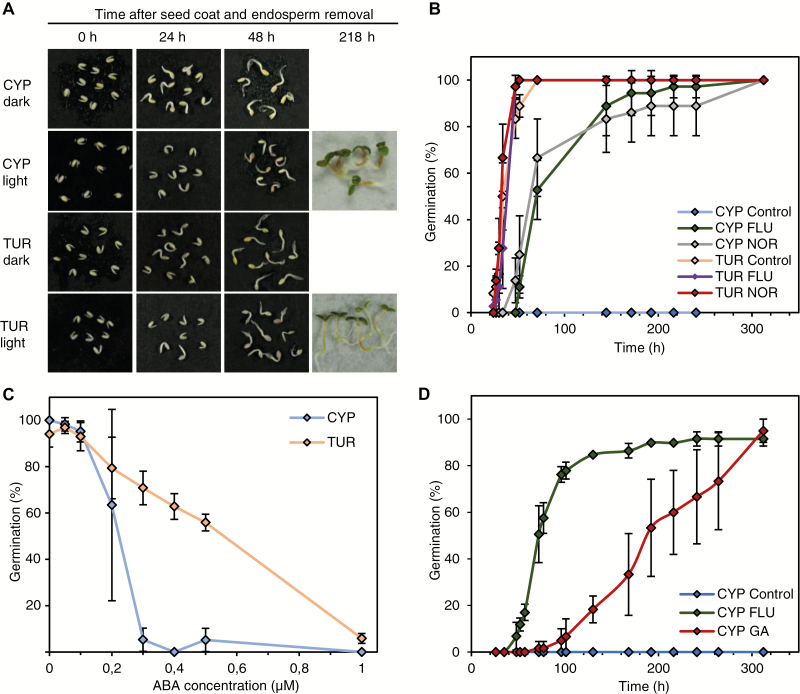
Rescue of CYP seed germination in light by interference with ABA and GA signaling. (A) Development of CYP and TUR seedlings in darkness or 100 µmol m−2 s−1 light after removal of the ABA-producing seed coat and endosperm. 0 h represents the status directly after seedling isolation. (B) Percentage of germination over time when seeds were kept on plates supplemented with the ABA inhibitors 10 µM fluridone (FLU) or 10 µM norflurazon (NOR), or 0.01% DMSO as a control, under continuous 100 µmol m−2 s−1 light. (C) Percentage of germination scored after 6 days for seeds kept in the dark on plates with external application of ABA at concentrations of 0.05, 0.1, 0.2, 0.3, 0.4, 0.5, or 1 μM, or 0.01% DMSO as a control. (D) Percentage of germination over time for seeds kept under continuous 100 µmol m−2 s−1 light on plates with external application of 10 µM GA4 + 7 (GA) or 0.01% DMSO as a control. Error bars represent SD (three independent replicates).
Fig. 7.
Fig. 7.
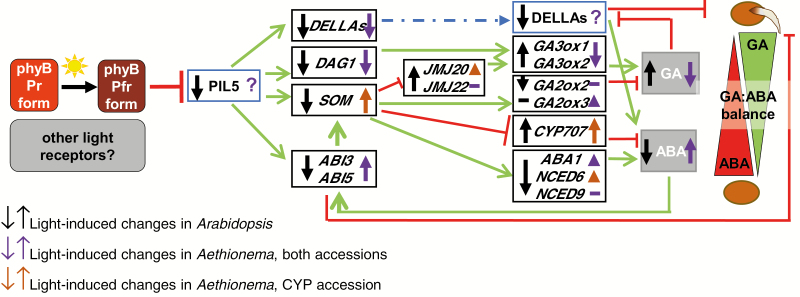
Antipodal transcriptional changes in Arabidopsis and Aethionema of key hormone regulatory genes. Summary of light-regulated changes in transcript levels in seeds, based on published data for Arabidopsis (after Stawska and Oracz 2015) and with the data for Aethionema presented in this study. Blue boxes indicate proteins whose stability is regulated by light. Black boxes indicate genes whose expression is light-regulated. Changes in expression upon light exposure are indicated by black (Arabidopsis), purple (Aethionema, both accessions), and orange (Aethionema, CYP accession only) arrows. The role of other photoreceptors in Aethionema seed germination is not yet known. As indicated by question marks, the stability of PIL5 and DELLA proteins is unknown in Aethionema.

References

    1. Altschul SF, Gish W, Miller W, Myers EW, Lipman DJ. 1990. Basic local alignment search tool. Journal of Molecular Biology 215, 403–410. - PubMed
    1. Anders S, Pyl PT, Huber W. 2015. HTSeq—a Python framework to work with high-throughput sequencing data. Bioinformatics 31, 166–169. - PMC - PubMed
    1. Argyris J, Dahal P, Hayashi E, Still DW, Bradford KJ. 2008. Genetic variation for lettuce seed thermoinhibition is associated with temperature-sensitive expression of abscisic acid, gibberellin, and ethylene biosynthesis, metabolism, and response genes. Plant Physiology 148, 926–947. - PMC - PubMed
    1. Barrero JM, Downie AB, Xu Q, Gubler F. 2014. A role for barley CRYPTOCHROME1 in light regulation of grain dormancy and germination. The Plant Cell 26, 1094–1104. - PMC - PubMed
    1. Barrero JM, Jacobsen JV, Talbot MJ, White RG, Swain SM, Garvin DF, Gubler F. 2012. Grain dormancy and light quality effects on germination in the model grass Brachypodium distachyon. New Phytologist 193, 376–386. - PubMed

Publication types