Using Peer Support in Developing Empowering Mental Health Services (UPSIDES): Background, Rationale and Methodology
- PMID: 30951270
- PMCID: PMC6634474
- DOI: 10.5334/aogh.2435
Using Peer Support in Developing Empowering Mental Health Services (UPSIDES): Background, Rationale and Methodology
Abstract
Background: Peers are people with lived experience of mental illness. Peer support is an established intervention in which peers offer support to others with mental illness. A large proportion of people living with severe mental illness receive no care. The care gap is largest in low- and middle-income countries, with detrimental effects on individuals and societies. The global shortage of human resources for mental health is an important driver of the care gap. Peers are an under-used resource in global mental health.
Objectives: To describe rationale and methodology of an international multicentre study which will scale-up peer support for people with severe mental illness in high-, middle-, and low-income countries through mixed-methods implementation research.
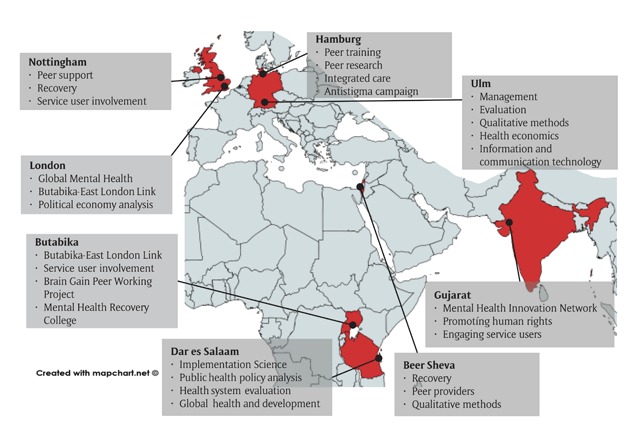
Methods: UPSIDES is an international community of research and practice for peer support, including peer support workers, mental health researchers, and other relevant stakeholders in eight study sites across six countries in Europe, Africa, and Asia. During the first two years of UPSIDES, a series of qualitative studies and systematic reviews will explore stakeholders' perceptions and the current state of peer support at each site. Findings will be incorporated into a conceptual framework to guide the development of a culturally appropriate peer support intervention to be piloted across all study sites. All intervention and study materials will be translated according to internationally recognised guidelines.Expected Impact: UPSIDES: will leverage the unique expertise of people with lived experience of mental illness to strengthen mental health systems in high-, middle- and low-income countries. UPSIDES will actively involve and empower service users and embed patient-centeredness, recovery orientation, human rights approaches, and community participation into services. The focus on capacity-building of peers may prove particularly valuable in low-resource settings in which shortages of human capital are most severe.
© 2019 The Author(s). This is an open-access article distributed under the terms of the Creative Commons Attribution 4.0 International License (CC-BY 4.0), which permits unrestricted use, distribution, and reproduction in any medium, provided the original author and source are credited. See http://creativecommons.org/licenses/by/4.0/.
Conflict of interest statement
The authors have no competing interests to declare.
Figures
References
-
- Fuhr DC, Salisbury TT, de Silva MJ, et al. Effectiveness of peer-delivered interventions for severe mental illness and depression on clinical and psychosocial outcomes: A systematic review and meta-analysis. Soc Psychiatr Psychiatr Epidemiol. 2014; 49: 1691–1702. DOI: 10.1007/s00127-014-0857-5 - DOI - PMC - PubMed
-
- Repper J and Perkins R. Social Inclusion and Recovery: A Model for Mental Health Practice Kent: Baillière Tindall; 2003.
-
- Shepherd G, Boardman J and Slade M. Making Recovery a Reality London: Sainsbury Centre for Mental Health; 2008.
Publication types
MeSH terms
LinkOut - more resources
Full Text Sources
Medical
Miscellaneous