Review
. 2019 Sep 12;62(17):7618-7642.
doi: 10.1021/acs.jmedchem.9b00370. Epub 2019 Apr 18.

Recent Progress in Natural-Product-Inspired Programs Aimed To Address Antibiotic Resistance and Tolerance

Affiliations
Review

Recent Progress in Natural-Product-Inspired Programs Aimed To Address Antibiotic Resistance and Tolerance

Yasmeen Abouelhassan et al. J Med Chem. .

Abstract

Bacteria utilize multiple mechanisms that enable them to gain or acquire resistance to antibiotic therapies during the treatment of infections. In addition, bacteria form biofilms which are surface-attached communities of enriched populations containing persister cells encased within a protective extracellular matrix of biomolecules, leading to chronic and recurring antibiotic-tolerant infections. Antibiotic resistance and tolerance are major global problems that require innovative therapeutic strategies to address the challenges associated with pathogenic bacteria. Historically, natural products have played a critical role in bringing new therapies to the clinic to treat life-threatening bacterial infections. This Perspective provides an overview of antibiotic resistance and tolerance and highlights recent advances (chemistry, biology, drug discovery, and development) from various research programs involved in the discovery of new antibacterial agents inspired by a diverse series of natural product antibiotics.


Conflict of interest statement

The authors declare no competing financial interest.

Figures

Figure 1
Figure 1
Antibacterial targets of conventional antibiotics and mechanisms by which bacteria develop resistance to these therapeutic agents.
Figure 2
Figure 2
Presentation of the distinctions between acquired antibiotic resistance and innate antibiotic tolerance.
Figure 3
Figure 3
Strategies to address the problems associated with antibiotic resistance and tolerance presented in this Perspective.
Figure 4
Figure 4
iChip (multichannel device) technology developed by Lewis and co-workers to culture previously “unculturable” bacteria, which led to the discovery of the new antibiotic teixobactin 1.
Figure 5
Figure 5
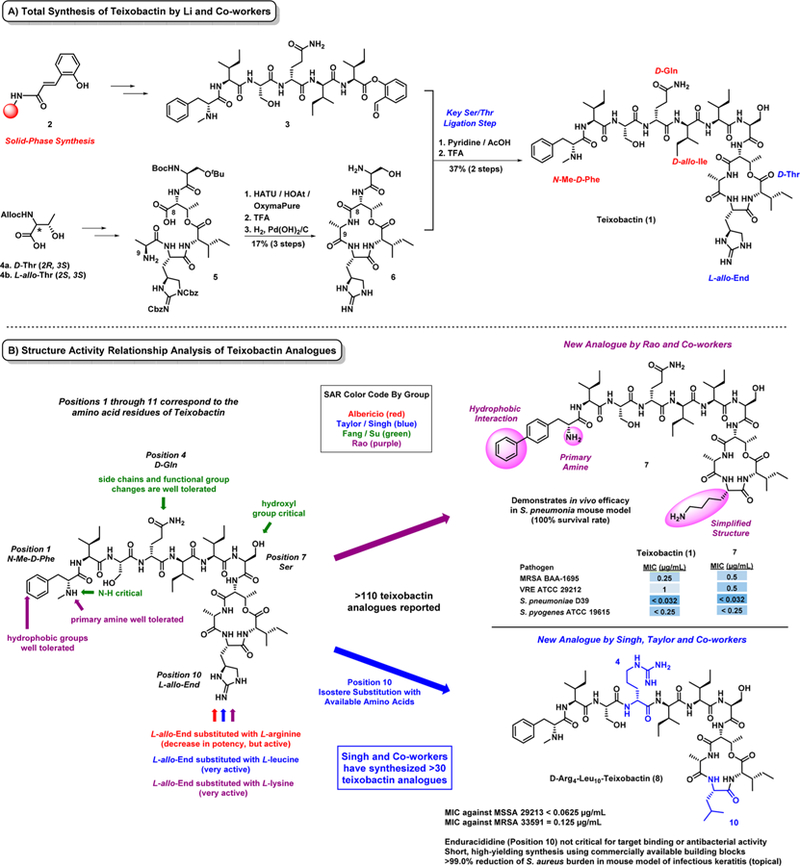
(A) Total synthesis of the new antibiotic teixobactin 1 and (B) structure–activity relationship (SAR) insights.
Figure 6
Figure 6
eNTRy rules defined by Hergenrother and co-workers that enabled the successful conversion of the Gram-positive antibacterial agent 6DNM 10 into 6DNM-NH3 11, a new broad-spectrum antibacterial agent.
Figure 7
Figure 7
(A) Myers’ retrosynthetic analysis of tetracycline. (B) Key Michael–Claisen annulation step for fully synthetic tetracycline antibiotics. (C) Mechanism of Michael–Claisen annulation reaction. (D) Antibacterial profiles of fully synthetic tetracycline antibiotics, including FDA-approved eravacycline 26.
Figure 8
Figure 8
(A) Overview of the structure–activity relationships related to macrolide antibiotics with Myers’ design elements regarding new, fully synthetic macrolides. (B) Overview of the convergent chemical synthesis approach to access fully synthetic macrolide small molecules.
Figure 9
Figure 9
Antibacterial profiles of select FSM analogues identified from microbiological studies. Several analogues demonstrate high antibacterial potencies and overcome specific macrolide resistance mechanisms. Resistant strain details are the following: iErmA, inducible erythromycin ribosome methyltransferase A; MsrA, macrolide streptogramin resistance efflux pump A; ErmB, erythromycin ribosome methyltransferase B; MefA, macrolide efflux protein A.
Figure 10
Figure 10
(A) Retrosynthesis and (B) synthetic scheme to the Pseudomonas aeruginosa selective natural product promysalin by Wuest and co-workers. (C) Representative promysalin analogues synthesized using diverted total synthesis to probe structure–activity relationships against P. aeruginosa (strain PA14).
Figure 11
Figure 11
Experimental workflow for pull-down experiments using photoactive diazirines 67 and 68 to identify succinate dehydrogenase (SdhC) as the biological target of species-specific antibiotic promysalin 53.
Figure 12
Figure 12
(A) Structure and iron(III) complex with the S. aureus siderophore staphyloferrin B. (B) Enterobactin and iron(III) bound complex utilized by multiple Gram-negative pathogens for iron acquisition. (C) Utilization of iron uptake systems as a platform for antibiotic drug delivery by Miller and co-workers (“Trojan horse” conjugate 74 selectively and potently targets P. aeruginosa via iron uptake systems).
Figure 13
Figure 13
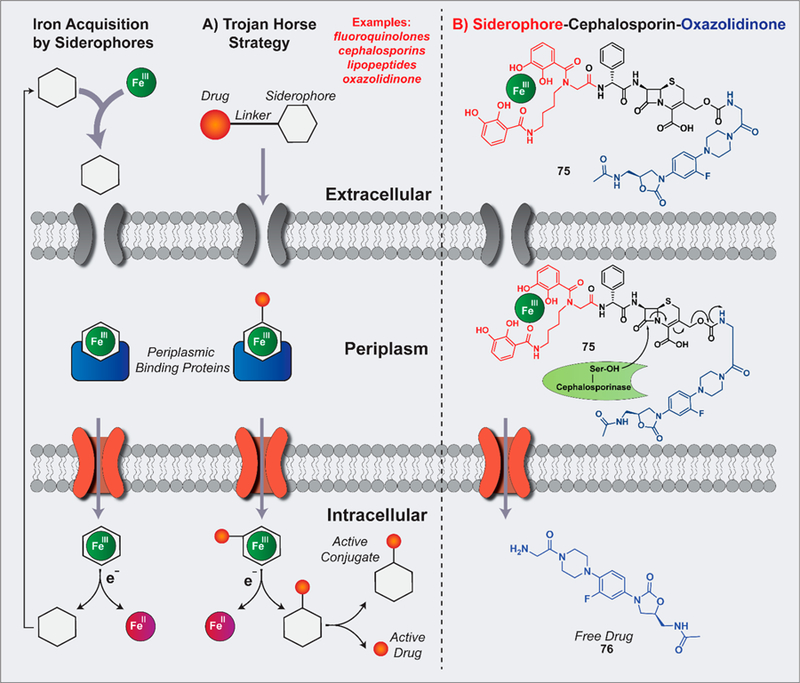
(A) Illustration of the Trojan horse strategy for targeted antibiotic delivery. (B) Example of Trojan horse strategy with a suicide siderophore–cephalosporin–oxazolidinone 75 (via releasable linker) recently reported by Miller and co-workers.
Figure 14
Figure 14
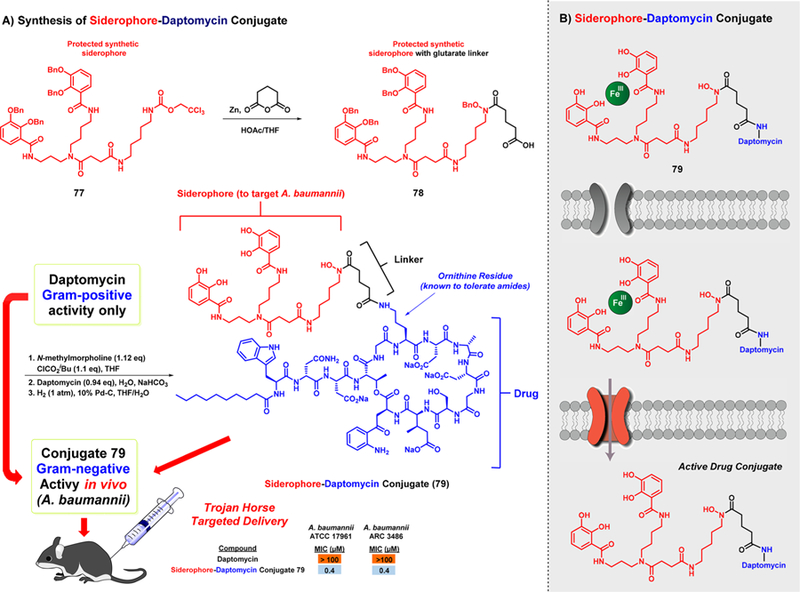
Chemical synthesis and targeted A. baumannii activities of siderophore–daptomycin conjugate 79.
Figure 15
Figure 15
Structures of the natural product, ADEP1 (80), its synthetic counterparts, and the key intramolecular hydrogen bonding required for activity. Structural modifications have been highlighted with different colors on each synthetic analogue.
Figure 16
Figure 16
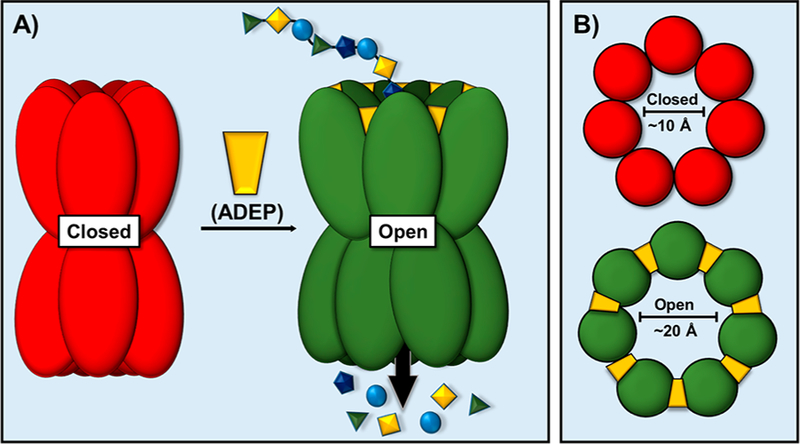
(A) ADEPs bind to Clp-ATPase binding sites, promoting the entry of unfolded proteins into proteolytic sites, causing indiscriminate degradation of nascent polypeptides, ultimately leading to self-digestion and bacterial cell death. (B) The binding of ADEP analogues engenders the open conformation of the ClpP protease.
Figure 17
Figure 17
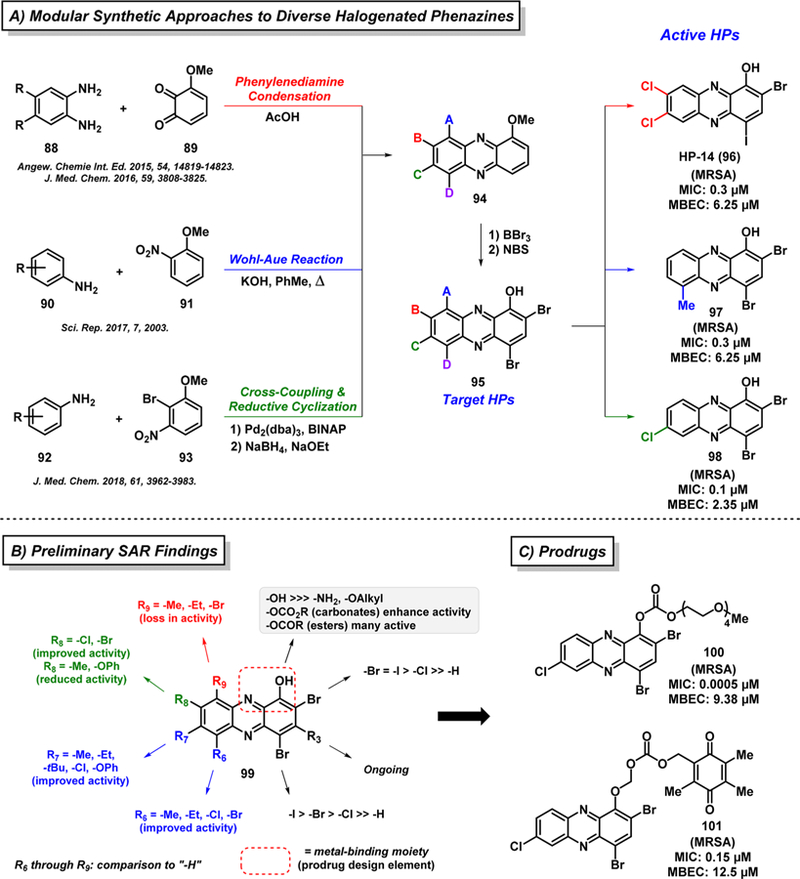
Chemical synthesis of halogenated phenazines and preliminary SAR findings.
Figure 18
Figure 18
Proposed mechanism of MRSA biofilm eradication by HP-14, based on RNA-seq findings.

References

    1. Lewis K Platforms for Antibiotic Discovery. Nat. Rev. Drug Discovery 2013, 12, 371–387. - PubMed
    1. Brown ED; Wright GD Antibacterial Drug Discovery in the Resistance Era. Nature 2016, 529, 336–343. - PubMed
    1. Blair JMA; Webber MA; Baylay AJ; Ogbolu DO; Piddock LJV Molecular Mechanisms of Antibiotic Resistance. Nat. Rev. Microbiol 2015, 13, 42–51. - PubMed
    1. Rossiter SE; Fletcher MH; Wuest WM Natural Products as Platforms To Overcome Antibiotic Resistance. Chem. Rev 2017, 117, 12415–12474. - PMC - PubMed
    1. Ali J; Rafiq QA; Ratcliffe E Antimicrobial Resistance Mechanisms and Potential Synthetic Treatments. Futur. Sci. OA 2018, 4, FSO290. - PMC - PubMed

Publication types

MeSH terms