


Invasion ecology meets parasitology: Advances and challenges
- PMID: 30951572
- PMCID: PMC5715220
- DOI: 10.1016/j.ijppaw.2017.03.006
Invasion ecology meets parasitology: Advances and challenges
Abstract
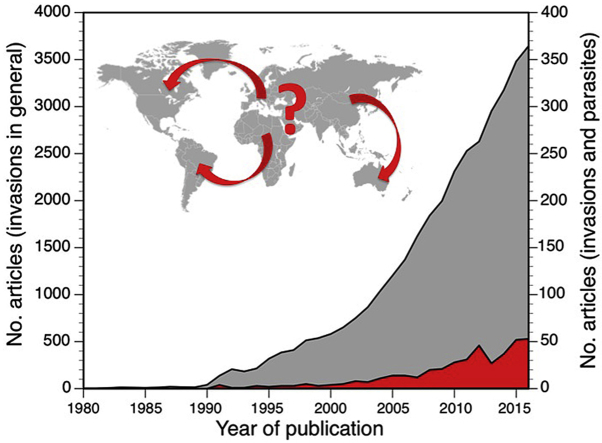
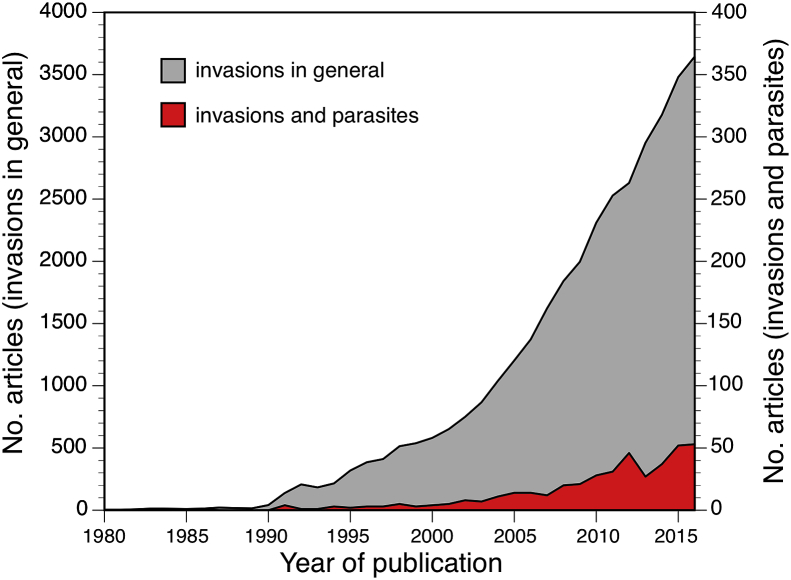
Biological invasions threaten the diversity and functioning of native ecosystems, and the rate at which species are being introduced to new areas shows no sign of slowing down. Parasites play roles in biological invasions, for instance when native parasites interact with exotic hosts, or when parasites themselves are introduced to new areas. However, publication trends show clearly that research on parasitism in the context of biological invasions is lagging far behind research on biological invasions in general. The different articles in this special issue of International Journal for Parasitology-Parasites and Wildlife on 'Invasions' address various aspects of the interface between parasitology and invasion biology, including how invasive free-living species lose or gain parasites on the invasion front as they move away from their site of introduction, how these invasive species affect the dynamics of native parasites, and how exotic parasites become established and impact native hosts. Together, they highlight the challenges facing researchers in this area, and set the agenda for the next few years of research.
Keywords: Biological invasions; Enemy release; Non-natives; Parasites; alien species.
Figures
References
-
- Cohen A.N., Carlton J.T. Accelerating invasion rate in a highly invaded estuary. Science. 1998;279:555–558. - PubMed
-
- Colautti R.I., Ricciardi A., Grigorovich I.A., MacIsaac H.J. Is invasion success explained by the enemy release hypothesis? Ecol. Lett. 2004;7:721–733.
-
- Dunn A.M. Parasites and biological invasions. Adv. Parasitol. 2009;68:161–184. - PubMed
Publication types
LinkOut - more resources
Full Text Sources
