Review
. 2019 Apr 4;74(1):8-18.
doi: 10.1016/j.molcel.2019.03.011.

Molecular Mechanisms Directing PRC2 Recruitment and H3K27 Methylation

Affiliations
Review

Molecular Mechanisms Directing PRC2 Recruitment and H3K27 Methylation

Anne Laugesen et al. Mol Cell. .

Abstract

The polycomb repressive complex 2 (PRC2) is a chromatin-associated methyltransferase catalyzing mono-, di-, and trimethylation of lysine 27 on histone H3 (H3K27). This activity is required for normal organismal development and maintenance of gene expression patterns to uphold cell identity. PRC2 function is often deregulated in disease and is a promising candidate for therapeutic targeting in cancer. In this review, we discuss the molecular mechanisms proposed to take part in modulating PRC2 recruitment and shaping H3K27 methylation patterns across the genome. This includes consideration of factors influencing PRC2 residence time on chromatin and PRC2 catalytic activity with a focus on the mechanisms giving rise to regional preferences and differential deposition of H3K27 methylation. We further discuss existing evidence for functional diversity between distinct subsets of PRC2 complexes with the aim of extracting key concepts and highlighting major open questions toward a more complete understanding of PRC2 function.

Keywords: EZH2; H3K27; PRC2; cancer; chromatin; epigenetics; gene expression; histone methylation; polycomb; transcription.


Figures

Figure 1:
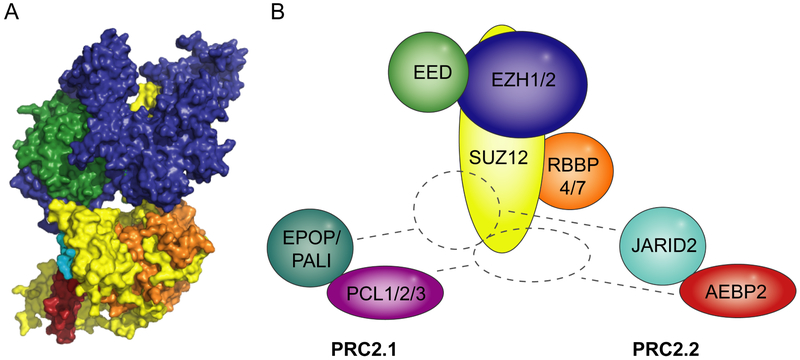
Figure 1:. Structure of PRC2 with associated non-core subunits.
A. Crystal structures, PDB ID: 5WAI (Chen et al., 2018) and PDB ID: 5LS6 (Vaswani et al., 2016), superimposed onto Cryo-EM structure, PDB ID: 6C23 (Kasinath et al., 2018a), showing core PRC2 (SUZ12 (yellow), EED (green), EZH2 (blue)) with fragments of AEBP2 (red) and JARID2 (turquoise). B. Schematic drawing of PRC2 with indication of core subunits and potential for incorporation of distinct sets of non-core subunits to form PRC2.1 and PRC2.2 ((Hauri et al., 2016)).
Figure 2:
Figure 2:. Overview of the genomic distribution of H3K27 methylation.
A. Average ChIP-seq signals for H3K27me1 (light blue), H3K27me2 (medium blue), and H3K27me3 (dark blue) over active and inactive genes (relative gene lengths +/− 20 kb) based on tracing of plotted ChIP-seq data from (Hojfeldt et al., 2018). B. Stylized representation of genomic snapshots of plotted ChIP-seq tracks of H3K27 methylation and SUZ12 (red) illustrating overlapping patterns of SUZ12 and H3K27me3 by an inactive gene, enrichment of H3K27me1 over an active gene and intergenic H3K27me2. TSS: Transcription start site, TTS: Transcription termination site, CGI: CpG island, kb: kilobases.
Figure 3:
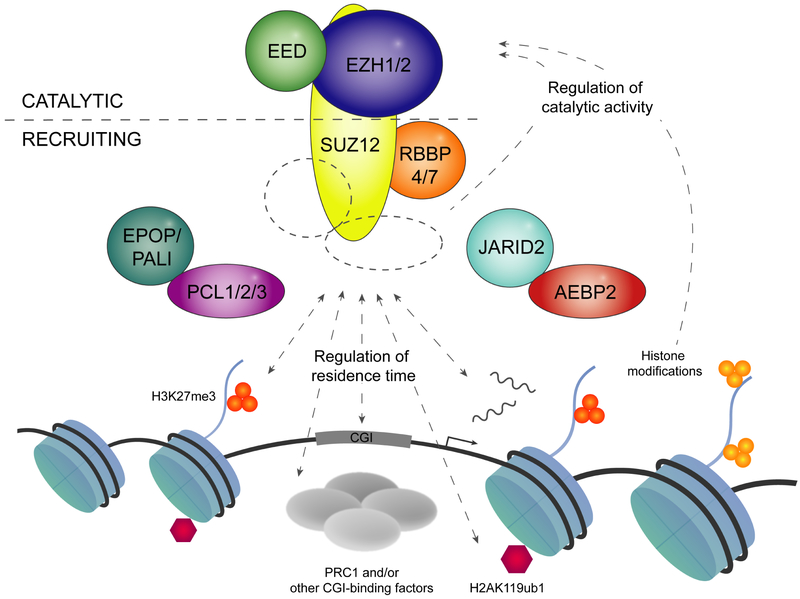
Figure 3:. Schematic representation of factors potentially influencing PRC2 recruitment or catalytic activity.
SUZ12 acts as scaffold for the complex, containing a C-terminal VEFS domain binding to EED and EZH2/1 and a N-terminal domain with associated non-core subunits. Chromatin binding is dependent on the N-terminal part of SUZ12, and CGI residence time may be modulated by non-core subunits, transcriptional activity and colocalizing factors including PRC1, H2AK119ub1 and H3K27me3. The catalytic activity of PRC2 may be influenced by non-core subunits and post-translational modifications of histones (H3K27me3, H3K4me3 and H3K36me2/me3).

References

    1. Alabert C, Bukowski-Wills JC, Lee SB, Kustatscher G, Nakamura K, de Lima Alves F, Menard P, Mejlvang J, Rappsilber J, and Groth A (2014). Nascent chromatin capture proteomics determines chromatin dynamics during DNA replication and identifies unknown fork components. Nat Cell Biol 16, 281–293. - PMC - PubMed
    1. Alekseyenko AA, Gorchakov AA, Kharchenko PV, and Kuroda MI (2014). Reciprocal interactions of human C10orf12 and C17orf96 with PRC2 revealed by BioTAP-XL cross-linking and affinity purification. Proc Natl Acad Sci U S A 111, 2488–2493. - PMC - PubMed
    1. Ballare C, Lange M, Lapinaite A, Martin GM, Morey L, Pascual G, Liefke R, Simon B, Shi Y, Gozani O, et al. (2012). Phf19 links methylated Lys36 of histone H3 to regulation of Polycomb activity. Nat Struct Mol Biol 19, 1257–1265. - PMC - PubMed
    1. Beltran M, Yates CM, Skalska L, Dawson M, Reis FP, Viiri K, Fisher CL, Sibley CR, Foster BM, Bartke T, et al. (2016). The interaction of PRC2 with RNA or chromatin is mutually antagonistic. Genome Res 26, 896–907. - PMC - PubMed
    1. Beringer M, Pisano P, Di Carlo V, Blanco E, Chammas P, Vizan P, Gutierrez A, Aranda S, Payer B, Wierer M, et al. (2016). EPOP Functionally Links Elongin and Polycomb in Pluripotent Stem Cells. Mol Cell 64, 645–658. - PubMed

Publication types

LinkOut - more resources