Review
. 2019 Apr 4;104(4):565-577.
doi: 10.1016/j.ajhg.2019.02.024.

The Iceberg under Water: Unexplored Complexity of Chromoanagenesis in Congenital Disorders

Affiliations
Review

The Iceberg under Water: Unexplored Complexity of Chromoanagenesis in Congenital Disorders

Cinthya J Zepeda-Mendoza et al. Am J Hum Genet. .

Abstract

Structural variation, composed of balanced and unbalanced genomic rearrangements, is an important contributor to human genetic diversity with prominent roles in somatic and congenital disease. At the nucleotide level, structural variants (SVs) have been shown to frequently harbor additional breakpoints and copy-number imbalances, a complexity predicted to emerge wholly as a single-cell division event. Chromothripsis, chromoplexy, and chromoanasynthesis, collectively referred to as chromoanagenesis, are three major mechanisms that explain the occurrence of complex germline and somatic SVs. While chromothripsis and chromoplexy have been shown to be key signatures of cancer, chromoanagenesis has been detected in numerous cases of developmental disease and phenotypically normal individuals. Such observations advocate for a deeper study of the polymorphic and pathogenic properties of complex germline SVs, many of which go undetected by traditional clinical molecular and cytogenetic methods. This review focuses on congenital chromoanagenesis, mechanisms leading to occurrence of these complex rearrangements, and their impact on chromosome organization and genome function. We highlight future applications of routine screening of complex and balanced SVs in the clinic, as these represent a potential and often neglected genetic disease source, a true "iceberg under water."


Figures

Figure 1
Figure 1
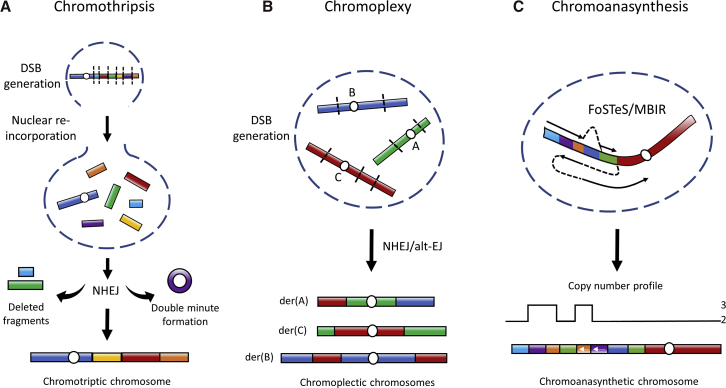
Characteristics of Chromothripsis, Chromoplexy, and Chromoanasynthesis-Derived SVs (A) A chromosome in a micronucleus can undergo massive DNA damage and result in multiple double-strand breaks (DSBs, depicted with dashed black lines). When the micronucleus is re-incorporated into the nucleus during mitosis, the DSBs undergo repair through NHEJ, where chromosome segments are randomly stitched back together, lost, or become double minutes. Functionally relevant segments could become double minutes and undergo amplification, as has been observed in MYC and other oncogene-containing segments in various cancer cases., , (B) In chromoplexy, different DSBs can be repaired with or without DNA loss at the breakpoints and be arranged into various derivative configurations, as shown here by the rearrangements of example chromosomes A, B, and C. (C) In chromoanasynthesis, a normal chromosome can undergo DNA segment re-synthesis (dashed lines to show template switches and solid arrows to show replication) mediated by replication processes such as FoSTeS and MMBIR. These mechanisms lead to templated insertions that exhibit higher copy-number and may be arranged in different orientations (depicted in purple and orange with white arrows signifying inverted sequence orientation). Notice the chromoanasynthesis chromosome has a copy-number profile exhibiting intercalating duplication-normal-duplication (dup-nml-dup) copy-number states, as seen in previous studies.
Figure 2
Figure 2
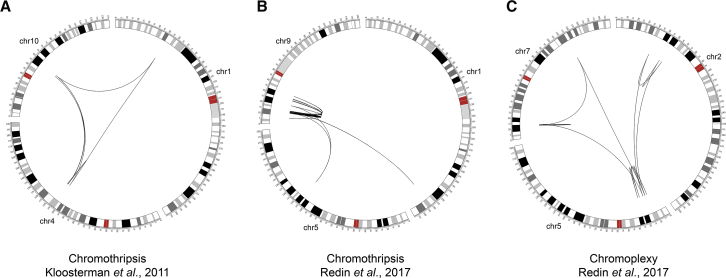
Circos Representation and Comparison of Congenital Chromothripsis and Chromoplexy Cases Two chromothripsis events (A, child described by Kloosterman and co-authors and B, Redin and co-authors [DGAP122]56) and one congenital chromoplexy instance (C, UTR20 from Redin and co-authors56) are shown. Circos diagrams look different from the original case publications as these graphs display chromoanagenesis rearrangements with whole chromosome views. Notice the presence of clustered breakpoints in all three cases, characteristic of chromothripsis events. Notice also the involvement of multiple chromosomes for all examples, similar to what is observed in chromoplexy. The occurrence of characteristic features from both mechanisms suggests that they could act sequentially or simultaneously in a cell.
Figure 3
Figure 3
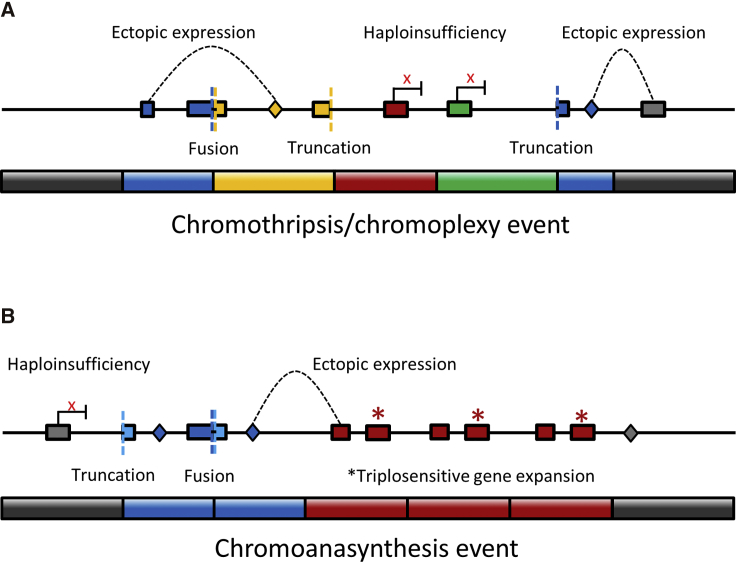
Functional Consequences of Chromoanagenesis Rearranged chromosome fragments are colored in blue, yellow, red, and green. Grey fragments represent the remainder of the chromosome, to pter (left gray fragments) and qter (right gray fragment). (A) Chromothripsis/chromoplexy events can lead to gene truncation (colored boxes and colored dashed lines), fusions (adjacent colored boxes and colored dashed lines), gene haploinsufficiency due to removal of regulatory elements (enhancers marked as colored diamonds and haploinsufficient gene transcription marked with an x), or ectopic expression caused by position effects (enhancers marked as colored diamonds and dashed lines indicate the genes on which they are exerting their effects). (B) Similar to chromothripsis/chromoplexy, chromoanasynthesis can lead to gene truncation, gene fusion, gene haploinsufficiency due to removal of regulatory elements or ectopic expression. In addition, expansion and transcription of triplosensitive genes could be observed in chromoanasynthesis.

References

    1. Shendure J., Balasubramanian S., Church G.M., Gilbert W., Rogers J., Schloss J.A., Waterston R.H. DNA sequencing at 40: past, present and future. Nature. 2017;550:345–353. - PubMed
    1. Tuzun E., Sharp A.J., Bailey J.A., Kaul R., Morrison V.A., Pertz L.M., Haugen E., Hayden H., Albertson D., Pinkel D. Fine-scale structural variation of the human genome. Nat. Genet. 2005;37:727–732. - PubMed
    1. Iafrate A.J., Feuk L., Rivera M.N., Listewnik M.L., Donahoe P.K., Qi Y., Scherer S.W., Lee C. Detection of large-scale variation in the human genome. Nat. Genet. 2004;36:949–951. - PubMed
    1. Sebat J., Lakshmi B., Troge J., Alexander J., Young J., Lundin P., Månér S., Massa H., Walker M., Chi M. Large-scale copy number polymorphism in the human genome. Science. 2004;305:525–528. - PubMed
    1. Sharp A.J., Locke D.P., McGrath S.D., Cheng Z., Bailey J.A., Vallente R.U., Pertz L.M., Clark R.A., Schwartz S., Segraves R. Segmental duplications and copy-number variation in the human genome. Am. J. Hum. Genet. 2005;77:78–88. - PMC - PubMed

Publication types