Randomized Controlled Trial
. 2019 Apr 8;68(8):1311-1319.
doi: 10.1093/cid/ciy735.

Chloroquine Versus Dihydroartemisinin-Piperaquine With Standard High-dose Primaquine Given Either for 7 Days or 14 Days in Plasmodium vivax Malaria

Affiliations
Randomized Controlled Trial

Chloroquine Versus Dihydroartemisinin-Piperaquine With Standard High-dose Primaquine Given Either for 7 Days or 14 Days in Plasmodium vivax Malaria

Cindy S Chu et al. Clin Infect Dis. .

Abstract

Background: Primaquine is necessary for the radical cure of Plasmodium vivax malaria, but the optimum duration of treatment and best partner drug are uncertain. A randomized controlled trial was performed to compare the tolerability and radical curative efficacy of 7-day versus 14-day high-dose primaquine regimens (total dose 7mg/kg) with either chloroquine or dihydroartemisinin-piperaquine.

Methods: Patients with uncomplicated P. vivax malaria on the Thailand-Myanmar border were randomized to either chloroquine (25mg base/kg) or dihydroartemisinin-piperaquine (dihydroartemisinin 7mg/kg and piperaquine 55mg/kg) plus primaquine, either 0.5 mg/kg/day for 14 days or 1 mg/kg/day for 7 days. Adverse events within 42 days and 1-year recurrence rates were compared and their relationship with day 6 drug concentrations assessed.

Results: Between February 2012 and July 2014, 680 patients were enrolled. P. vivax recurrences (all after day 35) occurred in 80/654 (12%) patients; there was no difference between treatments. Compared to the 7-day primaquine groups the pooled relative risk of recurrence in the 14-day groups was 1.15 (95% confidence interval 0.7 to 1.8). Hematocrit reductions were clinically insignificant except in G6PD female heterozygotes, 2 of whom had hematocrit reductions to <23% requiring blood transfusion.

Conclusion: Radical cure should be deployed more widely. The radical curative efficacy in vivax malaria of 7-day high-dose primaquine is similar to the standard 14-day high-dose regimen. Chloroquine and dihydroartemisinin-piperaquine are both highly effective treatments of the blood stage infection. Quantitative point of care G6PD testing would ensure safe use of the 7-day high-dose primaquine regimen in G6PD heterozygous females.

Clinical trials registration: NCT01640574.

Keywords: Plasmodium vivax; chloroquine; dihydroartemisinin-piperaquine; primaquine; radical cure.


Figures

Figure 1.
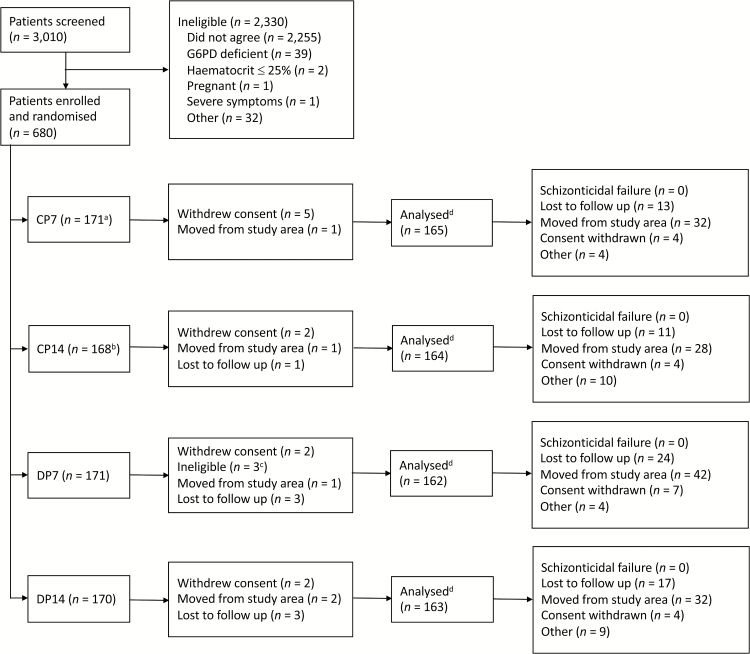
Figure 1.
Study diagram. aOne patient randomized to the CP7 arm was given DP7 bTwo patients randomized to the CP14 arm were given CP7 cTwo patients vomited the drug treatment twice and one patient had received a blood transfusion in the prior 3 months. dA total of 26 patient were excluded from the analyses because they had not completed the schizonticidal treatment. The three patients with incorrect randomization were included in the analysis. Abbreviations: CP7, Chloroquine + Primaquine 1 mg/kg/day for 7 days; CP14, Chloroquine + Primaquine 0.5 mg/kg/day for 14 days; DP7, Dihydroartemisinin-piperaquine + Primaquine 1 mg/kg/day for 7 days; DP14, Dihydroartemisinin-piperaquine + Primaquine 0.5 mg/kg/day for 14 days; G6PD, glucose-6-phosphate dehydrogenase.
Figure 2.
Figure 2.
Recurrence of Plasmodium vivax malaria during the 1-year study. Survival curves comparing marginal time to first recurrence in the 2 schizontocide groups (left panel) and the 2 radical cure groups (right panel). Vertical notches denote right censored observations. 95% confidence intervals are shown by the shaded areas. The dashed black line shows the proportion recurring when not given radical cure in recent (two years previous) historical controls from the same study site [22].
Figure 3.
Figure 3.
Noninferiority analysis of the 7-day versus 14-day high-dose primaquine regimens. The relative risk of a new Plasmodium vivax infection in the 7-day high-dose primaquine regimen (13.5%) was not inferior to the 14-day regimen (15.3%). The difference in relative risk between the two regimens was 1.8% (95% confidence interval −9.8 to +6.7%).
Figure 4.
Figure 4.
Risk of Plasmodium vivax relapse in relation to primaquine and carboxyprimaquine drug levels. The predicted individual risks of recurrence within 1 year as a function of day 7 primaquine (left panel) and carboxy-primaquine (right panel) concentrations. These relationships are estimated from a mixed effects Cox proportional hazards model where sex, schizonticide treatment, and primaquine and carboxy-primaquine concentrations were independent predictive covariates.
Figure 5.
Figure 5.
Median methemoglobin measurements during primaquine administration. Evolution of methemoglobin concentrations over time within the four study groups. Data from PMQ7 arm are shown in light and dark red for CQ and DP, respectively. Data from PMQ14 are shown in light and dark blue for CQ and DP, respectively. The thick brown and aqua lines correspond to the median trends for the pooled 7-day and 14-day primaquine groups, respectively. Abbreviations: CQ, chloroquine; DP, dihydroartemisinin-piperaquine, PMQ7, primaquine 1 mg/kg/day for 7 days; PMQ14, primaquine 0.5 mg/kg/day for 14 days.

References

    1. Battle KE, Gething PW, Elyazar IRF, et al. The global public health significance of Plasmodium vivax. Adv Parisitol 2012; 80:1–111. - PubMed
    1. World Health Organization. Guidelines for the treatment of malaria, 3rd ed. Geneva: World Health Organization.
    1. Commons RJ, Thriemer K, Humphreys G, et al. The vivax surveyor: online mapping database for Plasmodium vivax clinical trials. Int J Parasitol Drugs Drug Resist 2017; 7:181–90. - PMC - PubMed
    1. Phyo AP, Lwin KM, Price RN, et al. Dihydroartemisinin-piperaquine versus chloroquine in the treatment of Plasmodium vivax malaria in Thailand: a randomized controlled trial. Clin Infect Dis 2011; 53:977–84. - PMC - PubMed
    1. Betuela I, Rosanas-Urgell A, Kiniboro B, et al. Relapses contribute significantly to the risk of Plasmodium vivax infection and disease in Papua New Guinean children 1–5 years of age. J Infect Dis 2012; 206:1771–80. - PubMed

Publication types

MeSH terms

Associated data