


Influenza A Reinfection in Sequential Human Challenge: Implications for Protective Immunity and "Universal" Vaccine Development
- PMID: 30953061
- PMCID: PMC7319262
- DOI: 10.1093/cid/ciz281
Influenza A Reinfection in Sequential Human Challenge: Implications for Protective Immunity and "Universal" Vaccine Development
Abstract
Background: Identification of correlates of protection against human influenza A virus infection is important in development of broadly protective ("universal") influenza vaccines. Certain assumptions underlie current vaccine developmental strategies, including that infection with a particular influenza A virus should offer long-term or lifelong protection against that strain, preventing reinfection. In this study we report observations made when 7 volunteers participated in sequential influenza challenge studies where they were challenged intranasally using the identical influenza A(H1N1)pdm09 virus approximately 1 year apart. We evaluate and describe the outcomes of these 7 rechallenge participants and discuss what these results may suggest about correlates of protection and development of more broadly protective influenza vaccines.
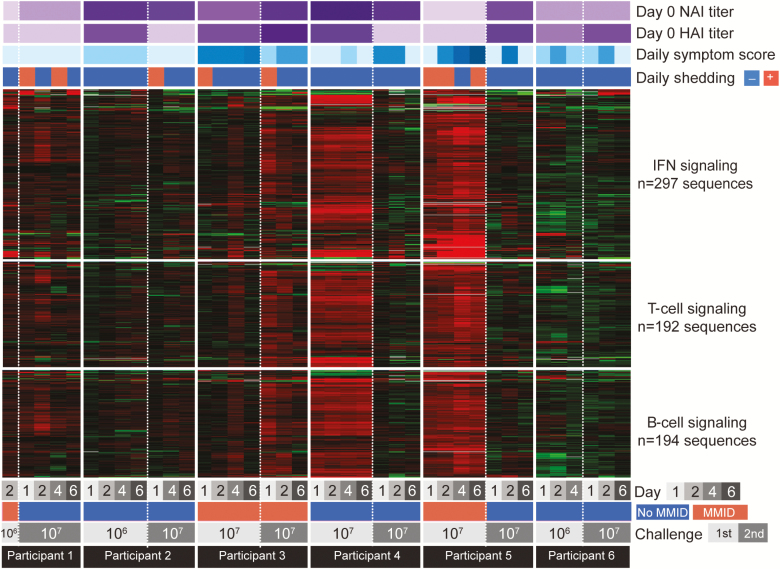
Methods: Seven participants were enrolled in 2 viral challenge studies at 7.5- to 18.5-month intervals. Both challenge studies used the identical lot of influenza A (H1N1)pdm09 virus administered intranasally. We evaluated pre- and postchallenge hemagglutination inhibition, neuraminidase inhibition, and stalk antibody titers; peripheral blood leukocyte host gene expression response profiles; daily viral detection via nasal wash; and clinical signs and symptoms.
Results: At least 3 of 7 participants demonstrated confirmed laboratory evidence of sequential infection, with 5 of 7 demonstrating clinical evidence.
Conclusions: The data presented in this report demonstrate that sequential infection with the identical influenza A virus can occur and suggest it may not be rare. These data raise questions about immune memory responses in an acute superficial respiratory mucosal infection and their implications in development of broadly protective influenza vaccines. Further investigation of these observations is warranted.
Clinical trials registration: NCT01646138; NCT01971255.
Keywords: CHIM; challenge; healthy volunteer; influenza A; vaccine.
Published by Oxford University Press for the Infectious Diseases Society of America 2019.
Figures
References
-
- Yassine HM, Boyington JC, McTamney PM, et al. . Hemagglutinin-stem nanoparticles generate heterosubtypic influenza protection. Nat Med 2015; 21:1065–70. - PubMed
-
- Nabel GJ, Fauci AS. Induction of unnatural immunity: prospects for a broadly protective universal influenza vaccine. Nat Med 2010; 16:1389–91. - PubMed
Publication types
MeSH terms
Substances
Associated data
LinkOut - more resources
Full Text Sources
Medical
Molecular Biology Databases
