


Assessment of direct and indirect associations between children active school travel and environmental, household and child factors using structural equation modelling
- PMID: 30953526
- PMCID: PMC6451289
- DOI: 10.1186/s12966-019-0794-5
Assessment of direct and indirect associations between children active school travel and environmental, household and child factors using structural equation modelling
Abstract
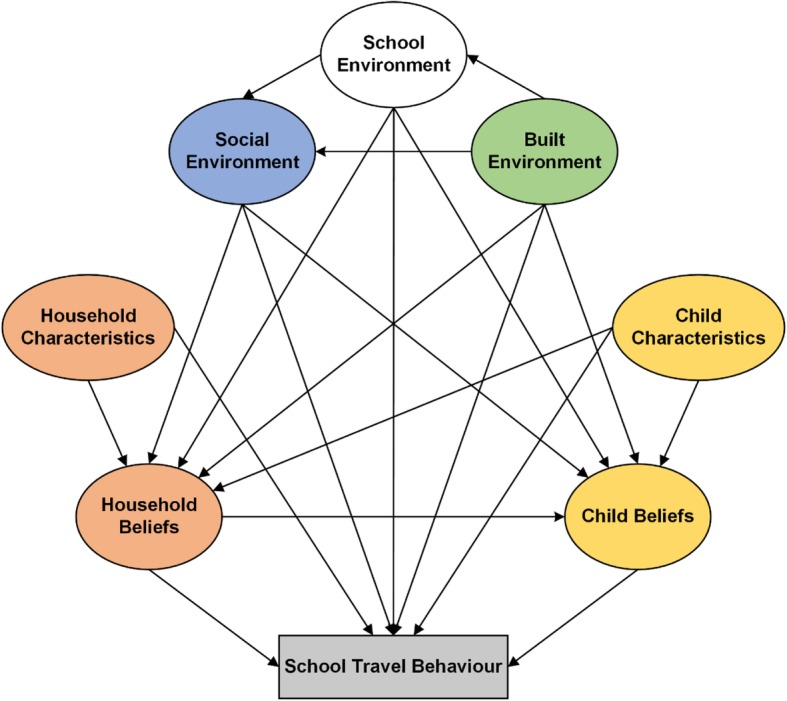
Background: Active school travel (AST) is influenced by multiple factors including built and social environments, households and individual variables. A holistic theory such as Mitra's Behavioural Model of School Transportation (BMST) is vital to comprehensively understand these complex interrelationships. This study aimed to assess direct and indirect associations between children's AST and environmental, household and child factors based on the BMST using structural equation modelling (SEM).
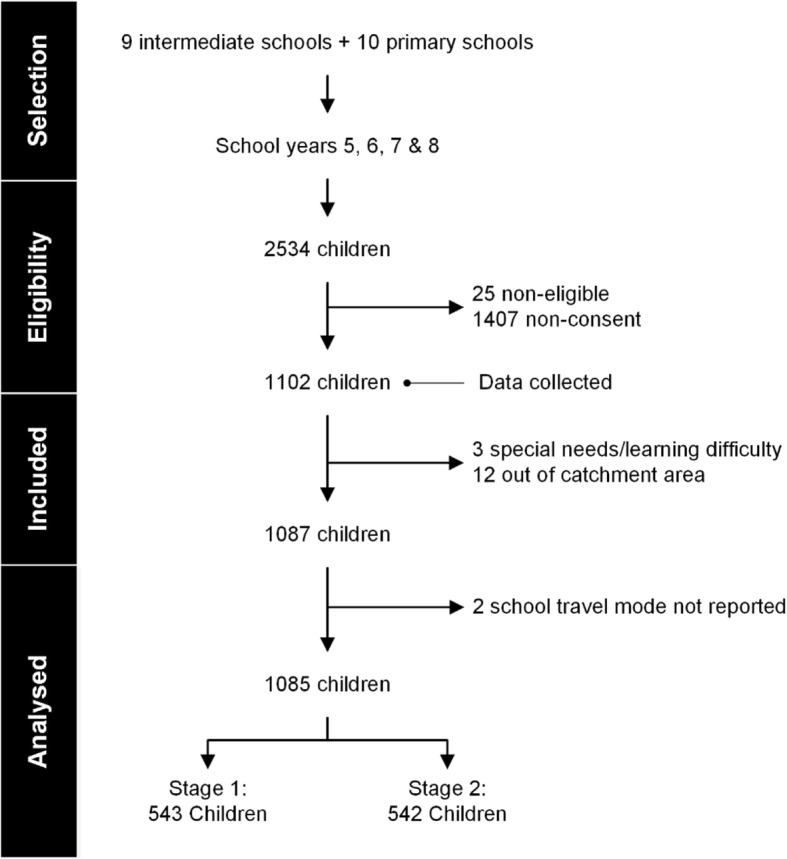
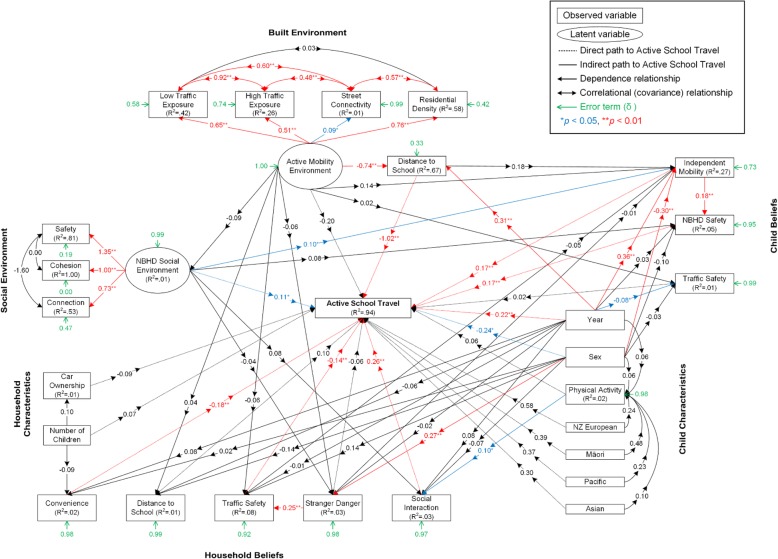
Methods: Data were drawn from Neighbourhoods for Active Kids (NfAK), a cross-sectional study of 1102 children aged 8-13 years (school years 5-8) and their parents from nine intermediate and 10 primary schools in Auckland, New Zealand between February 2015 and December 2016. Data were collected using an online participatory mapping survey (softGIS) with children, a computer-assisted telephone interviewing survey (CATI) with parents, and ArcGIS for built environment attributes. Based on the BMST a conceptual model of children's school travel behaviour was specified for SEM analyses ('hypothesised SEM'), and model modification was made to improve the model ('modified SEM'). SEM analyses using Mplus were performed to test the hypothesised/modified SEM and to assess direct and indirect relationships among variables.
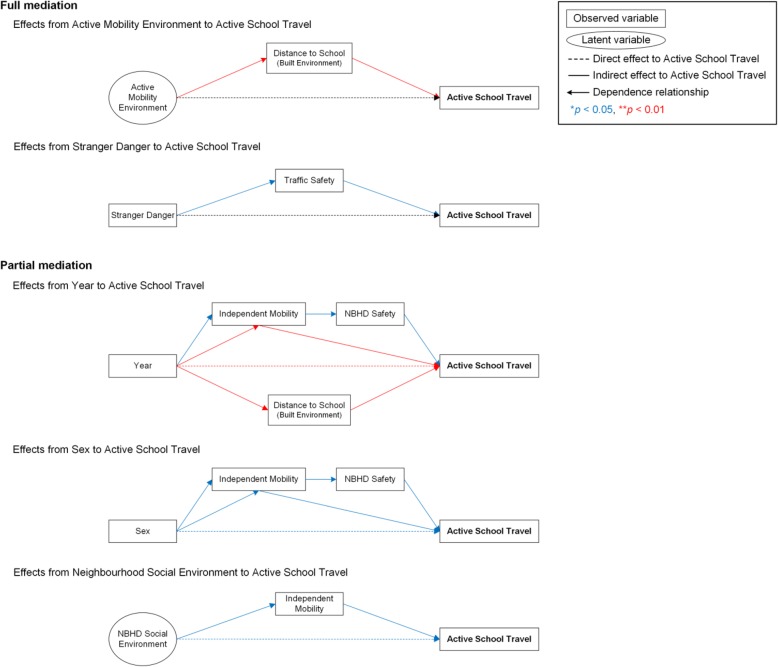
Results: The overall fit of the modified SEM was acceptable (N = 542; Root mean square error of approximation = 0.04, Comparative fit index = 0.94, Tucker-Lewis index = 0.92). AST was positively associated with child independent mobility, child-perceived neighbourhood safety, and parent-perceived importance of social interaction and neighbourhood social environment. Distance to school, and parental perceptions of convenience and concerns about traffic safety were negatively associated with AST. Parental fears of stranger danger were indirectly related to AST through those of traffic safety. Distance to school and child independent mobility mediated relationships between AST and child school year and sex.
Conclusions: Increasing children's AST requires action on multiple fronts including communities that support independent mobility by providing child friendly social and built environments, safety from traffic, and policies that promote local schools and safe vehicle-free zones around school.
Keywords: Active travel; Built environment; Independent mobility; Safety; Social environment; Socio-ecological model.
Conflict of interest statement
Ethics approval and consent to participate
Ethical approval to conduct the study was granted by the host institution ethics committees (AUTEC, 14/263, 3 September 2014; MUHECN 3 September 2014; UAHPEC 9 September 2014). Participant information sheets, child assent forms, and parent consent forms were provided to students. The students were asked to return their signed assent and parent consent forms within 2 weeks if they agreed to participate in the study.
Consent for publication
Not applicable.
Competing interests
The authors declare that they have no competing interests.
Publisher’s Note
Springer Nature remains neutral with regard to jurisdictional claims in published maps and institutional affiliations.
Figures
References
-
- Garrard J. Active transport: children and young people (an overview of recent evidence) 2009.
-
- Ikeda E, Stewart T, Garrett N, Egli V, Mandic S, Hosking J, Witten K, Hawley G, Tautolo ES, Rodda J, et al. Built environment associates of active school travel in New Zealand children and youth: a systematic meta-analysis using individual participant data. J Transp Health. 2018. 10.1016/j.jth.2018.04.007.
-
- School zones and school reviews. https://www.govt.nz/browse/education/school-and-college/school-zones. Accessed 15 Aug 2018.
-
- Enrolment schemes (school zones). https://parents.education.govt.nz/primary-school/schooling-in-nz/enrolme.... Accessed Aug 15.
Publication types
MeSH terms
LinkOut - more resources
Full Text Sources
Medical
