


Towards neural co-processors for the brain: combining decoding and encoding in brain-computer interfaces
- PMID: 30954862
- PMCID: PMC6860027
- DOI: 10.1016/j.conb.2019.03.008
Towards neural co-processors for the brain: combining decoding and encoding in brain-computer interfaces
Abstract
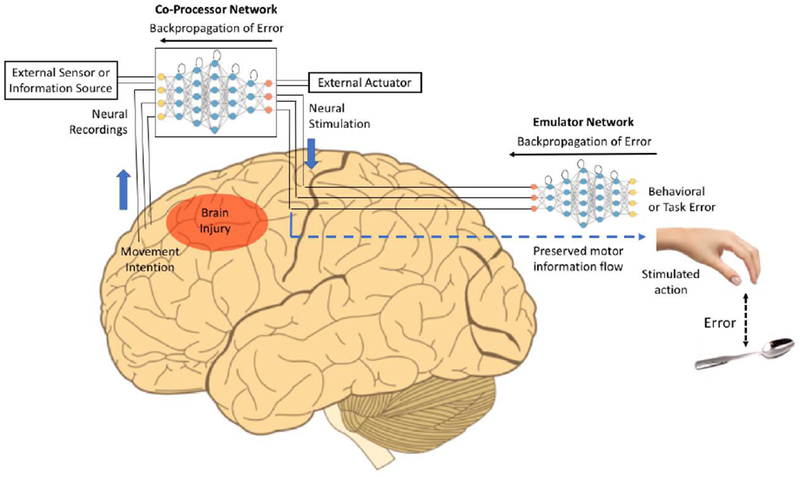
The field of brain-computer interfaces is poised to advance from the traditional goal of controlling prosthetic devices using brain signals to combining neural decoding and encoding within a single neuroprosthetic device. Such a device acts as a 'co-processor' for the brain, with applications ranging from inducing Hebbian plasticity for rehabilitation after brain injury to reanimating paralyzed limbs and enhancing memory. We review recent progress in simultaneous decoding and encoding for closed-loop control and plasticity induction. To address the challenge of multi-channel decoding and encoding, we introduce a unifying framework for developing brain co-processors based on artificial neural networks and deep learning. These 'neural co-processors' can be used to jointly optimize cost functions with the nervous system to achieve desired behaviors ranging from targeted neuro-rehabilitation to augmentation of brain function.
Copyright © 2019 Elsevier Ltd. All rights reserved.
Conflict of interest statement
Conflict of interest statement
Nothing declared.
Figures
References
-
- Rao RPN. Brain-Computer Interfacing: An Introduction, New York, NY: Cambridge University Press, 2013.
-
- Wolpaw J, Wolpaw EW. (eds.) Brain-Computer Interfaces: Principles and Practice. Oxford University Press, 2012.
-
- Moritz CT, Ruther P, Goering S, Stett A, Ball T, Burgard W, Chudler EH, Rao RP. New Perspectives on Neuroengineering and Neurotechnologies: NSF-DFG Workshop Report. IEEE Trans Biomed Eng. 63(7):1354–67, 2016. - PubMed
-
- Lebedev MA, Nicolelis MA. Brain-Machine Interfaces: From Basic Science to Neuroprostheses and Neurorehabilitation. Physiol Rev. 97(2):767–837, 2017. - PubMed
-
- Fetz EE. Operant conditioning of cortical unit activity. Science. 1969. February 28;163(870):955–58. - PubMed
-
This article was the first to demonstrate a brain-computer interface in a monkey. The author presents results showing that neurons in the motor cortex can be trained to control an artificial device through operant conditioning.
Publication types
MeSH terms
Grants and funding
LinkOut - more resources
Full Text Sources
Other Literature Sources
