


Towards resilience through systems-based plant breeding. A review
- PMID: 30956692
- PMCID: PMC6417397
- DOI: 10.1007/s13593-018-0522-6
Towards resilience through systems-based plant breeding. A review
Abstract
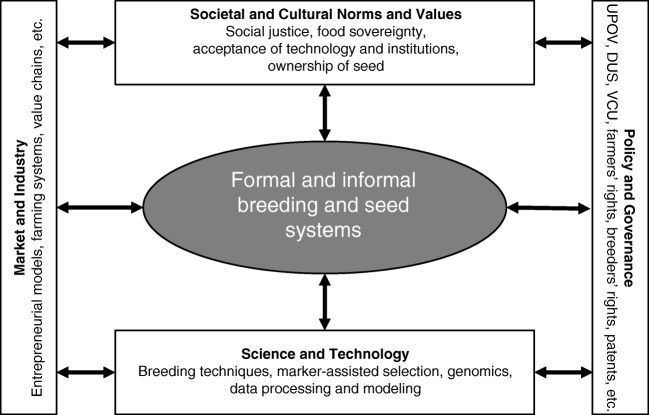
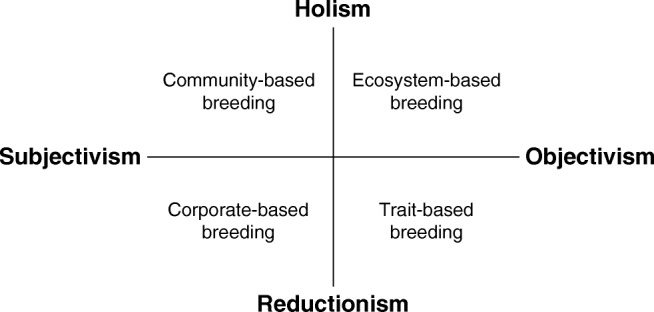
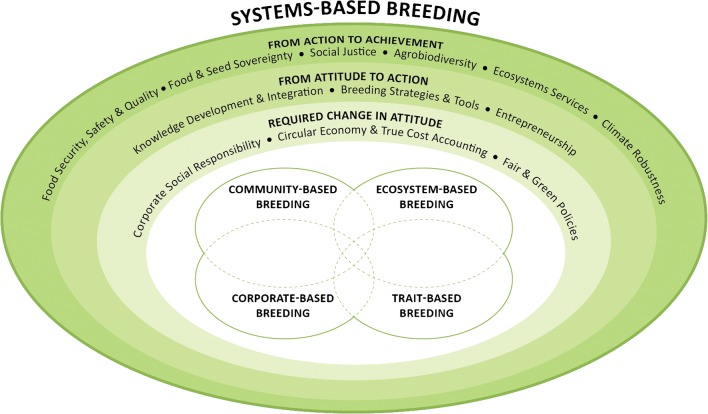
How the growing world population can feed itself is a crucial, multi-dimensional problem that goes beyond sustainable development. Crop production will be affected by many changes in its climatic, agronomic, economic, and societal contexts. Therefore, breeders are challenged to produce cultivars that strengthen both ecological and societal resilience by striving for six international sustainability targets: food security, safety and quality; food and seed sovereignty; social justice; agrobiodiversity; ecosystem services; and climate robustness. Against this background, we review the state of the art in plant breeding by distinguishing four paradigmatic orientations that currently co-exist: community-based breeding, ecosystem-based breeding, trait-based breeding, and corporate-based breeding, analyzing differences among these orientations. Our main findings are: (1) all four orientations have significant value but none alone will achieve all six sustainability targets; (2) therefore, an overarching approach is needed: "systems-based breeding," an orientation with the potential to synergize the strengths of the ways of thinking in the current paradigmatic orientations; (3) achieving that requires specific knowledge development and integration, a multitude of suitable breeding strategies and tools, and entrepreneurship, but also a change in attitude based on corporate responsibility, circular economy and true-cost accounting, and fair and green policies. We conclude that systems-based breeding can create strong interactions between all system components. While seeds are part of the common good and the basis of agrobiodiversity, a diversity in breeding approaches, based on different entrepreneurial approaches, can also be considered part of the required agrobiodiversity. To enable systems-based breeding to play a major role in creating sustainable agriculture, a shared sense of urgency is needed to realize the required changes in breeding approaches, institutions, regulations and protocols. Based on this concept of systems-based breeding, there are opportunities for breeders to play an active role in the development of an ecologically and societally resilient, sustainable agriculture.
Keywords: Agrobiodiversity; Breeding strategies; Common good; Ecological resilience; Entrepreneurial models; Resource use efficiency; Seed systems; Social justice; Societal resilience; Sustainability.
Conflict of interest statement
Compliance with ethical standardsThe authors declare that they have no conflict of interest.
Figures
References
-
- Alkon AH (2013) Food justice, food sovereignty and the challenge of neoliberalism. Food sovereignty: a critical dialogue. Conference Paper # 38 presented at the 'Food Sovereignty: A Critical Dialogue' international conference, convened by the Yale Program in Agrarian Studies, September 14–15, 2013
-
- Almekinders CJM (2011) The joint development of JM-12.7: a technographic description of the making of a bean variety. NJAS - Wageningen Journal of Life Sciences 57:207–216
-
- Almekinders C, Hardon J (eds) (2006) Bringing farmers back into breeding. Experiences with participatory plant breeding and challenges for institutionalisation, Agromisa Special 5, Wageningen, 2006, p. 125. http://documents.plant.wur.nl/cgn/literature/reports/BringingFarmersBack...
-
- Bachmann L (2010) Farmer-led participatory plant breeding. Methods and impacts. The MASIPAG farmers Network in the Philippines. In: Goldringer I, Dawson JC, Rey F, Vettoretti A, Chable V, Lammerts van Bueren ET, Finckh M, Barot S (eds) Breeding for resilience: a strategy for organic and low-input farming systems? EUCARPIA 2nd Conference of the Organic and Low-Input Agriculture Section, Paris, France, 1–3 December 2010, p 119–122
-
- Bänziger M, Cooper M. Breeding for low-input conditions and consequences for participatory plant breeding: examples from tropical maize and wheat. Euphytica. 2001;122(3):503–519. doi: 10.1023/A:1017510928038. - DOI
LinkOut - more resources
Full Text Sources