


The Epidemiology of Antiphospholipid Syndrome: A Population-Based Study
- PMID: 30957430
- PMCID: PMC6717037
- DOI: 10.1002/art.40901
The Epidemiology of Antiphospholipid Syndrome: A Population-Based Study
Erratum in
-
Errors in Two Sentences in the Patients and Methods Section of the Article by Duarte-García et al (Arthritis Rheumatol, September 2019).Arthritis Rheumatol. 2020 Apr;72(4):597. doi: 10.1002/art.41241. Arthritis Rheumatol. 2020. PMID: 32227632 No abstract available.
Abstract
Objective: To estimate the annual incidence and prevalence of and frequency of mortality associated with antiphospholipid syndrome (APS).
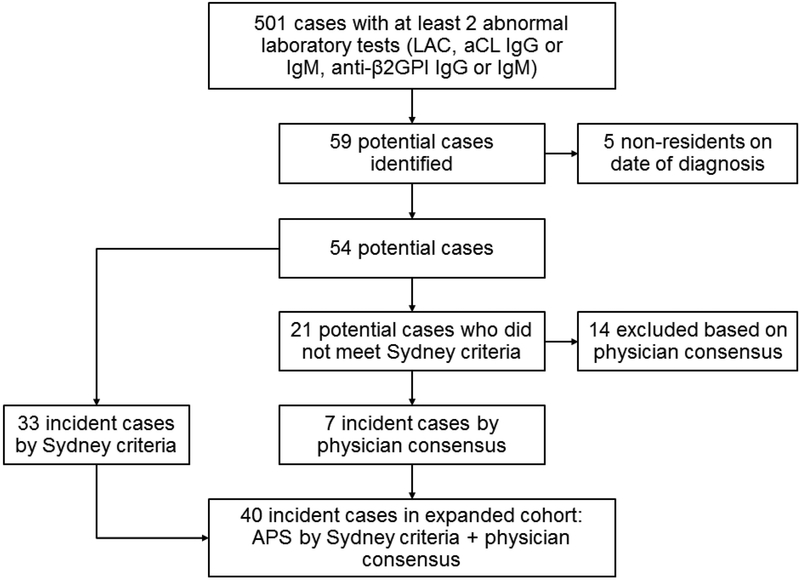
Methods: An inception cohort of patients with incident APS in 2000-2015 from a geographically well-defined population was identified based on comprehensive individual medical records review. All cases met the 2006 Sydney criteria for APS (primary definition) or had a diagnosis of APS confirmed by physician consensus (secondary definition). Levels of lupus anticoagulant, IgM and IgG anticardiolipin antibodies, and anti-β2-glycoprotein I antibodies were tested in a centralized laboratory. Incidence rates were age- and sex-adjusted to the 2010 US white population. Prevalence estimates were obtained from the incidence rates, assuming that there was no increased mortality associated with APS and that migration in or out of the area was independent of disease status.
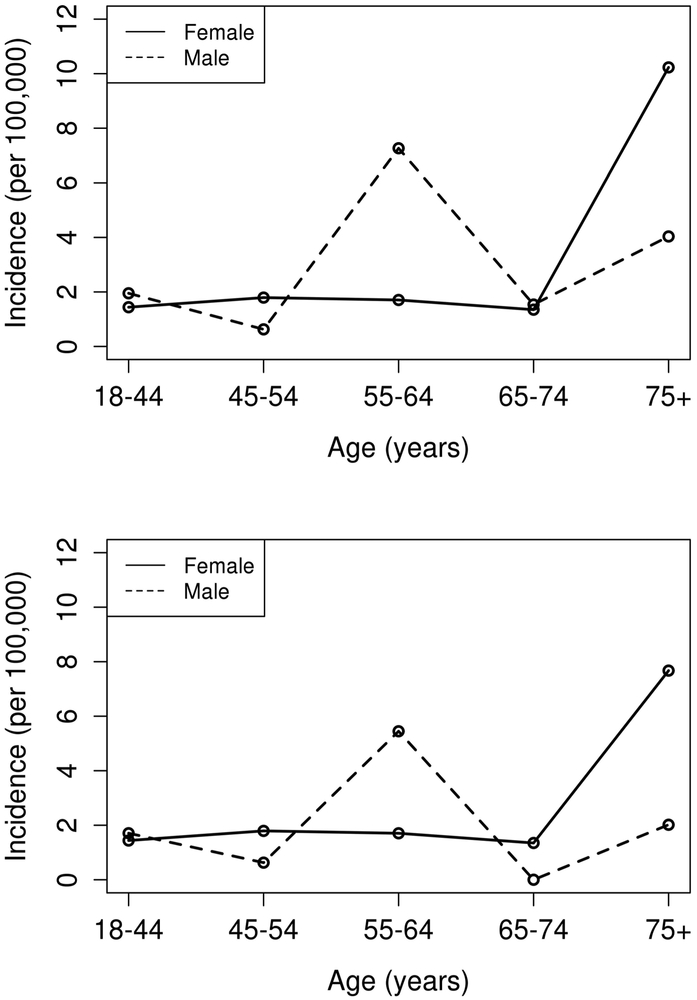
Results: Among this cohort in 2000-2015, 33 cases of incident APS, as defined by the Sydney criteria, were identified (mean age of patients 54.2 years; 55% female, 97% white). The annual incidence of APS in adults ages ≥18 years was 2.1 (95% confidence interval [95% CI] 1.4-2.8) per 100,000 population. Incidence rates were similar in both sexes. The estimated prevalence of APS was 50 (95% CI 42-58) per 100,000 population, and was similar in both sexes. Six patients (18%) had a concurrent diagnosis of systemic lupus erythematosus. The most frequent clinical manifestation was deep vein thrombosis. The overall frequency of mortality among patients with APS was not significantly different from that in the general population (standardized mortality ratio 1.61, 95% CI 0.74-3.05).
Conclusion: APS occurred in ~2 persons per 100,000 population per year. The estimated prevalence was 50 per 100,000 population. Overall mortality was not notably different from that observed in the general population.
© 2019, American College of Rheumatology.
Figures
Comment in
-
Overrepresentation of Elderly Subjects in a Population-Based Study of Antiphospholipid Syndrome: Comment on the Article by Duarte-García et al.Arthritis Rheumatol. 2019 Oct;71(10):1768-1769. doi: 10.1002/art.41002. Epub 2019 Sep 2. Arthritis Rheumatol. 2019. PMID: 31131989 No abstract available.
-
Reply.Arthritis Rheumatol. 2019 Oct;71(10):1769-1770. doi: 10.1002/art.41000. Epub 2019 Aug 29. Arthritis Rheumatol. 2019. PMID: 31135097 No abstract available.
References
-
- Corban MT, Duarte-Garcia A, McBane RD, Matteson EL, Lerman LO, Lerman A. Antiphospholipid Syndrome: Role of Vascular Endothelial Cells and Implications for Risk Stratification and Targeted Therapeutics. J Am Coll Cardiol. 2017;69(18):2317–30. doi: 10.1016/j.jacc.2017.02.058. PubMed PMID: 28473138. - DOI - PubMed
-
- Miyakis S, Lockshin MD, Atsumi T, Branch DW, Brey RL, Cervera R, et al. International consensus statement on an update of the classification criteria for definite antiphospholipid syndrome (APS). J Thromb Haemost. 2006;4(2):295–306. doi: 10.1111/j.1538-7836.2006.01753.x. PubMed PMID: 16420554. - DOI - PubMed
-
- Andreoli L, Chighizola CB, Banzato A, Pons-Estel GJ, Ramire de Jesus G, Erkan D. Estimated frequency of antiphospholipid antibodies in patients with pregnancy morbidity, stroke, myocardial infarction, and deep vein thrombosis: a critical review of the literature. Arthritis Care Res (Hoboken). 2013;65(11):1869–73. doi: 10.1002/acr.22066. PubMed PMID: 23861221. - DOI - PubMed
Publication types
MeSH terms
Substances
Grants and funding
LinkOut - more resources
Full Text Sources
Miscellaneous
