


Bovine brucellosis in Pakistan; an analysis of engagement with risk factors in smallholder farmer settings
- PMID: 30957947
- PMCID: PMC6682800
- DOI: 10.1002/vms3.165
Bovine brucellosis in Pakistan; an analysis of engagement with risk factors in smallholder farmer settings
Abstract
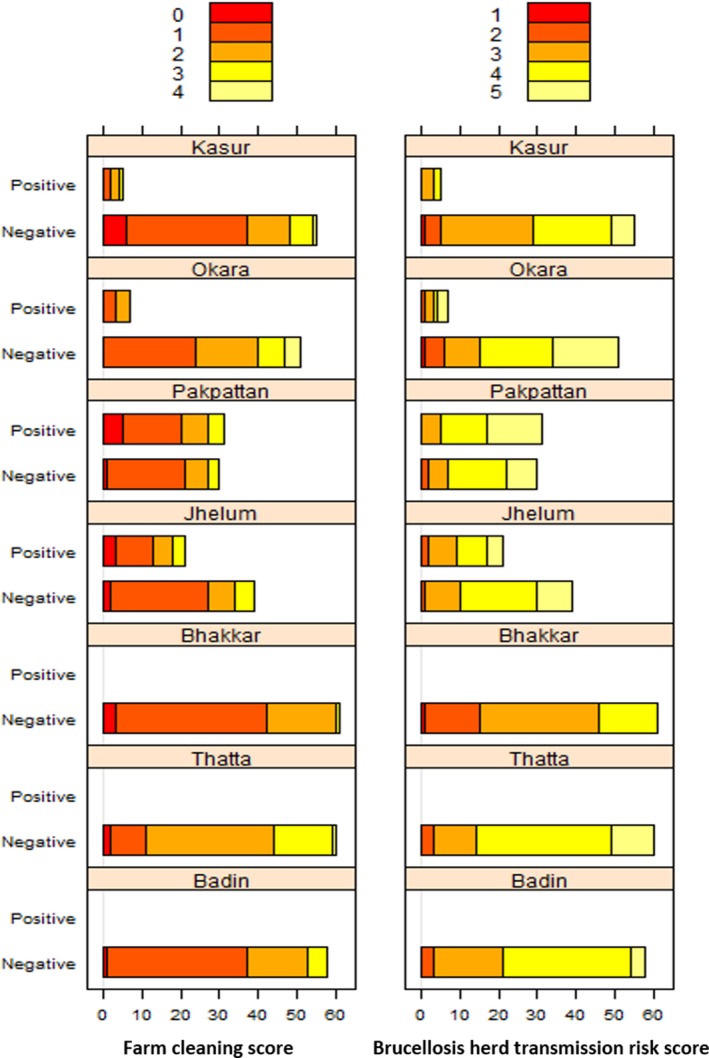
A cross-sectional study was conducted to estimate the seroprevalence of bovine brucellosis in smallholder farms in seven regions in Pakistan, identify herd and individual level risk factors for seropositivity and assess the level of engagement of farmers with risk factors. In total, 1063 cattle and buffalo belonging to 420 herds in seven districts were sampled. The Rose Bengal test (RBT), indirect enzyme-linked immunosorbent assay (I-ELISA) and competitive enzyme-linked immunosorbent assay (C-ELISA) were used for the serological diagnosis of bovine brucellosis on all the serum samples. The associations between herd-and animal-level risk factors and seropositivity were investigated using logistic regression analyses. In addition, herd management practice scores, created to quantify the number of management practices undertaken that pose a risk for Brucella transmission, were calculated and compared between seropositive and negative herds within each district. Overall herd and animal prevalence were estimated to be 16.2% (95% CI, 13-20%) and 8.7% (95% CI, 7.2-10.6%), respectively, across all districts sampled. Herds with a history of last trimester abortion were found to be more likely to be positive than herds without such history (OR = 2.06, 95% CI, 1.09-3.89), providing validation of our findings and identifying that clinical disease is occurring in this region. It was also identified that herds with five to eight buffalo (OR = 3.80, 95% CI, 1.69-8.49), and those with more than eight buffalo (OR = 3.81, 95% CI, 1.51-9.58) were more likely to be positive for Brucella than those with less (one to two and three to four) buffaloes present in the herd. The presence of other domestic animals at the farm and purchasing animals in last year were found to have no association with seropositivity. The findings of this study support the need for the development of targeted intervention strategies specific to the disease status of each district.
Keywords: Pakistan; bovine brucellosis; risk factors; seroprevalence; smallholder farmers.
© 2019 The Authors. Veterinary Medicine and Science Published by John Wiley & Sons Ltd.
Conflict of interest statement
The authors declare that they have no conflict of interest.
Figures
References
-
- Afzal M. (2009) Re‐designing smallholder dairy production in Pakistan. Pakistan Veterinary Journal 30, 187–190.
-
- Ahasan M.S., Rahman M.S., Rahman A.K. & Berkvens D. (2017) Bovine and caprine brucellosis in Bangladesh: Bayesian evaluation of four serological tests, true prevalence, and associated risk factors in household animals. Tropical Animal Health and Production 49, 1–11. - PubMed
-
- Ahmad T., Khan I., Razzaq S. & Akhtar R. (2017) Prevalence of bovine brucellosis in Islamabad and rawalpindi districts of Pakistan. Pakistan Journal of Zoology 49, 1123.
-
- Ahmadkhani M. & Alesheikh A.A. (2017) Space‐time analysis of human brucellosis considering environmental factors in Iran. Asian Pacific Journal of Tropical Disease 7, 257–265.
-
- Ali S., Ali Q., Melzer F., Khan I., Akhter S., Neubauer H. & Jamal S.M. (2014) Isolation and identification of bovine Brucella isolates from Pakistan by biochemical tests and PCR. Tropical Animal Health and Production 46, 73–78. - PubMed
Publication types
MeSH terms
LinkOut - more resources
Full Text Sources
