. 2019 Mar 24:(145):10.3791/59104.
doi: 10.3791/59104.

Characterizing Histone Post-translational Modification Alterations in Yeast Neurodegenerative Proteinopathy Models

Affiliations

Characterizing Histone Post-translational Modification Alterations in Yeast Neurodegenerative Proteinopathy Models

Seth A Bennett et al. J Vis Exp. .

Abstract

Neurodegenerative diseases, such as amyotrophic lateral sclerosis (ALS) and Parkinson's disease (PD), cause the loss of hundreds of thousands of lives each year. Effective treatment options able to halt disease progression are lacking. Despite the extensive sequencing efforts in large patient populations, the majority of ALS and PD cases remain unexplained by genetic mutations alone. Epigenetics mechanisms, such as the post-translational modification of histone proteins, may be involved in neurodegenerative disease etiology and progression and lead to new targets for pharmaceutical intervention. Mammalian in vivo and in vitro models of ALS and PD are costly and often require prolonged and laborious experimental protocols. Here, we outline a practical, fast, and cost-effective approach to determining genome-wide alterations in histone modification levels using Saccharomyces cerevisiae as a model system. This protocol allows for comprehensive investigations into epigenetic changes connected to neurodegenerative proteinopathies that corroborate previous findings in different model systems while significantly expanding our knowledge of the neurodegenerative disease epigenome.


Figures
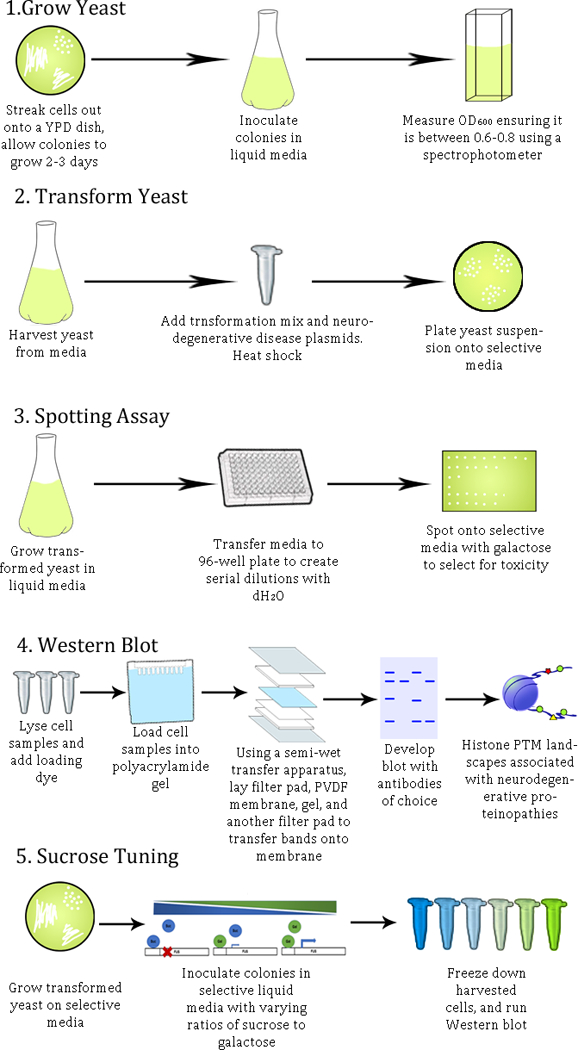
Figure 1:
Figure 1:
Method overview for the characterization of changes in histone post-translational modifications connected to neurodegenerative disease proteinopathies in yeast models.
Figure 2:
Figure 2:. Toxicity associated with overexpression of neurodegenerative proteinopathy-related proteins in yeast models.
Spotting assays show cell viability for yeast overexpressing vector control, TDP-43, FUS, or α-synuclein in the presence of glucose (a) or galactose (b). (c) Growth curve illustrating cell viability in liquid culture under galactose induction. Error bars indicate the ± SD. n = 3 for each strain. Replicates result from completely independent experiments. Data adapted with permission from Chen, K. et al. Neurodegenerative Disease Proteinopathies Are Connected to Distinct Histone Post-translational Modification Landscapes. ACS Chem Neurosci. 9 (4), pp 838–848 doi:10.1021/acschemneuro.7b00297. Copyright 2018 American Chemical Society.
Figure 3:
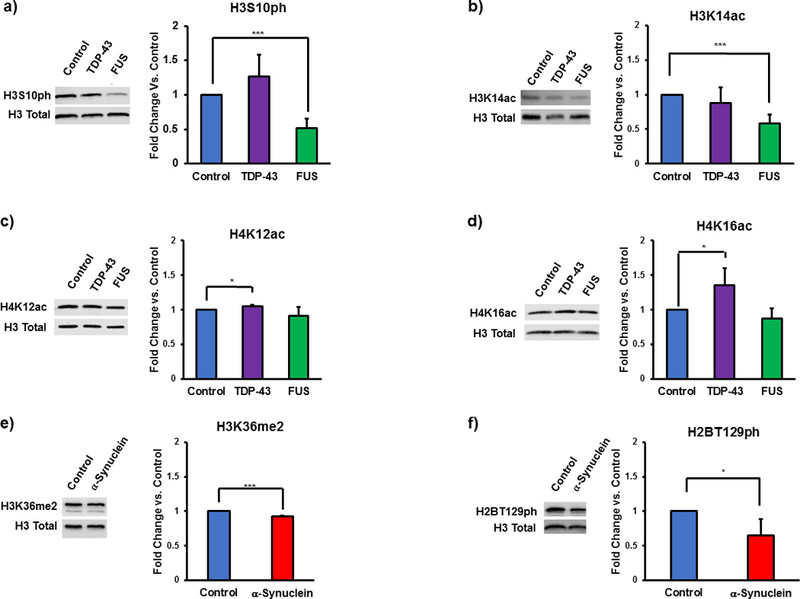
Figure 3:. Changes in histone post-translational modifications associated with overexpression of neurodegenerative proteinopathy-related proteins in yeast models.
An FUS proteinopathy model shows decreased levels of (a) H3S10ph, n = 6, and (b) H3K14ac, n = 3. Conversely, a TDP-43 proteinopathy model shows increased levels of (c) H4K12ac, n = 3, and (d) H4K16ac, n = 6, while a α-synuclein model shows decreased levels of (e) H3K36me2, n = 3, and (f) H2BT129ph, n= 7. Error bars show + SD. *, p < 0.05, ***, p < 0.001. Replicates result from completely independent experiments. Data adapted with permission from Chen, K. et al. Neurodegenerative Disease Proteinopathies Are Connected to Distinct Histone Post-translational Modification Landscapes. ACS Chem Neurosci. 9 (4), pp 838–848 doi:10.1021/acschemneuro.7b00297. Copyright 2018 American Chemical Society.
Figure 4:
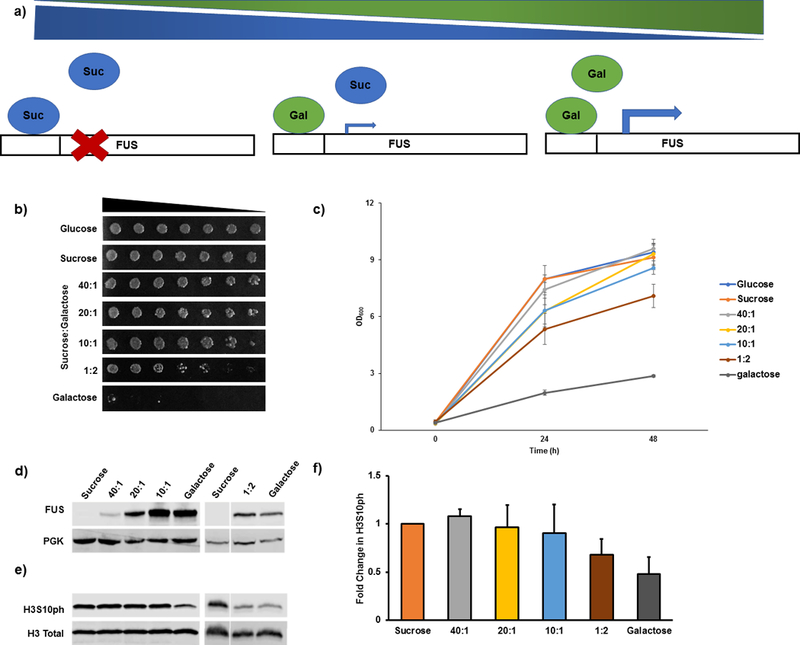
Figure 4:. Extent of decrease in H3S10ph levels is tied to the level of FUS overexpression.
(a) Cartoon illustration of the use of sucrose and galactose ratios to ‘tune’ the amount of FUS overexpression. (b) Spotting assays showing cell viability in the presence of varying levels of galactose. (c) Growth curve in liquid culture showing cell viability in the presence of varying levels of galactose. Error bars indicate ± SD. (d) Representative immunoblots showing that the FUS protein levels rise as cells are exposed to increasing ratios of galactose. Phosphoglycerate kinase (PGK) was used as a loading control. (e) Representative immunoblots showing corresponding decreases in H3S10ph levels with increasing ratios of galactose. (f) Quantitation histogram of (e). n = 3 for each condition. Error bars indicate + SD for quantification chart. Replicates result from completely independent experiments. Data adapted with permission from Chen, K. et al. Neurodegenerative Disease Proteinopathies Are Connected to Distinct Histone Post-translational Modification Landscapes. ACS Chem Neurosci. 9 (4), pp 838–848 doi:10.1021/acschemneuro.7b00297. Copyright 2018 American Chemical Society.

References

    1. Landgrave-Gómez J, Mercado-Gómez O, Guevara-Guzmán R Epigenetic mechanisms in neurological and neurodegenerative diseases. Frontiers in Cellular Neuroscience. 9, 58 (2015). - PMC - PubMed
    1. Paez-Colasante X, Figueroa-Romero C, Sakowski SA, Goutman SA, Feldman EL Amyotrophic lateral sclerosis: mechanisms and therapeutics in the epigenomic era. Nature Reviews Neurology. 11 (5), 266–279, doi:10.1038/nrneurol.2015.57, (2015). - DOI - PubMed
    1. Beitz JM Parkinson’s Disease: a Review. Frontiers in bioscience (6), 65–74, doi:10.2741/S415 (2014). - DOI - PubMed
    1. Kim HJ et al. Mutations in prion-like domains in hnRNPA2B1 and hnRNPA1 cause multisystem proteinopathy and ALS. Nature. 495, 467, doi:10.1038/nature1192210.1038/nature11922https://www.nature.com/articles/nature11922-supplementary-informationhttps://www.nature.com/articles/nature11922-supplementary-information, (2013). - DOI - PMC - PubMed
    1. Poewe W et al. Parkinson disease. Nature Reviews Disease Primers. 3, 17013, doi:10.1038/nrdp.2017.1310.1038/nrdp.2017.13https://www.nature.com/articles/nrdp201713-supplementary-informationhttps://www.nature.com/articles/nrdp201713-supplementary-information, (2017). - DOI - PubMed

Publication types

MeSH terms