Comment
. 2019 Apr 8;129(5):1830-1832.
doi: 10.1172/JCI128479.

Singling out Th2 cells in eosinophilic esophagitis

Comment

Singling out Th2 cells in eosinophilic esophagitis

Walter L Eckalbar et al. J Clin Invest. .

Abstract

Eosinophilic esophagitis (EoE) is a recently described disease in which exposure to specific foods and allergens leads to type 2 inflammation, epithelial barrier dysfunction, and difficulty in swallowing. In the current issue of the JCI, Wen and colleagues investigate tissue T cell heterogeneity in patients with EoE using single-cell RNA sequencing (scRNA-seq). Esophageal epithelium from individuals with EoE convtained a prominent population of Th2 cells not seen in controls. The short-chain fatty acid (SCFA) receptor FFAR3 was found to be highly expressed in EoE Th2 cells. Experiments presented here provide evidence that SCFAs may promote type 2 inflammation in allergic diseases such as EoE and asthma. This study provides an early example of scRNA-seq for identifying relevant cell populations and mechanisms underlying allergic diseases.


Conflict of interest statement

Conflict of interest: The authors have declared that no conflict of interest exists.

Figures

Figure 1
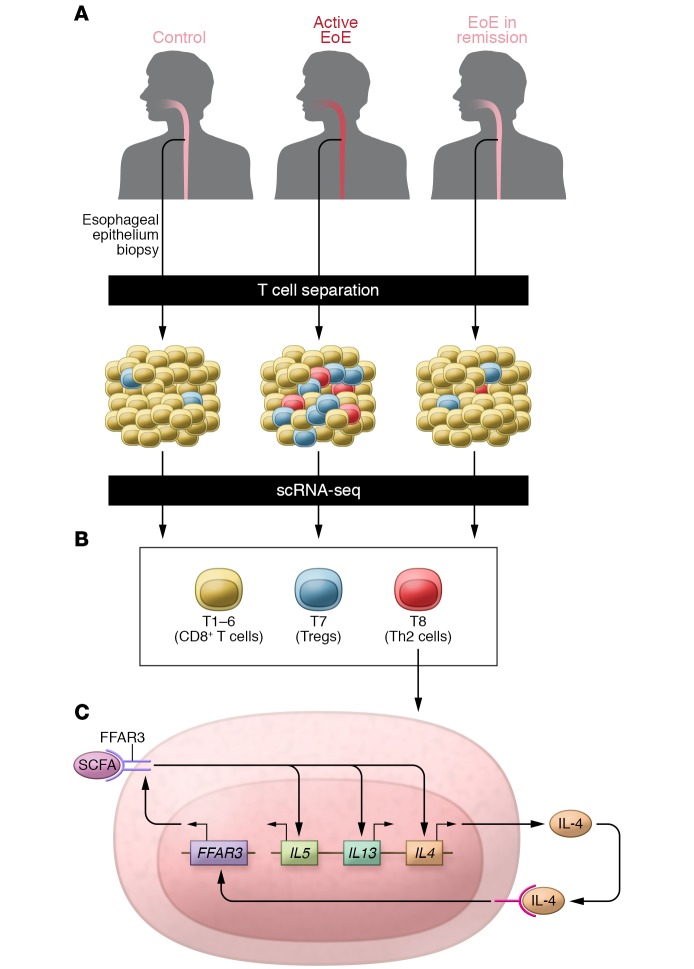
Figure 1. Single-cell RNA-seq–based identification of a role for FFAR3 in Th2 cells.
(A) T cells were isolated from esophageal biopsies obtained from subjects with EoE and healthy controls and analyzed by single-cell RNA-seq (scRNA-seq) on the Fluidigm C1 platform. (B) Two clusters of CD4+ T cells, T7 and T8, were enriched in subjects with EoE. (C) Cluster T8 included effector memory Th2 cells expressing IL4, IL5, and IL13, as well as FFAR3. Stimulation with FFAR ligands (SCFAs) increased production of Th2 cytokines in cell culture and augmented type 2 responses in an allergic airway disease model. In addition, IL-4 stimulated expression of FFAR3, suggesting the existence of a positive feedback loop that might amplify type 2 responses in EoE and other allergic diseases.

Comment on

References

    1. Attwood SE, Smyrk TC, Demeester TR, Jones JB. Esophageal eosinophilia with dysphagia. A distinct clinicopathologic syndrome. Dig Dis Sci. 1993;38(1):109–116. doi: 10.1007/BF01296781. - DOI - PubMed
    1. Furuta GT, Katzka DA. Eosinophilic esophagitis. N Engl J Med. 2015;373(17):1640–1648. doi: 10.1056/NEJMra1502863. - DOI - PMC - PubMed
    1. Dellon ES, et al. Distribution and variability of esophageal eosinophilia in patients undergoing upper endoscopy. Mod Pathol. 2015;28(3):383–390. doi: 10.1038/modpathol.2014.110. - DOI - PMC - PubMed
    1. Straumann A, Bauer M, Fischer B, Blaser K, Simon HU. Idiopathic eosinophilic esophagitis is associated with a T(H)2-type allergic inflammatory response. J Allergy Clin Immunol. 2001;108(6):954–961. doi: 10.1067/mai.2001.119917. - DOI - PubMed
    1. Martin LJ, et al. Eosinophilic esophagitis (EoE) genetic susceptibility is mediated by synergistic interactions between EoE-specific and general atopic disease loci. J Allergy Clin Immunol. 2018;141(5):1690–1698. doi: 10.1016/j.jaci.2017.09.046. - DOI - PMC - PubMed

Publication types