. 2019 Jun;79(8):909-919.
doi: 10.1002/pros.23801. Epub 2019 Apr 8.

Activation of cGMP/PKG/p65 signaling associated with PDE5-Is downregulates CCL5 secretion by CD8 + T cells in benign prostatic hyperplasia

Affiliations

Activation of cGMP/PKG/p65 signaling associated with PDE5-Is downregulates CCL5 secretion by CD8 + T cells in benign prostatic hyperplasia

Song Jin et al. Prostate. 2019 Jun.

Abstract

Background: Benign prostatic hyperplasia (BPH) is the most common urological disease in elderly men, but the underlying pathophysiological mechanisms are complex and not fully understood. Phosphodiesterase type 5 inhibitors (PDE5-Is) used to treat BPH could upregulate the cyclic guanosine monophosphate (cGMP)-dependent protein kinase G (PKG) signaling, which was shown to blunt inflammation in the prostate. Our previous findings indicate that CD8+ T cells promote the proliferation of BPH epithelial cells (BECs) in low androgen conditions through secretion of CCL5; however, the role of the cGMP/PKG pathway in the process is unclear.

Methods: Paraffin-embedded tissues were used for expression quantity of CD8+ T cells, CCL5, cyclin D1, and PDE5 protein by immunohistology in prostate specimens which were/were not treated with finasteride 5 mg daily for at least 6 months before surgery. BPH-1 cells were cocultured with or without CD8 + T cells or PDE5-Is in low androgen conditions for 4 days. The conditioned media, BPH-1 cells, and CD8 + T cells were harvested for the subsequent experiments. The quantitative polymerase chain reaction was used for assaying the level of messenger RNA expression of CCL5. CCL5 in the conditioned media was detected by the enzyme-linked immunosorbent assay. The effect of PDE5-Is on cocultured BPH-1/CD8 + T-cell proliferation was detected by the cell counting kit-8. A high-fat diet (HFD)-induced prostatic hyperplasia rat model was used to investigate the effect of cGMP/PKG activation in CD8 + T cells in vivo.

Results: CD8+ T-cell infiltration into human BPH tissues was positively correlated with the expression of CCL5, cyclin D1, and PDE5, whereas in an HFD-induced prostatic hyperplasia rat model, the activation of the cGMP/PKG signaling by a PDE5-I could suppress the CD8 + T-cell infiltration and the CCL5 and cyclin D1 expression. Furthermore, the activation of the cGMP/PKG pathway inhibited CCL5 secretion by CD8 + T cells by downregulating nuclear factor-κB p65 phosphorylation, which reduced the growth of BPH-1 through CCL5/STAT5/CCND1 signaling.

Conclusions: Our results indicate that the upregulation of the cGMP/PKG/p65 signaling reduces CCL5 secretion in CD8 + T cells, which in turn decreases the proliferation of BECs in low androgen conditions, suggesting that the combination of 5α reductase inhibitors lowering androgen levels and PDE5-Is may be a novel, more effective treatment for BPH patients.

Keywords: CCL5; CD8+ T cell; benign epithelial cell; cyclic guanosine monophosphate/protein kinase G; nuclear factor-κB/p65.


Conflict of interest statement

The authors declare that there are no conflict of interests.

Figures
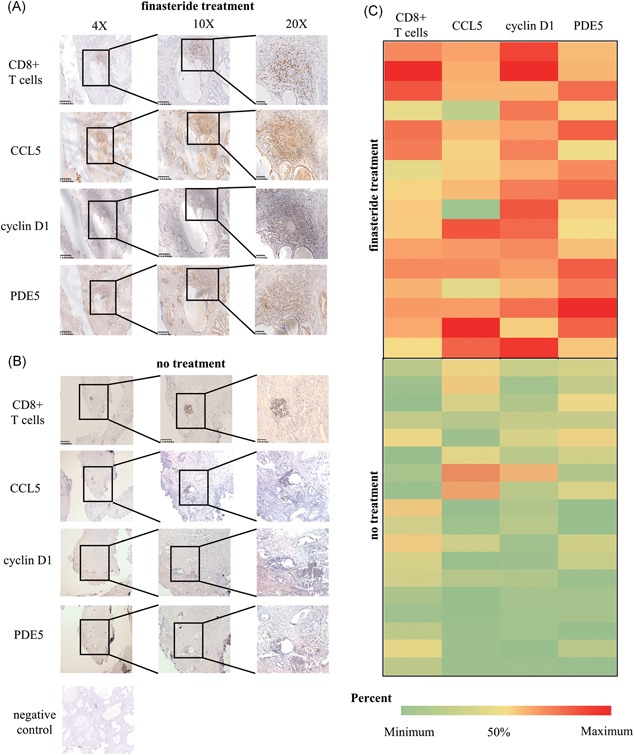
Figure 1
Figure 1
Comparison of CD8+ T‐cell infiltration and CCL5, CCND1, and PDE5 expression in tissues of finasteride‐treated and untreated BPH patients. A,B, Infiltration of CD8+ T cells and expression of CCL5, CCND1, and PDE5 were analyzed by IHC staining of serial paraffin sections from prostate tissues of BPH patients treated or not with finasteride for at least 6 months. C, Heat map showing the distribution of CD8+ T cells and CCL5, CCND1, and PDE5 expression in the finasteride‐treated and untreated groups. BPH, benign prostatic hyperplasia; IHC, immunohistochemistry; PDE5, phosphodiesterase type 5 [Color figure can be viewed at wileyonlinelibrary.com]
Figure 2
Figure 2
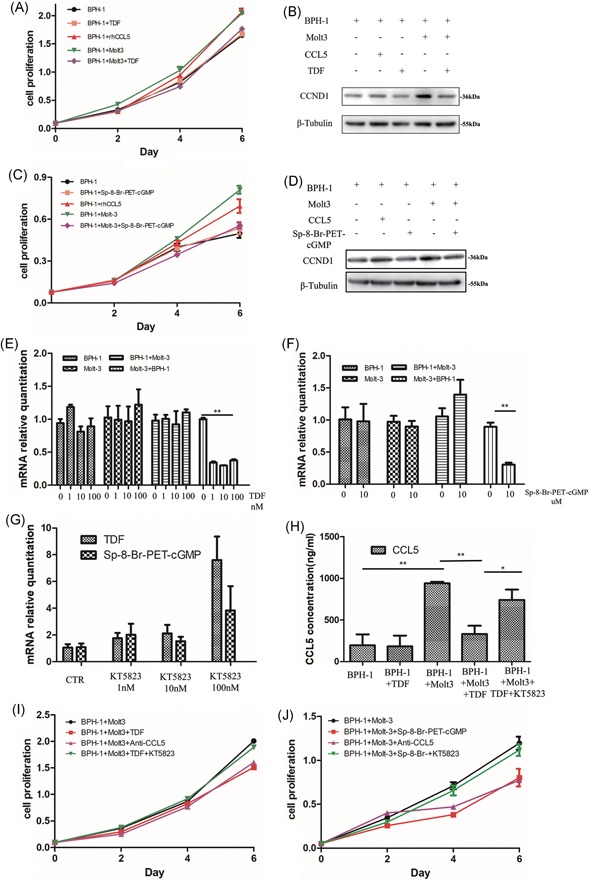
Activation of the cGMP/PKG signaling pathway could reverse the induction of BEC proliferation by CD8+ T cells through suppressing the secretion of CCL5 by CD8+ T cells in low androgen conditions. BECs were cocultured with or without Molt‐3 cells in low androgen conditions for 4 days. A,C, BECs cultured with rhCCL5 (1 μg/mL) and tadalafil (100 nM) or Sp‐8‐Br‐PET‐cGMP (10 μM) were analyzed for proliferation at days 2, 4, and 6 using the CCK‐8 assay. The data are shown as the mean ± SD; *P < 0.05 and **P < 0.01. B,D, BECs were harvested at day 4 and analyzed for CCND1 expression by Western blot analysis; β‐Tubulin was used as a loading control. E‐G, CCL5 mRNA expression in Molt‐3 cells at day 2 was analyzed by qPCR. CCL5 mRNA levels were downregulated by tadalafil (100 nM) or Sp‐8‐Br‐PET‐cGMP (10 μM) in Molt‐3 cells cocultured with BECs, but KT5823 (100 nM) reversed the effect. H, CCL5 secretion to conditioned medium of cocultures and monocultures treated or not with tadalafil and/or KT5823 at day 4 was assessed by ELISA. I,J, BPH‐1 cells treated or not with tadalafil or Sp‐8‐Br‐PET‐cGMP, anti‐CCL5 neutralizing antibody (2 μg/mL), and KT5823 were analyzed for proliferation at days 2, 4, and 6 using the CCK‐8 assay. Data are shown as the mean ± SD; *P < 0.05 and **P < 0.01. BEC, BPH epithelial cell; BPH, benign prostatic hyperplasia; CCK‐8, cell counting kit‐8; cGMP, cyclic guanosine monophosphate; ELISA, enzyme‐linked immunosorbent assay; mRNA, messenger RNA; PKG, protein kinase G; qPCR, quantitative polymerase chain reaction, TDF, tadalafil [Color figure can be viewed at wileyonlinelibrary.com]
Figure 3
Figure 3
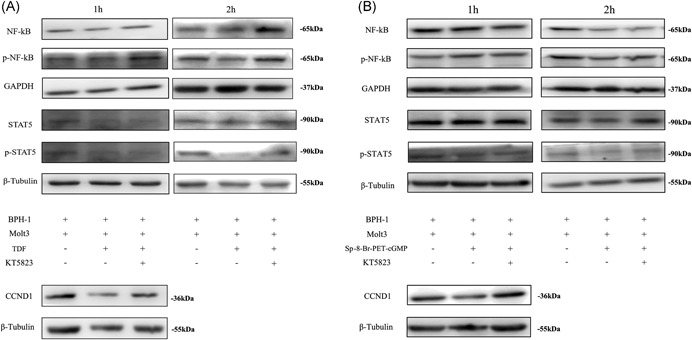
Expression of signaling molecules downstream of the cGMP/PKG pathway involved in the inhibition of BEC proliferation in low androgen conditions. Cocultures of BECs and Molt‐3 cells were treated with tadalafil (A) or Sp‐8‐Br‐PET‐cGMP (B) with or without KT5823 for 1 and 2 hours. BECs and Molt‐3 cells were harvested separately and analyzed by Western blot analysis for total NF‐κB and phospho‐NF‐κB (Molt‐3 cells) and total STAT5, phospho‐STAT5, and CCND1 (BPH‐1 cells). β‐Tubulin and GAPDH were used as loading controls. BEC, BPH epithelial cell; BPH, benign prostatic hyperplasia; cGMP, cyclic guanosine monophosphate; GAPDH, glyceraldehyde 3‐phosphate dehydrogenase; NF‐κB, nuclear factor‐κB; PKG, protein kinase G; STAT5, signal transducer and activator of transcription 5; TDF, tadalafil
Figure 4
Figure 4
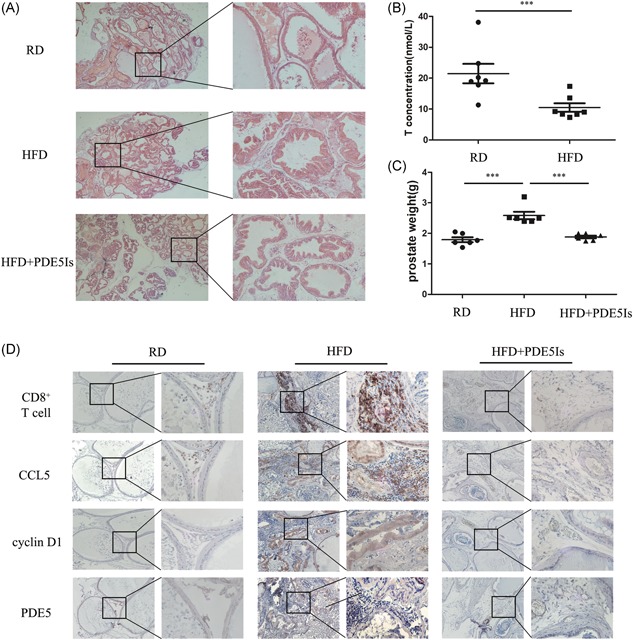
Activation of cGMP/PKG signaling suppressed CCL5 secretion by CD8+ T cells and reversed the induction of BEC proliferation in vivo. A, The degree of prostatic hyperplasia in rats receiving regular diet (RD), HFD, or HFD + PDE5‐Is was evaluated by hematoxylin and eosin staining of rat prostate samples (n = 6 rats per group). B, The serum testosterone levels of RD and HFD groups were measured using an automated chemiluminescence system at week 12; *P < 0.05, **P < 0.01, and ***P < 0.001 (by t test). C, All rat prostate weight of three groups were tested at last; *P < 0.05, **P < 0.01, and ***P < 0.001 (by one‐way ANOVA). D, CD8+ T‐cell infiltration and CCL5, CCND1, and PDE5 expression was analyzed by IHC staining in serial paraffin sections of the rat prostate. ANOVA, analysis of variance; BEC, BPH epithelial cell; cGMP, cyclic guanosine monophosphate; HFD, high‐fat diet; IHC, immunohistochemistry; PDE5, phosphodiesterase type 5; PKG, protein kinase G; RD, regular diet [Color figure can be viewed at wileyonlinelibrary.com]
Figure 5
Figure 5
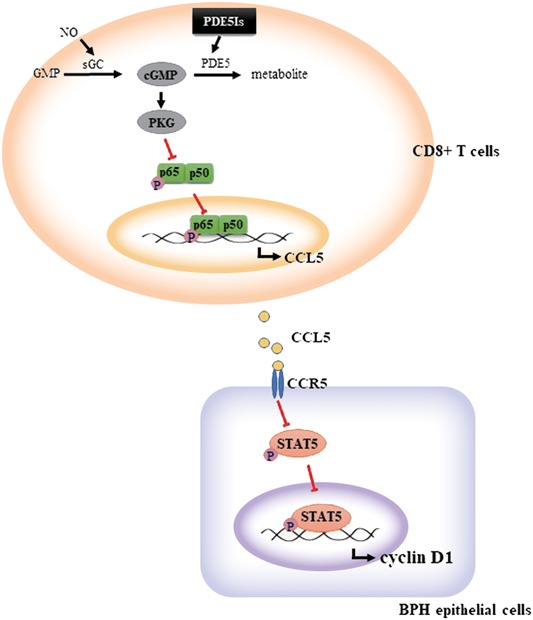
Schematic representation of the molecular mechanism underlying BEC proliferation in BPH. Activation of the cGMP/PKG signaling pathway in CD8+ T cells decreased NF‐κB phosphorylation and CCL5 secretion, resulting in the inhibition of CCL5/STAT5/CCND1 signaling in BECs and decrease of their proliferation in low androgen conditions. BEC, BPH epithelial cell; BPH, benign prostatic hyperplasia; cGMP, cyclic guanosine monophosphate; NF‐κB, nuclear factor‐κB; PDE5, phosphodiesterase type 5; PDE5‐I, PDE5 inhibitors; PKG, protein kinase G; STAT5, signal transducer and activator of transcription 5 [Color figure can be viewed at wileyonlinelibrary.com]

References

    1. Gacci M, Eardley I, Giuliano F, et al. Critical analysis of the relationship between sexual dysfunctions and lower urinary tract symptoms due to benign prostatic hyperplasia. Eur Urol. 2011;60(4):809‐825. - PubMed
    1. Gacci M, Corona G, Salvi M, et al. A systematic review and meta‐analysis on the use of phosphodiesterase 5 inhibitors alone or in combination with alpha‐blockers for lower urinary tract symptoms due to benign prostatic hyperplasia. Eur Urol. 2012;61(5):994‐1003. - PubMed
    1. Oelke M, Giuliano F, Mirone V, Xu L, Cox D, Viktrup L. Monotherapy with tadalafil or tamsulosin similarly improved lower urinary tract symptoms suggestive of benign prostatic hyperplasia in an international, randomised, parallel, placebo‐controlled clinical trial. Eur Urol. 2012;61(5):917‐925. - PubMed
    1. Oelke M, Shinghal R, Sontag A, Baygani SK, Donatucci CF. Time to onset of clinically meaningful improvement with tadalafil 5 mg once daily for lower urinary tract symptoms secondary to benign prostatic hyperplasia: analysis of data pooled from 4 pivotal, double‐blind, placebo controlled studies. J Urol. 2015;193(5):1581‐1589. - PubMed
    1. Donatucci CF, Brock GB, Goldfischer ER, et al. Tadalafil administered once daily for lower urinary tract symptoms secondary to benign prostatic hyperplasia: a 1‐year, open‐label extension study. BJU Int. 2011;107(7):1110‐1116. - PubMed

Publication types