


Effect of Aging on Chemical and Rheological Properties of Bitumen
- PMID: 30961270
- PMCID: PMC6401746
- DOI: 10.3390/polym10121345
Effect of Aging on Chemical and Rheological Properties of Bitumen
Abstract
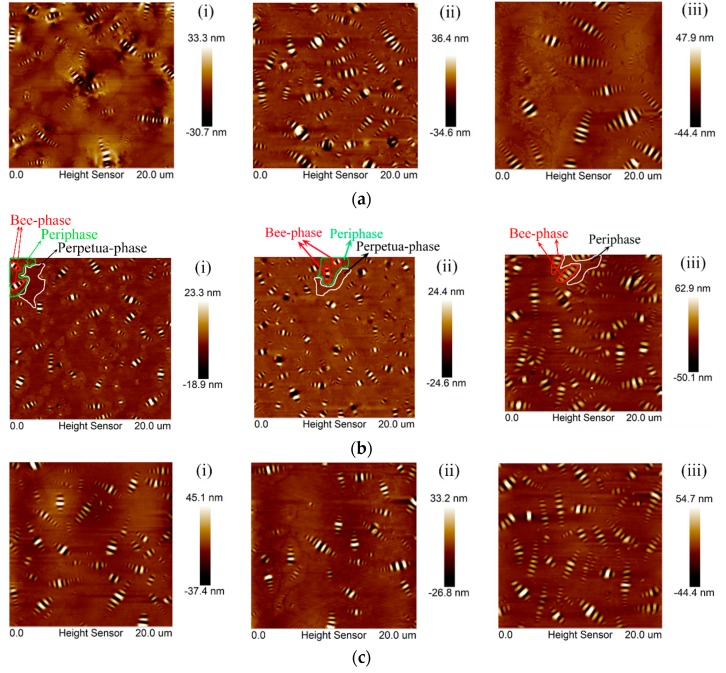
Engineering performance of asphalt pavement highly depends on the properties of bitumen, the bonding material to glue aggregates and fillers together. During the service period, bitumen is exposed to sunlight, oxygen and vehicle loading which in turn leads to aging and degradation. A comprehensive understanding of the aging mechanism of bitumen is of critical importance to enhance the durability of asphalt pavement. This study aims to determine the relations between micro-mechanics, chemical composition, and macro-mechanical behavior of aged bitumen. To this end, the effect of aging on micro-mechanics, chemical functional groups, and rheological properties of bitumen were evaluated by atomic force microscope, Fourier transform infrared spectroscopy and dynamic shear rheometer tests, respectively. Results indicated that aging obviously increased the micro-surface roughness of bitumen. A more discrete distribution of micromechanics on bitumen micro-surface was noticed and its elastic behavior became more significant. Aging also resulted in raised content of carbonyl, sulfoxide, and aromatic ring functional groups. In terms of rheological behavior, the storage modulus of bitumen apparently increased after aging due to the transformation of viscous fractions to elastic fractions, making it stiffer and less viscous. By correlation analysis, it is noted that the bitumen rheological behavior was closely related to its micro-mechanics.
Keywords: aging; bitumen; functional group; micro mechanics; rheological property.
Conflict of interest statement
The authors declare no conflict of interest.
Figures


References
-
- Wang J., Yuan J., Kim K.W., Xiao F. Chemical, thermal and rheological characteristics of composite polymerized asphalts. Fuel. 2018;227:289–299. doi: 10.1016/j.fuel.2018.04.100. - DOI
-
- Yuan J., Wang J., Xiao F., Amirkhanian S., Wang J., Xu Z. Impacts of multiple-polymer components on high temperature performance characteristics of airfield modified binders. Constr. Build. Mater. 2017;134:694–702. doi: 10.1016/j.conbuildmat.2016.12.156. - DOI
-
- Yu J., Yu X., Gao Z., Guo F., Wang D., Yu H. Fatigue Resistance Characterization of Warm Asphalt Rubber by Multiple Approaches. Appl. Sci. 2018;8:1495. doi: 10.3390/app8091495. - DOI
-
- Liu K., Zhang X., Guo D., Wang F., Xie H. The interlaminar shear failure characteristics of asphalt pavement coupled heating cables. Mater. Struct. 2018;51:67. doi: 10.1617/s11527-018-1193-0. - DOI
-
- Zeng W., Wu S., Wen J., Chen Z. The temperature effects in aging index of asphalt during UV aging process. Constr. Build. Mater. 2015;93:1125–1131. doi: 10.1016/j.conbuildmat.2015.05.022. - DOI
Grants and funding
LinkOut - more resources
Full Text Sources
