


Adaptive individual variation in phenological responses to perceived predation levels
- PMID: 30962485
- PMCID: PMC6453887
- DOI: 10.1038/s41467-019-09138-5
Adaptive individual variation in phenological responses to perceived predation levels
Erratum in
-
Author Correction: Adaptive individual variation in phenological responses to perceived predation levels.Nat Commun. 2019 Dec 6;10(1):5667. doi: 10.1038/s41467-019-13715-z. Nat Commun. 2019. PMID: 31806870 Free PMC article.
Abstract
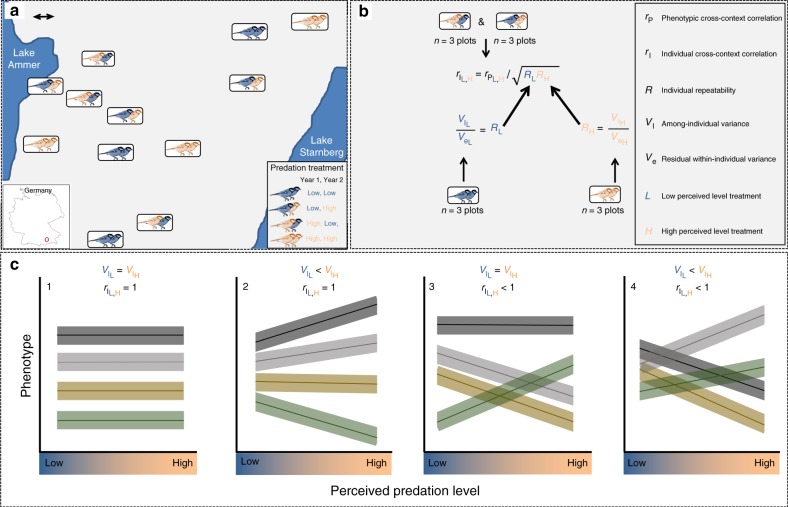
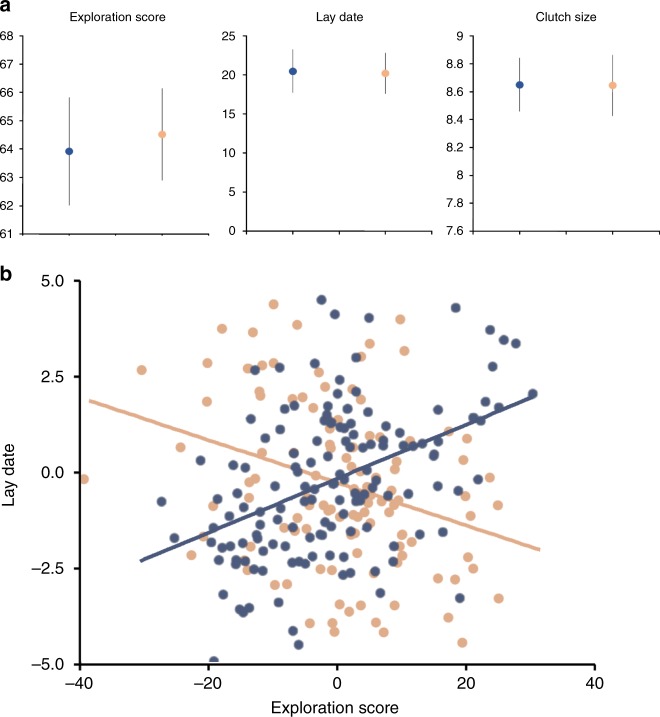
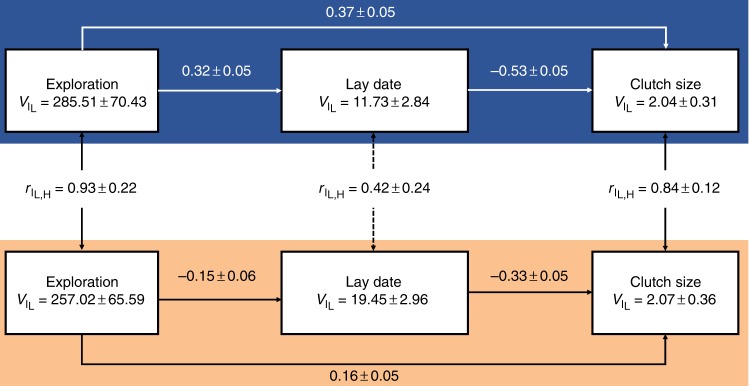
The adaptive evolution of timing of breeding (a component of phenology) in response to environmental change requires individual variation in phenotypic plasticity for selection to act upon. A major question is what processes generate this variation. Here we apply multi-year manipulations of perceived predation levels (PPL) in an avian predator-prey system, identifying phenotypic plasticity in phenology as a key component of alternative behavioral strategies with equal fitness payoffs. We show that under low-PPL, faster (versus slower) exploring birds breed late (versus early); the pattern is reversed under high-PPL, with breeding synchrony decreasing in conjunction. Timing of breeding affects reproductive success, yet behavioral types have equal fitness. The existence of alternative behavioral strategies thus explains variation in phenology and plasticity in reproductive behavior, which has implications for evolution in response to anthropogenic change.
Conflict of interest statement
The authors declare no competing interests.
Figures
References
-
- Vedder O, Bouwhuis S, Sheldon BC. The contribution of an avian top predator to selection in prey species. J. Anim. Ecol. 2014;83:99–106. - PubMed
-
- Davies, N., Krebs, J. & West, S. An Introduction to Behavioural Ecology. (Wiley-Blackwell, Oxford, 2012).
-
- Gotmark F. Predation by sparrowhawks favours early breeding and small broods in great tits. Oecologia. 2002;130:25–32. - PubMed
-
- Ims RA. On the adaptive value of reproductive synchrony as a predator-swamping strategy. Am. Nat. 1990;136:485–498.
