


Impact of psychologically tailored hand hygiene interventions on nosocomial infections with multidrug-resistant organisms: results of the cluster-randomized controlled trial PSYGIENE
- PMID: 30962918
- PMCID: PMC6434638
- DOI: 10.1186/s13756-019-0507-5
Impact of psychologically tailored hand hygiene interventions on nosocomial infections with multidrug-resistant organisms: results of the cluster-randomized controlled trial PSYGIENE
Abstract
Background: Professional hand hygiene compliance represents a multifaceted behaviour with various determinants. Thus, it has been proposed to apply psychological frameworks of behaviour change to its promotion. However, randomized controlled trials of such approaches, which also assess nosocomial infections (NIs), are rare. This study analyses data of the PSYGIENE-trial (PSYchological optimized hand hyGIENE promotion), which has shown improvements in compliance after interventions tailored based on the Health Action Process Approach (HAPA), on rates of NIs with multidrug-resistant organisms (MDROs).
Methods: A parallel-group cluster-randomized controlled trial was conducted on all 10 intensive care units and two hematopoietic stem cell transplantation units at Hannover Medical School, a German tertiary care hospital. Educational training sessions for physicians and nurses (individual-level intervention) and feedback discussions with clinical managers and head nurses (cluster-level) were implemented in 2013. In the "Tailoring"-arm (n = 6 wards), interventions were tailored based on HAPA-components, which were empirically assessed and addressed by behaviour change techniques. As active controls, n = 6 wards received untailored educational sessions of the local "Clean Care is Safer Care"-campaign (Aktion Saubere Hände: "ASH"-arm). From 2013 to 2015 compliance was assessed by observation following the World Health Organization, while alcohol-based hand rub usage (AHRU) and NIs with multidrug-resistant gram-negative bacteria, Methicillin-resistant Staphylococcus aureus or Vancomycin-resistant Enterococcus were assessed following national surveillance protocols. Data were analysed at cluster-level.
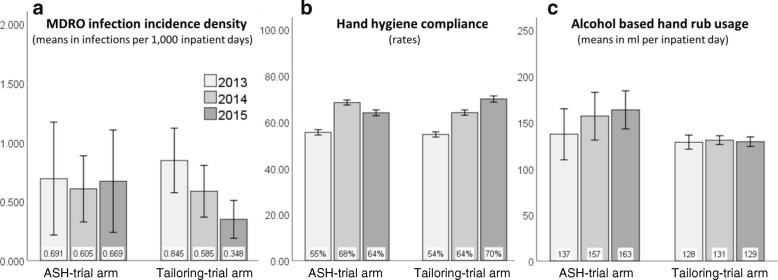
Results: In the "Tailoring"-arm, interventions led to a decrease of 0.497 MDRO-infections per 1000 inpatient days from 2013 to 2015 (p = 0.015). This trend was not found in the "ASH"-arm (- 0 . 022 infections; p = 0.899). These patterns corresponded inversely to the trends in compliance but not in AHRU.
Conclusions: While interventions tailored based on the HAPA-model did not lead to a significantly lower incidence rate of MDRO-infections compared to control wards, a significant reduction, compared to baseline, was found in the second follow-up year in the "Tailoring"- but not the "ASH"-arm. This indicates that HAPA-tailored hand hygiene interventions may contribute to the prevention of NIs with MDRO. Further research should focus on addressing compliance by interventions tailored not only to wards, but also leaders, teams, and individuals.
Trial registration: German Clinical Trials Register/International Clinical Trials Registry Platform, DRKS00010960. Registered 19 August 2016-Retrospectively registered, https://www.drks.de/drks_web/navigate.do?navigationId=trial.HTML&TRIAL_ID=DRKS00010960. http://apps.who.int/trialsearch/Trial2.aspx?TrialID=DRKS00010960.
Keywords: Hand hygiene compliance; Intensive care units; Multidrug-resistant organisms; Nosocomial infections; Physicians and nursing staff; Psychological tailoring.
Conflict of interest statement
The PSYGIENE-trial was approved by the Ethics Committee at Hannover Medical School on May 9th, 2012 (#1434–2012), and by its Employee Committee on October 12th, 2012 (#2012–10–18).Not applicable.All authors declare that there are no competing interests.Springer Nature remains neutral with regard to jurisdictional claims in published maps and institutional affiliations.
Figures
References
-
- Allegranzi B, Stewardson AJ, Pittet D. Compliance with hand hygiene best practices. In: Pittet D, Boyce JM, Allegranzi B, editors. Hand hygiene: a handbook for medical professionals. Chichester: Wiley Blackwell; 2017. pp. 76–84.
-
- World Health Organization (WHO). WHO guidelines of hand hygiene in health care: first global patient safety challenge clean care is safer care. Geneva: WHO; 2009. whqlibdoc.who.int/publications/2009/9789241597906_eng.pdf . Accessed 6 Feb 2019 - PubMed
Publication types
MeSH terms
LinkOut - more resources
Full Text Sources
Medical
Research Materials
Miscellaneous
