


A National Survey of Internal Medicine Primary Care Residency Program Directors
- PMID: 30963438
- PMCID: PMC6614222
- DOI: 10.1007/s11606-019-04984-x
A National Survey of Internal Medicine Primary Care Residency Program Directors
Abstract
Background: The United States is facing a primary care physician shortage. Internal medicine (IM) primary care residency programs have expanded substantially in the past several decades, but there is a paucity of literature on their characteristics and graduate outcomes.
Objective: We aimed to characterize the current US IM primary care residency landscape, assess graduate outcomes, and identify unique programmatic or curricular factors that may be associated with a high proportion of graduates pursuing primary care careers.
Design: Cross-sectional study PARTICIPANTS: Seventy out of 100 (70%) IM primary care program directors completed the survey.
Main measures: Descriptive analyses of program characteristics, educational curricula, clinical training experiences, and graduate outcomes were performed. Bivariate and multivariate logistic regression analyses were used to determine the association between ≥ 50% of graduates in 2016 and 2017 entering a primary care career and program characteristics, educational curricula, and clinical training experiences.
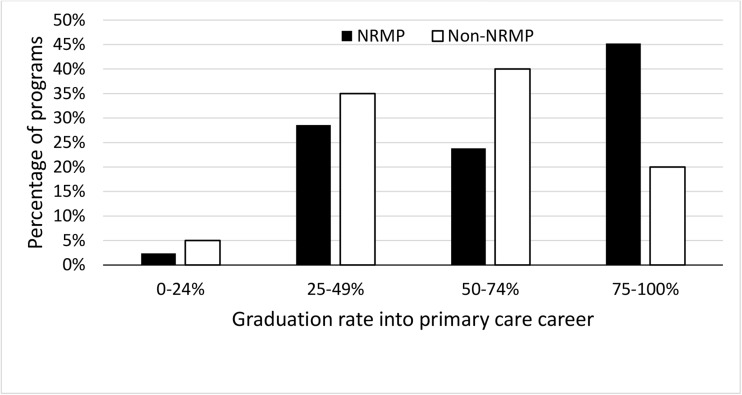
Key results: Over half of IM primary care program graduates in 2016 and 2017 pursued a primary care career upon residency graduation. The majority of program, curricular, and clinical training factors assessed were not associated with programs that have a majority of their graduates pursuing a primary care career path. However, programs with a majority of program graduates entering a primary care career were less likely to have X + Y scheduling compared to the other programs.
Conclusions: IM primary care residency programs are generally succeeding in their mission in that the majority of graduates are heading into primary care careers.
Keywords: medical education-career choice; medical education-graduate; medical student and residency education; primary care; survey research.
Conflict of interest statement
The authors declare that they do not have a conflict of interest.
Figures
References
-
- Baicker K, Chandra A. Medicare spending, the physician workforce, and beneficiaries’ quality of care. Health Aff. 2004;23(SUPPL). 10.1377/hlthaff.W4.184. - PubMed
-
- Dall T, West T, Chakrabarti R, Lacobucci W. The Complexities of Physician Supply and Demand: Projections from 2015 to 2030 (2017 Update). 2016:1–51.
MeSH terms
LinkOut - more resources
Full Text Sources
Miscellaneous
