. 2018 Dec 19;285(1893):20182233.
doi: 10.1098/rspb.2018.2233.

Clonal evolution and genome stability in a 2500-year-old fungal individual

Affiliations

Clonal evolution and genome stability in a 2500-year-old fungal individual

James B Anderson et al. Proc Biol Sci. .

Abstract

Individuals of the basidiomycete fungus Armillaria are well known for their ability to spread from woody substrate to substrate on the forest floor through the growth of rhizomorphs. Here, we made 248 collections of A. gallica in one locality in Michigan's Upper Peninsula. To identify individuals, we genotyped collections with molecular markers and somatic compatibility testing. We found several different individuals in proximity to one another, but one genetic individual stood out as exceptionally large, covering hundreds of tree root systems over approximately 75 hectares of the forest floor. Based on observed growth rates of the fungus, we estimate the minimum age of the large individual as 2500 years. With whole-genome sequencing and variant discovery, we also found that mutation had occurred within the somatic cells of the individual, reflecting its historical pattern of growth from a single point. The overall rate of mutation over the 90 mb genome, however, was extremely low. This same individual was first discovered in the late 1980s, but its full spatial extent and internal mutation dynamic was unknown at that time. The large individual of A. gallica has been remarkably resistant to genomic change as it has persisted in place.

Keywords: Armillaria; genome stability; mutation; single-nucleotide polymorphism.


Conflict of interest statement

The authors have no competing financial interests.

Figures
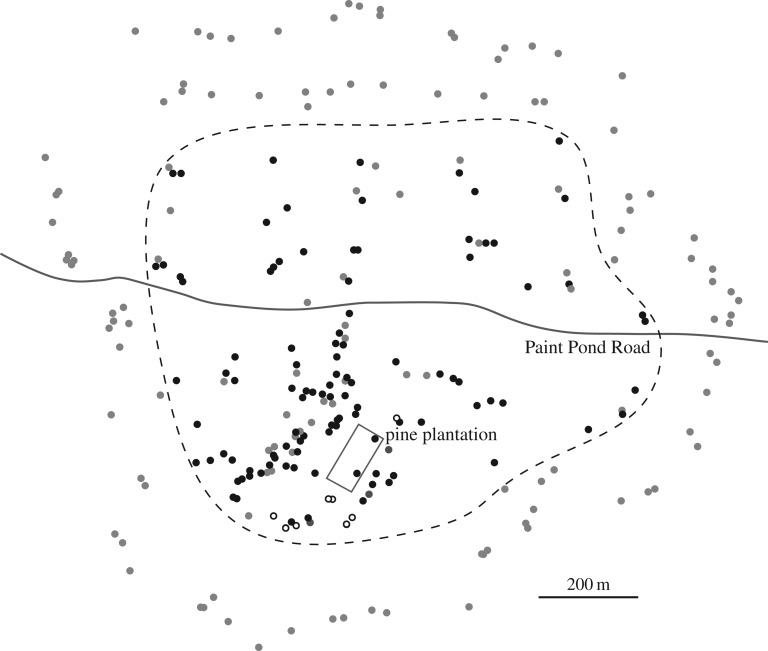
Figure 1.
Figure 1.
Map of all collections of Armillaria. Black dots, C1; open circles, C2; grey dots, all other individuals combined. The outline of the pine plantation and Paint Pond Road are included as alignment features. The present sample, which was larger and more broadly distributed than the previous [1], was designed to find the approximate borders of C1. The dashed line encompasses collections of C1 and includes some non-C1 individuals. Other individuals surround C1. The present sample reveals that C1 is larger and older than originally reported [1]. Based on previous growth rate measurements and estimation of fungal biomass, the revised estimates for minimum age and mass are 2500 years and 4 × 10⁵ kg, respectively.
Figure 2.
Figure 2.
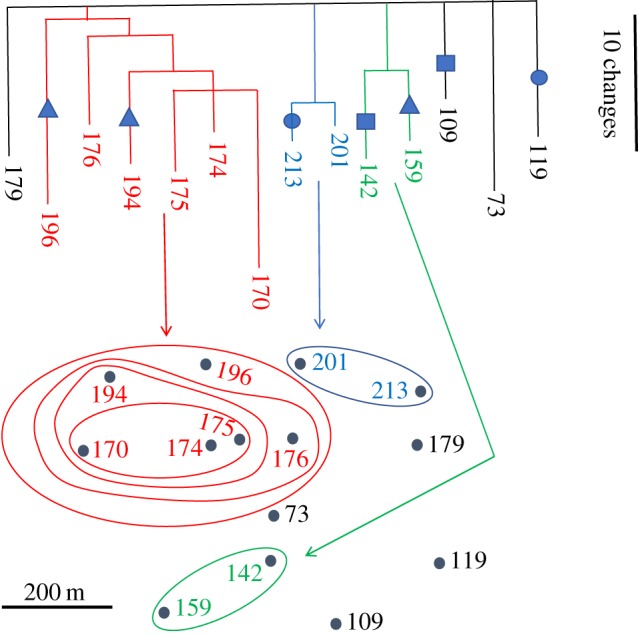
Phylogeny of Illumina-sequenced strains of A. gallica tied to spatial origin. The variants for this geophylogeny are listed in electronic supplementary material, table S3. Symbols represent sites at which changes occur in more than one branch of the tree. Circles, contig 12, position 174 630; squares, contig 61, position 336 513, triangles, contig 33, position 701 686 (electronic supplementary material, table S3).
Figure 3.
Figure 3.
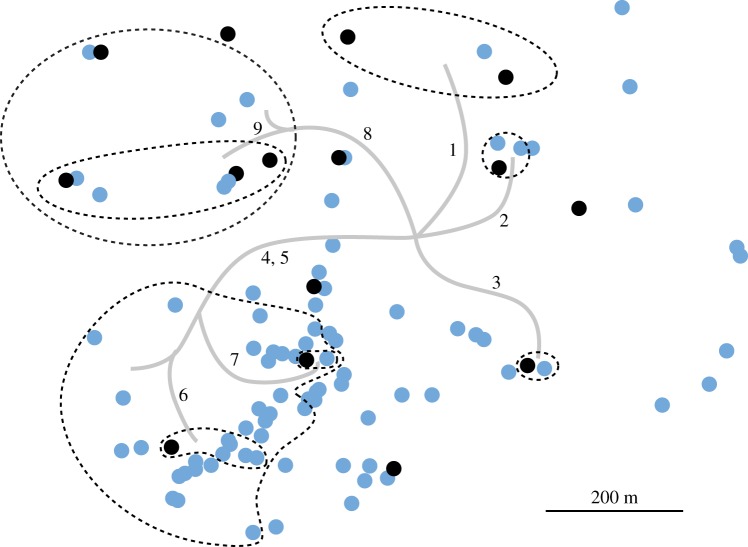
Variation at nine selected genomic sites mapped on all isolates of C1. Black dots represent Illumina-sequenced isolates. The sites listed below were identified from the Illumina-sequenced strains in electronic supplementary material, table S3. The sites were then PCR amplified and Sanger-sequenced in other C1 isolates (electronic supplementary material, table S4). Site variation is mapped to branches in the phylogenetic tree and spatial sectors encompassing derived genotypes are delineated with dashed lines. Site no. 1, scaffold 8, position 1 611 588; site no. 2, sc 24, pos 198 035; site no. 3, sc 85, pos 12 187; site no. 4 sc9, pos 1 017 767, site no. 5, sc 1, pos 1 829 026; site no. 6, sc 41, 509 147; site no. 7, sc 23, pos 681 486; site no. 8, sc 1, pos 1 019 568; site no. 9 sc 2, pos 3 135 125 (electronic supplementary material, table S3). The dots that are not encircled have only reference alleles at the nine sites assayed. Note that not all isolates were Sanger-sequenced over all nine sites. For certain sites, we sequenced enough isolates to encircle the variants by isolates carrying only reference alleles.

References

    1. Smith ML, Bruhn JN, Anderson JB. 1992. The fungus Armillaria bulbosa is among the largest and oldest organisms. Nature 356, 428–431. ( 10.1038/356428a0) - DOI
    1. Negrini S, Gorgoulis VG, Halazonetis TD. 2010. Genomic instability: an evolving hallmark of cancer. Nat. Rev. Mol. Cell Biol. 11, 220–228. ( 10.1038/nrm2858) - DOI - PubMed
    1. Smith ML, Duchesne LC, Bruhn JN, Anderson JB. 1990. Mitochondrial genetics in a natural population of the plant pathogen Armillaria. Genetics 126, 575–582. - PMC - PubMed
    1. Sipos G, Anderson J, Nagy L. 2018. Armillaria. Curr. Biol. 28, R297–R298. ( 10.1016/j.cub.2018.01.026) - DOI - PubMed
    1. Shaw CG, Roth LF. 1976. Persistence and distribution of a clone of Armillaria mellea in a Ponderosa Pine forest. Phytopathology 66, 1210–1213. ( 10.1094/Phyto-66-1210) - DOI